
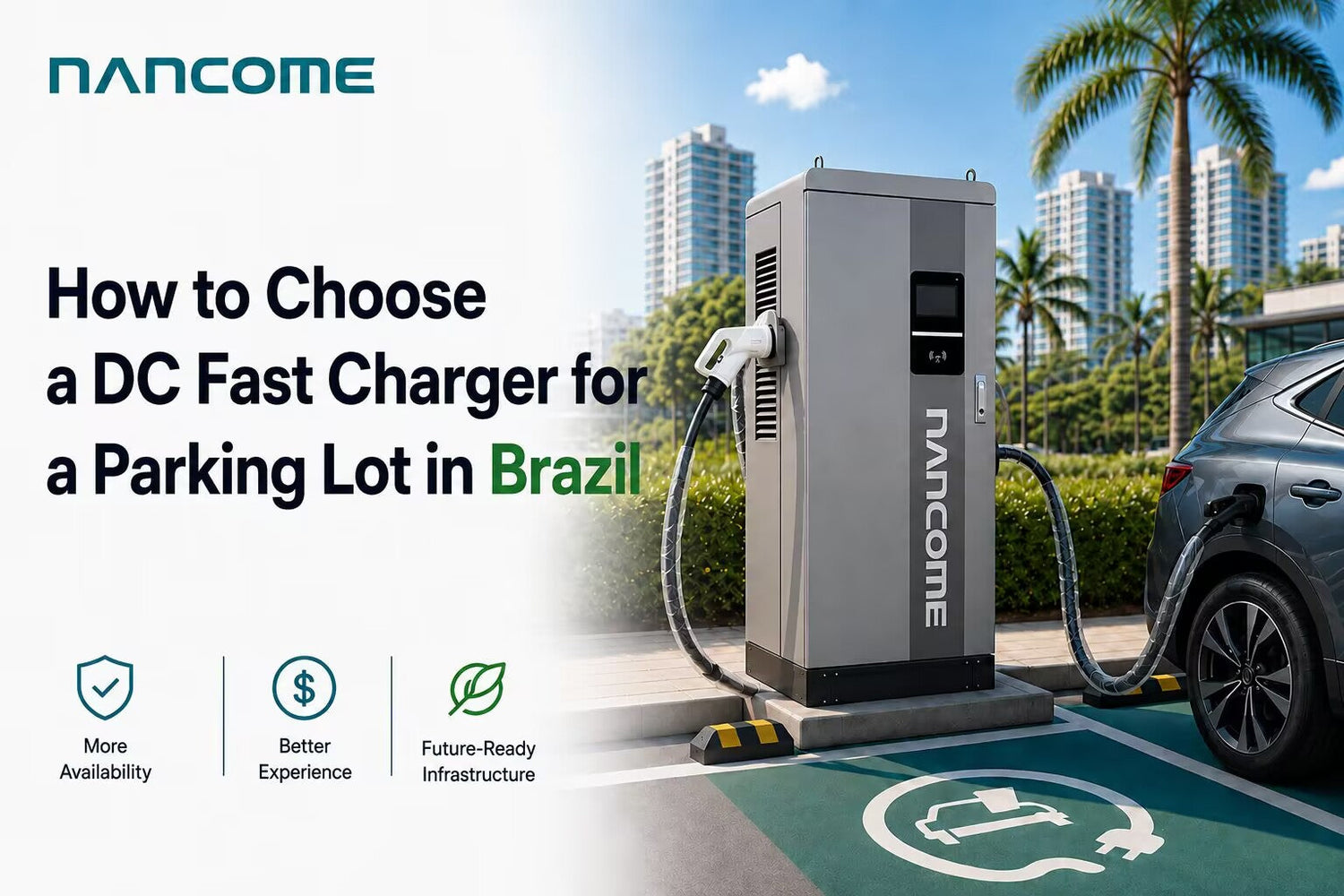
A practical guide for hotels, shopping centers, commercial buildings, and parking operators in a rapidly growing charging market
Current Overview of Parking Facilities and EV Charging in Brazil
• In 2026, the share of electrified light vehicles in the Brazilian market rose to 15.8% in the first half of the year, according to ABVE. The increased availability of models and the growth of plug-in vehicles are leading commercial parking facilities to treat charging as both a service and infrastructure.
• The ABVE/Tupi survey released in June 2026 recorded 25,429 public and semi-public charging points, of which 8,601 were DC fast chargers. DC charging infrastructure expanded by 32.8% in only three months.
• Brazil's electricity mix had an 86.8% renewable share in 2025, according to EPE. This creates a strong foundation for decarbonization, but each parking facility still needs to validate electrical capacity, safety, and its operating model.
1) The parking facility should start with user behavior
• A hotel, a shopping center, an urban parking facility, and a commercial building have different dwell times. Charging power should be sized according to this behavior, not only the number of parking spaces.
• Vehicles that remain for two or three hours allow a different strategy from a short-stay location. The shorter the charging window, the greater the need to assess power, turnover, and parking-space availability.
• Before choosing the equipment, record the average parking time, daily volume of electric vehicles, peak hours, and the objective of the service.
2) 40kW for pilot projects and lower-traffic sites
• A 40kW parking lot charger can support the first phase of hotels, attached workshops, buildings, and parking facilities that are still validating demand.
• The main advantage is enabling DC charging with controlled investment and less pressure on the electrical infrastructure, provided that users remain long enough and the expected queue is limited.
• When the parking facility offers long dwell times, a 40kW DC charger can be combined with commercial AC chargers for different user profiles.
3) 60kW as a balanced commercial solution
• For many medium-sized parking facilities, a 60kW DC charger offers a good balance between charging speed, cost, and electrical feasibility.
• It can serve shopping centers, hotels, paid parking facilities, dealerships, and semi-public sites that want a fast-charging experience without starting with excessive power.
• The configuration may include CCS2, OCPP, 4G/LAN, RFID, and one or two outputs. Each function should be defined according to the operating model.
4) When 80kW should be evaluated
• 80kW is more suitable when there is higher parking-space turnover, recurring charging sessions, and a need to reduce the occupancy time of the charging space.
• Before choosing this power level, confirm whether the target vehicles can use it and whether the transformer and available site demand can support charging without disproportionate expansion.
• A high-turnover parking facility may justify 80kW; a hotel with long dwell times may achieve a better return with a different strategy.
5) One or two outputs and parking-space organization
• Two outputs can increase flexibility, but they require a clear understanding of power distribution. The operator should know what happens when two vehicles charge at the same time.
• The layout should consider vehicle circulation, collision protection, charging-port positions, cable length, signage, lighting, and accessibility.
• A parking space without dwell-time rules may remain blocked after the charging session ends. Parking-space management needs to be part of the operation.
6) OCPP platform, billing, and access
• OCPP connects the charger to the management platform, but it does not define the app, Pix, card payment, or tariff by itself. These features depend on the system selected by the operator.
• If the parking facility already uses a platform, compatibility should be tested before deployment. If it does not, NANCOME can recommend a partner platform with subscription-based functions.
• RFID can be useful for guests, employees, registered customers, and internal fleets. For public operation, the authentication and payment flow should be defined before opening.
7) Electrical infrastructure and site preparation
• The local installer should verify voltage, the three-phase system, transformer, distribution board, protection devices, grounding, cable route, and the building's maximum load.
• For outdoor areas, the base, drainage, canopy when necessary, physical protection, ventilation, and maintenance access should also be planned.
• NANCOME can provide connection requirements and equipment documentation. Local engineering, approval, civil work, and installation remain the responsibility of qualified professionals in Brazil.
8) How NANCOME supports a parking project
• NANCOME manufactures commercial charging equipment and has electrical manufacturing experience dating back to 1992, helping integrate charger analysis with distribution boards, protection, and power distribution.
• The portfolio presented on nancome.com includes wall-mounted and floor-standing DC chargers, energy storage systems, and distribution cabinets. For Brazilian parking facilities, the priority is a 40kW, 60kW, or 80kW CCS2 solution that matches the site.
• Support may include configuration selection, OCPP, documentation, remote diagnostics, software updates, and guidance on spare parts.
9) Parking project checklist
• Average dwell time and expected charging sessions per day.
• Initial number of charging spaces and expansion potential.
• CCS2, one or two outputs, and power-distribution logic.
• Transformer, voltage, available demand, and distance to the distribution board.
• Platform, RFID, billing, occupancy rules, and the local person responsible for operation.
Result:
The best parking lot charger is the one that combines dwell time, turnover, electrical capacity, and management model. 40kW can start the service, 60kW suits many commercial projects, and 80kW should be reserved for sites where higher turnover has been demonstrated.

Deixar comentário
Os comentários precisam ser aprovados antes da publicação.
Este site é protegido por hCaptcha e a Política de privacidade e os Termos de serviço do hCaptcha se aplicam.