
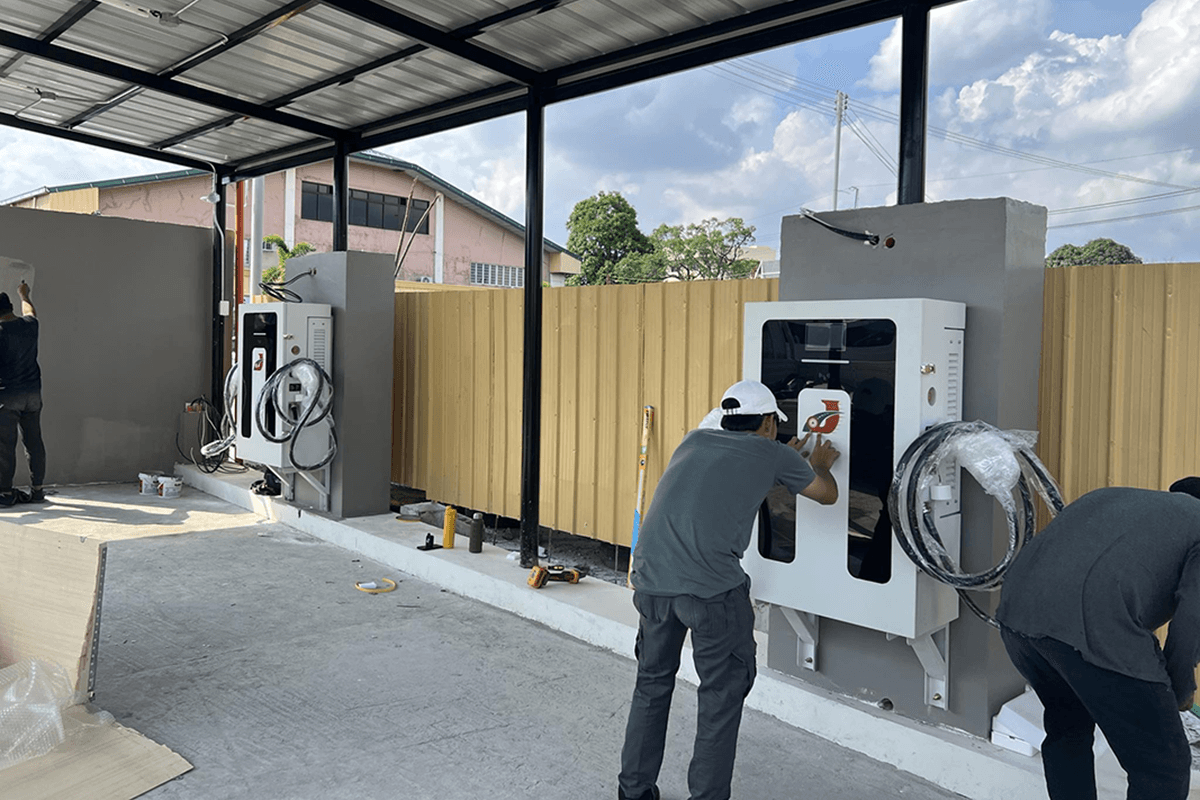
Nancome one‑stop delivery for reliable, compact fleet charging
National EV Landscape Snapshot – Philippines
·Momentum: Corporate and municipal fleets are piloting EVs for lower fuel and maintenance costs, with depot charging as the primary strategy.
·Infrastructure: Public DC coverage is growing in Metro Manila and intercity corridors; depot‑first rollouts remain the most predictable for fleets.
·Requirements: Tropical climate resilience, compact footprints, and software‑based access control (driver IDs, role‑based tariffs) are top priorities.
1) Project Overview
·Customer: A Philippines‑based company operating a private fleet for logistics and service calls.
·Objective: Install compact fast charging to turn vehicles around during shift overlaps without expanding the depot footprint.
·Configuration: Nancome 40 kW ev charger wall‑mounted units, each with dual DC guns (dynamic sharing per vehicle BMS); dedicated breakers and labeled cable runs for safety and speed.
·Delivery scope: One‑stop execution covering site survey, SLD/load study, civil works, electrical, commissioning, O&M training, and backend onboarding.
2) Site Context & Challenges
·Tight wall space and limited aisle width required a wall form factor with guided cable reach and bollard protection.
·Peak demand during shift changes; the goal was 20–45 minute top‑ups rather than full 0–100% charges.
·High ambient heat and monsoon rain demanded IP‑rated enclosures, conformal‑coated PCBs, and protected cable glands.
3) Solution Design
Power & Layout
·Two rows of dc wallbox units at 40 kW each; dual‑gun outputs allow charging two vehicles at balanced current or one vehicle at higher current depending on BMS requests.
·Load management caps aggregate site kW and staggers starts during demand peaks to protect the service entrance.
·Clear lane markings and wall‑mount brackets maintain aisle clearance for forklifts and vans.
System & Software
·Nancome OCPP EV charger backend integrates driver RFID, QR, and optional Plug‑and‑Charge where supported.
·The commercial ev charger with app lets dispatch assign vehicles to bays, view SOC/ETA, push price updates, and export shift reports.
· Remote diagnostics, alarms, and OTA firmware shorten MTTR and keep uptime above 99% in steady operations.
4) Implementation Highlights
·Wall‑mounted dual‑gun design maximizes stalls per meter of wall and avoids pedestal foundations.
·20–45 minute charger ev dc fast top‑ups cover typical daily routes; overnight AC remains optional for full charges.
·Color‑coded guns and cable holsters reduce mis‑plugs and speed driver hand‑offs.
5) Outcomes & ROI Snapshot*
*Indicative ranges from comparable Nancome fleet depots; actuals depend on tariff and duty cycle.
·Throughput: +25–38% more vehicles energized per shift after dual‑gun rollout.
·Energy cost: Time‑of‑use scheduling trimmed effective kWh costs by ~10–15%.
·Uptime: >99% with proactive alerts and hot‑swap power modules.
·Driver experience: App‑based self‑service reduced queue disputes and improved punctual departures.
6) Build & Compliance
·Wall anchors rated for seismic and typhoon loads; stainless fixings and sealed glands for monsoon exposure.
·Grounding, surge protection, and isolation monitoring aligned with relevant IEC standards and local utility interconnect rules.
7) Why Nancome
·Solution‑first: We deliver a complete depot charging operation—not just hardware.
·One‑stop delivery: Survey, build, software, and training under one accountable partner.
·Scalable: Add more dc wallbox units along the wall; reuse cabling trays and backend accounts as the fleet grows.
Result: With compact ev charger wall‑mounted units at 40 kW and an OCPP‑ready backend, the Philippines depot achieved predictable, fast turnarounds without expanding its footprint—demonstrating how Nancome converts tight walls into dependable fleet charging capacity.

Deixar comentário
Os comentários precisam ser aprovados antes da publicação.
Este site é protegido por hCaptcha e a Política de privacidade e os Termos de serviço do hCaptcha se aplicam.