
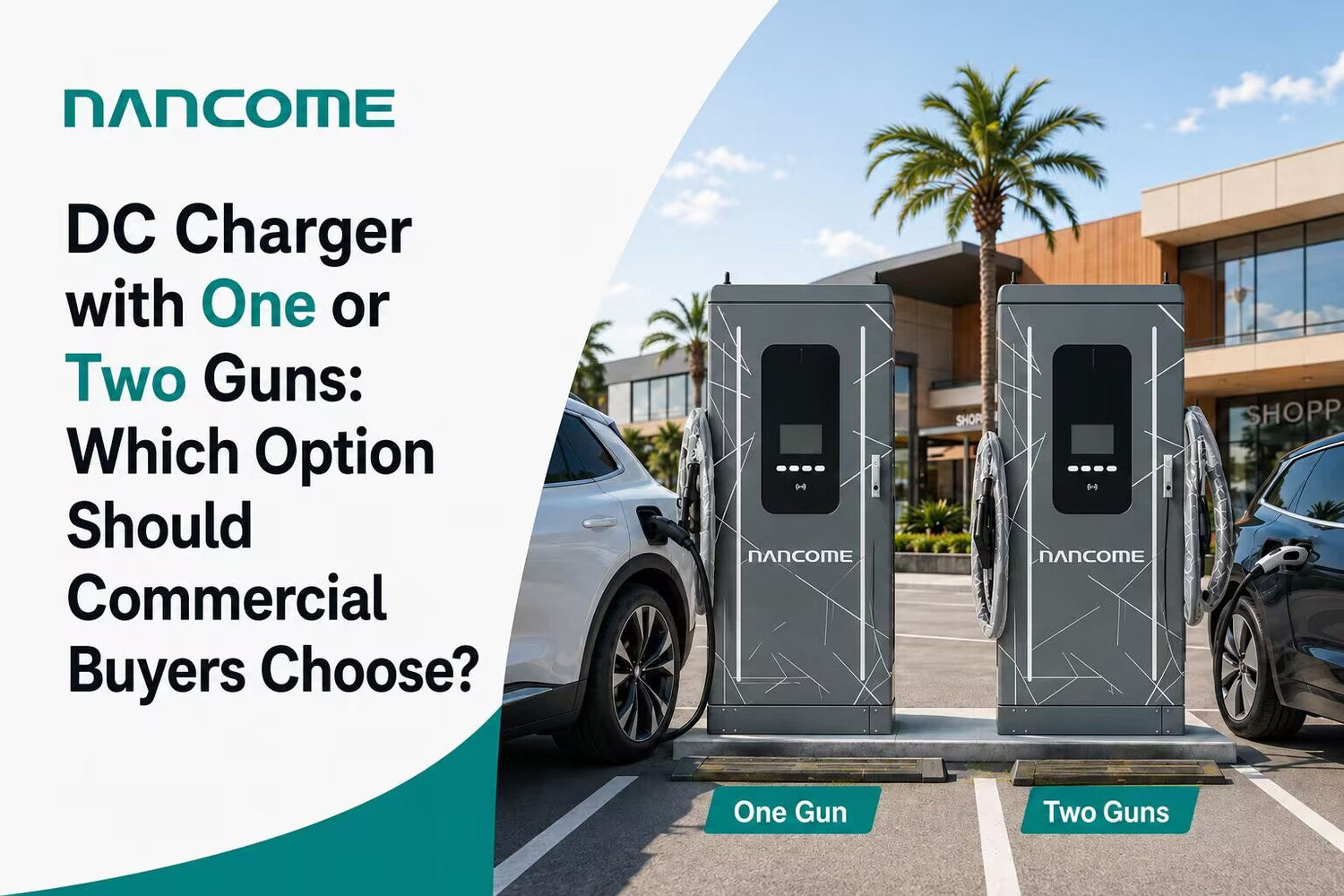
A practical guide for Brazilian dealerships, parking facilities, fleets, and small operators to compare flexibility, shared power, and site layout
Commercial Charging Overview in Brazil - More DC Charging Points Require Better Planning
• Brazil reached 25,429 public and semi-public charging points in May 2026; 8,601 were DC fast-charging points, representing growth of 32.8% in only three months, according to ABVE.
• With 215,023 electrified light vehicles sold in the first half of 2026 and a 15.8% market share, parking facilities, dealerships, and fleets are beginning to serve more users with different needs.
• At this stage, choosing between a single-output DC charger and a dual-output DC charger affects not only the equipment, but also parking spaces, circulation, available power, platform requirements, and service.
1) Short answer: two outputs are not automatically better
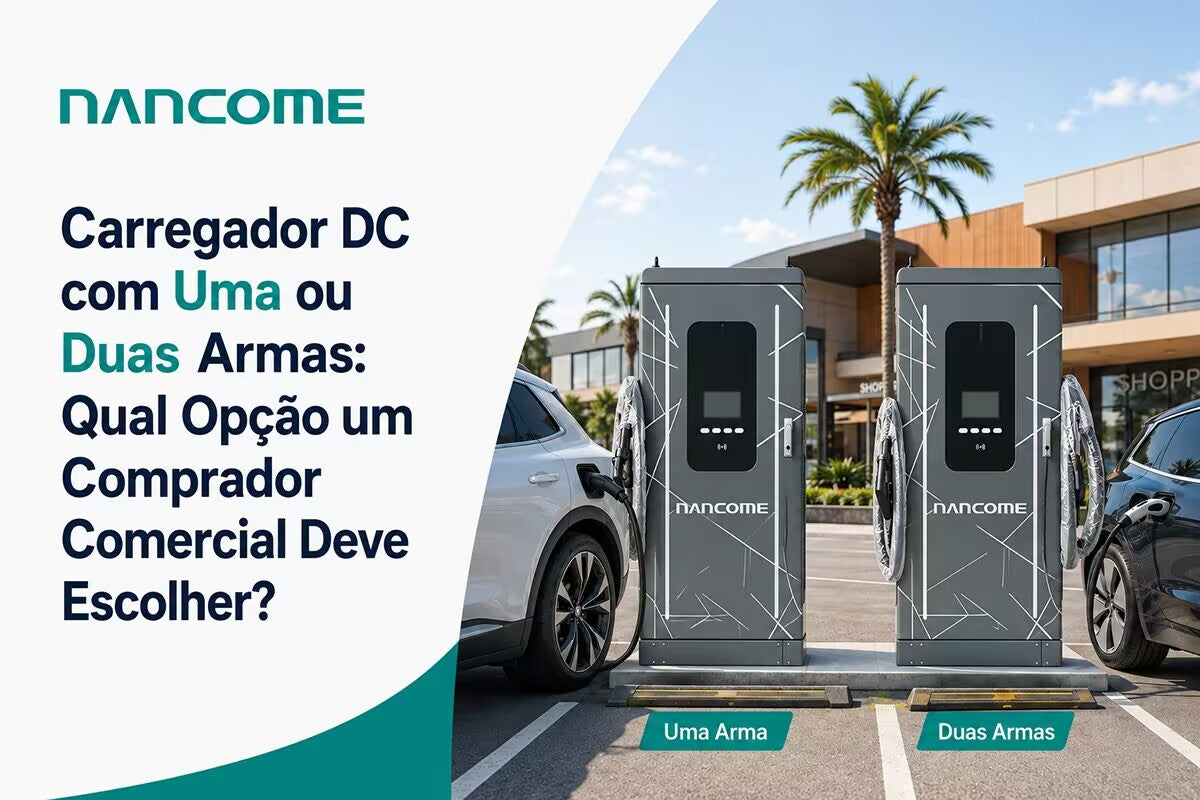
• Two outputs provide greater flexibility when two vehicles may need charging during the same period, but the benefit depends on actual usage frequency and how power is distributed.
• A single output may be more suitable for workshops, early-stage dealerships, lower-traffic parking facilities, and sites with only one operational charging space.
• The correct choice begins with daily sessions, peak hours, dwell time, number of parking spaces, and electrical capacity - not with the equipment that appears to have more features.
2) When a single-output DC charger makes sense
• A single-output DC charger simplifies the layout, reduces the possibility of crossed cables, and makes control easier when only one vehicle is served at a time.
• It is a practical option for charging test, delivery, and after-sales vehicles at dealerships, as well as for workshops and small fleets with organized schedules.
• For entry-level projects, 40kW or 60kW with one output can provide commercial CCS2 charging without requiring a more complex operation than the site actually needs.
3) When two outputs add operational value
• A dual-output DC charger is more useful when there is a real probability that two vehicles will arrive together or when the operator wants to keep two spaces available for different user profiles.
• Commercial parking facilities, rental companies, fleets, and small public charging sites can gain flexibility, especially when vehicle dwell times are not fully predictable.
• The benefit comes from availability and queue organization, not from assuming that each vehicle will receive the full rated power at the same time.
4) Understand power sharing before purchase
• In many dual-output chargers, the total power is shared. A 60kW unit may distribute its capacity between two charging sessions according to the architecture and configuration.
• The buyer should ask how much power each vehicle receives with one active session, with two active sessions, and as the batteries' states of charge change.
• The answer must be documented in the technical proposal; generic expressions such as "dual gun" do not explain the operating logic.
5) Compare vehicle flow, dwell time, and parking-space turnover
• When vehicles remain for several hours, two outputs with shared power can serve two spaces effectively without requiring high power.
• When the objective is to release a charging space quickly at a higher-turnover site, it may be preferable to concentrate power on one session or evaluate 80kW with clearly defined operating logic.
• The number of connectors should match the service model: internal use, complimentary customer charging, paid public charging, or fleet operation.
6) Layout, cables, and physical protection also influence the decision
• Two outputs require positioning that allows the cables to reach the charging ports without blocking circulation, crossing cables, or creating a collision risk.
• The project should confirm charger position, parking-space orientation, cable length, protective barriers, base, drainage, lighting, and maintenance access.
• Outdoor installation should use a configuration appropriate for the environment. NANCOME's floor-standing charger line includes IP54, remote operation, and customizable design options depending on the configuration.
7) Platform, RFID, and usage rules
• With two outputs, the platform must correctly identify each connector, charging session, user, and energy measurement.
• OCPP allows the charger to integrate with a compatible backend, but billing, an app, Pix, card payment, and reports depend on the contracted platform.
• For internal use, RFID or local authorization may be sufficient. For public operation, queue rules, tariffs, and user support must be defined before opening.
8) How to apply the logic to 40kW, 60kW, and 80kW
• 40kW with one output is a practical foundation for dealerships, workshops, and lower-traffic sites; two outputs should be selected only when simultaneous use is a real requirement.
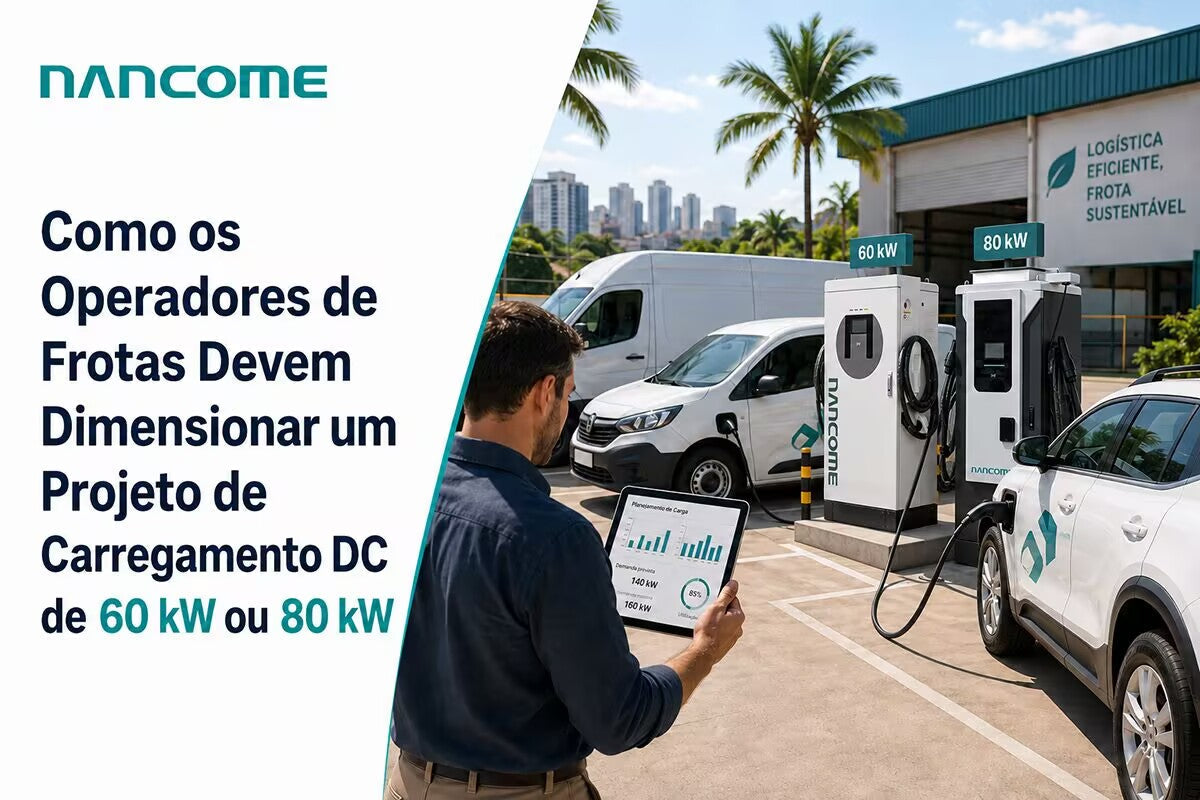
• 60kW can serve as a balanced option for commercial sites, with one or two outputs according to traffic and power-distribution logic.
• 80kW can improve turnover for fleets and busier parking facilities, provided that transformer capacity, maximum load, and charging-session frequency justify the power.
9) How NANCOME supports configuration selection
• NANCOME manufactures DC chargers, energy storage systems, and electrical distribution equipment, combining hardware knowledge with an understanding of power infrastructure.
• For Brazilian projects, the configuration should prioritize CCS2, OCPP, 4G/LAN, and RFID according to the application, without adding interfaces or functions for which demand has not been confirmed.
• Support may include configuration selection, connection requirements, documentation, remote diagnostics, software updates, and recommendations for common spare parts; installation and compliance remain the responsibility of qualified local teams.
10) Purchase decision checklist
• How many vehicles arrive each day, and how many may arrive at the same time?
• Will the power be dedicated to one vehicle or shared between two outputs?
• Does the site have one or two suitable charging spaces, an OCPP platform, three-phase power, and confirmed transformer capacity?
11) Next step
• Send the parking-space layout, estimated traffic, charging window, and electrical information to receive a recommendation for one or two outputs.
• Request the power-distribution curve and confirm the behavior with two active sessions before finalizing the configuration.
• Define in writing the responsibilities of the manufacturer, platform provider, installer, and local operator.
Result:
A dual-output charger is advantageous when the site genuinely needs to serve two vehicles and understands how power will be shared. For simpler projects, one output can reduce complexity and maintain better use of the available power. The decision should combine traffic, layout, electrical infrastructure, and operating model.
Market sources: ABVE Data (vehicle sales and charging infrastructure, 2026) and EPE/BEN 2026 (electricity mix, base year 2025).

Deixar comentário
Os comentários precisam ser aprovados antes da publicação.
Este site é protegido por hCaptcha e a Política de privacidade e os Termos de serviço do hCaptcha se aplicam.