
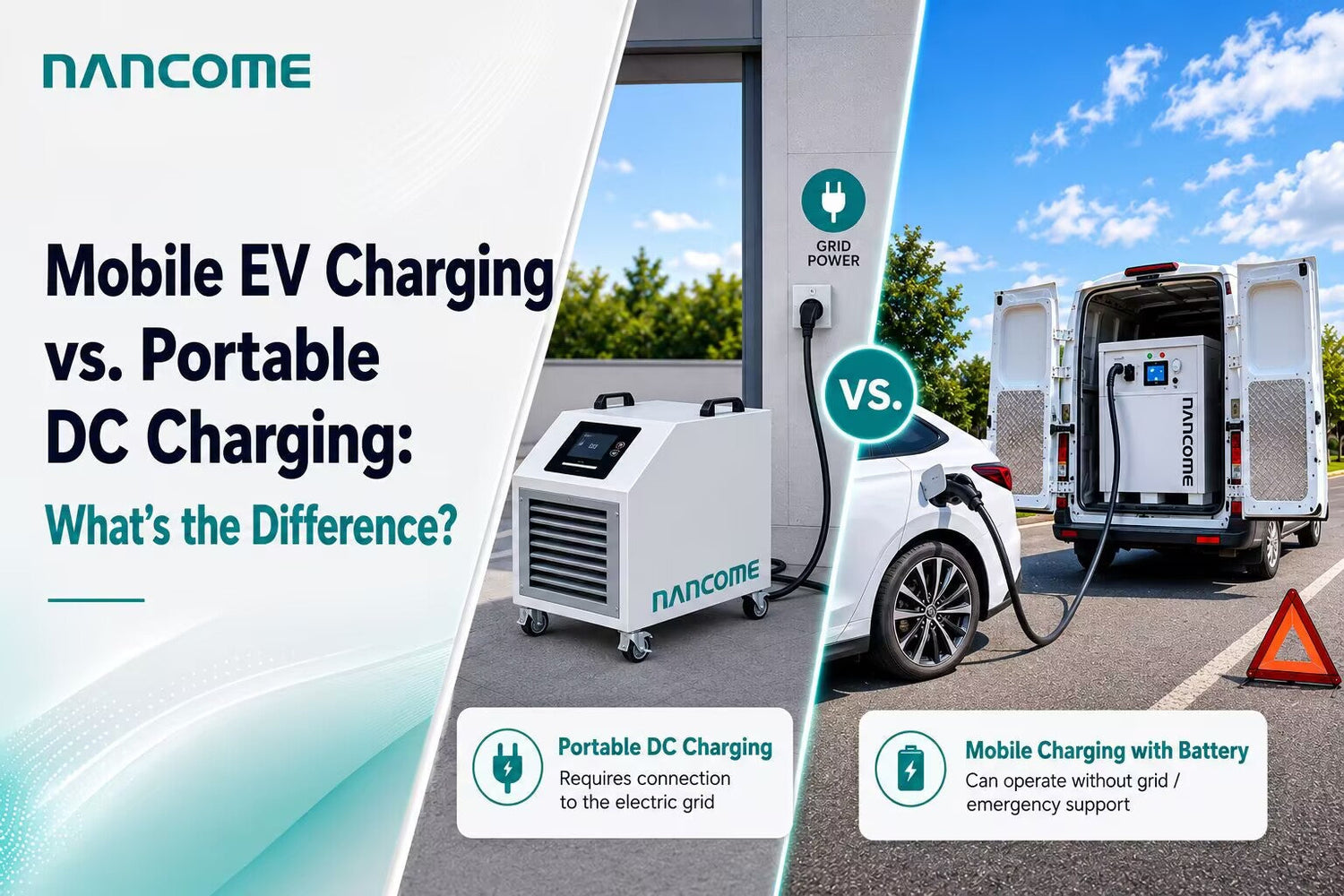
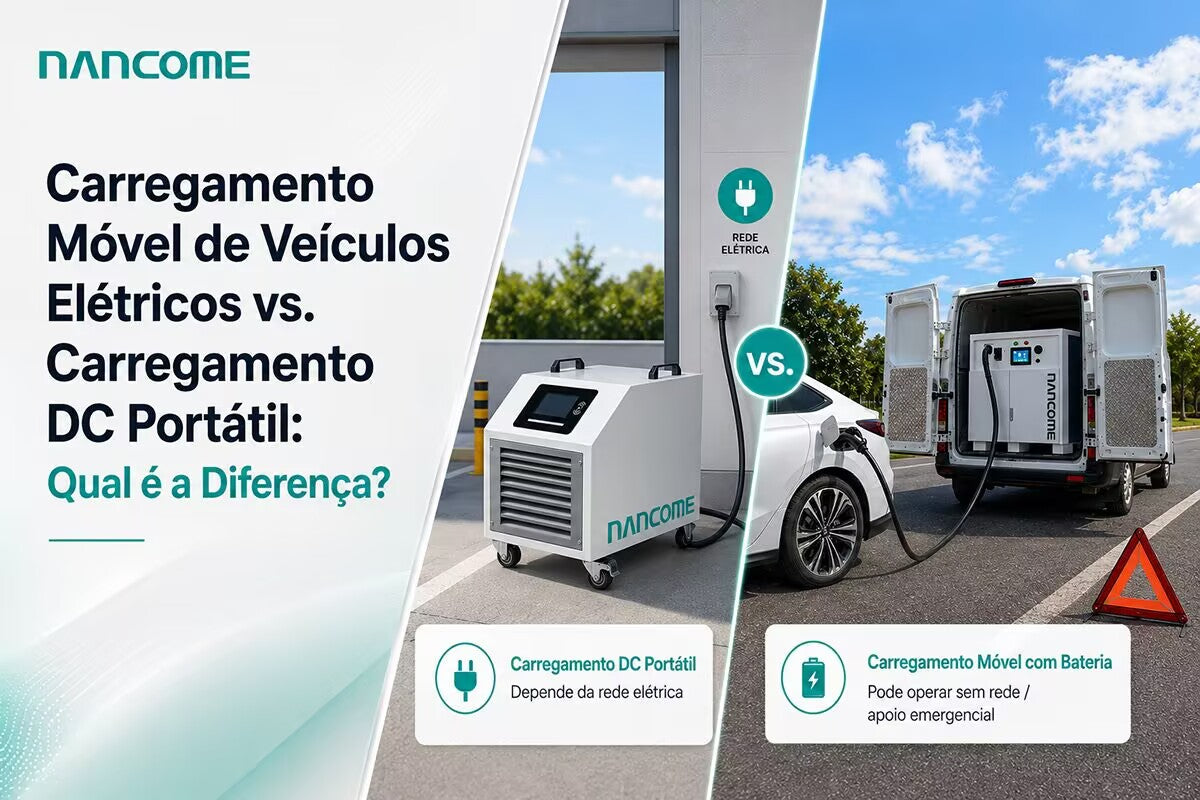
How roadside assistance companies, events, and temporary projects can distinguish a battery-free portable DC charger from a mobile charging system with energy storage
A Larger Market Also Creates Needs Beyond the Fixed Charging Network
• Brazil sold 215,023 electrified light vehicles in the first half of 2026 and already has more than 25,000 charging points in the public and semi-public network.
• The expansion of the fixed charging network reduces barriers, but it does not eliminate temporary needs, events, rescue operations, testing, construction sites, and locations where a charging point is not yet available.
• In these projects, "portable" and "mobile" are often used as though they mean the same thing, although they may represent equipment with completely different energy sources and operating models.
1) Short answer: the main difference is the source of energy
• A battery-free portable DC charger converts energy from the electrical grid or an external generator to charge the vehicle.
• A mobile battery charging system transports stored energy and can serve the vehicle without an immediate grid connection during the charging session.
• The choice depends on where the energy will come from, how long the equipment will operate, and how it will be recharged between service calls.
2) What is a battery-free portable DC charger?
• It is compact DC conversion equipment that must be connected to a compatible external source, such as a three-phase power supply or a properly sized generator.
• It can be used in workshops, events, tests, yards, trade fairs, and temporary operations where an energy source is available.
• Its advantage is avoiding the cost and weight of a battery bank; its limitation is that it cannot operate independently of the external power source.
3) What is a mobile charging system with energy storage?
• The system integrates a battery, BMS, power conversion, control, protection, and a DC output to deliver stored energy to the vehicle.
• It can be mounted on wheels, a platform, a trailer, or a service vehicle according to capacity, weight, and the operating model.
• NANCOME offers systems with an integrated battery, a wide voltage range, monitoring, and different capacities; for Brazil, the application should be treated as a special project.
4) Which solution is better for events and temporary operations?
• When the site has a three-phase grid connection or generator and the equipment needs to operate for many hours, a battery-free portable DC charger may be simpler.
• When the grid is unavailable, generator noise is unsuitable, or the operation needs to move between locations, a mobile battery system can be evaluated.
• The project should confirm the number of vehicles, energy per session, power, event duration, and the time available to recharge the system.
5) Which solution is better for roadside assistance?
• In roadside assistance, the objective is not to fully charge the vehicle, but to provide enough energy to reach a safe location or the nearest charging station.
• Equipment without a battery works only when the service vehicle carries a generator or can access a suitable electrical source at the location.
• For genuinely independent operation, roadside assistance charging normally requires energy storage, but capacity, weight, and daily service frequency need to be calculated.
6) Do not confuse output power with available energy
• kW indicates the rate at which power is delivered; kWh indicates the amount of stored energy.
• A 60kW system cannot maintain that output indefinitely: operating duration depends on usable battery capacity, losses, and the discharge limit.
• For each service call, calculate the energy required by the vehicle, efficiency, operating reserve, and the energy needed to return to the base.
7) Rescue capacity: 75kWh, 100kWh, 141kWh, or more
• 75kWh can support a pilot project with a limited number of service calls and controlled energy delivery per session.
• 100kWh or 141kWh increases operating range, but also increases weight, cost, space requirements, and the recharge time of the equipment itself.
• Higher capacities should be considered only when the service has demonstrated compatible demand, logistics, and a suitable recharging method.
8) Transport, safety, and recharging the system itself
• Confirm total weight, dimensions, fixing points, vehicle load limit, ventilation, impact protection, and the loading and unloading method.
• Define where the system will be recharged, what input power will be available, and how much time exists between service calls.
• BMS, thermal protection, emergency stop, training, and local procedures should be part of the pilot project.
9) CCS2, voltage, and vehicles served
• For Brazil, CCS2 should be the starting point, but the actual list of vehicles must be confirmed.
• The equipment voltage range should support the intended vehicles, including higher-voltage platforms where applicable.
• Additional interfaces should not be included only for marketing purposes; each one increases cable, inventory, and training complexity.
10) How NANCOME approaches mobile projects
• NANCOME combines charger, energy storage, and electrical distribution manufacturing, allowing the energy source, output power, and protection to be evaluated as one system.
• Support may include capacity selection, connection requirements, CCS2 configuration, documentation, remote diagnostics, and maintenance recommendations.
• The project should not be presented as a universal solution for Brazil. Application, frequency, logistics, recharging, and return must be confirmed before a proposal is prepared.
11) Inquiry checklist
• Is the application an event, workshop, test, emergency, or roadside assistance operation?
• Is an external power source available at the site, or does the operation need to be independent?
• How many kWh will be delivered per session, how many service calls will occur per day, and how will the equipment be recharged?
12) Next step
• First distinguish the requirement between a portable DC charger and a mobile energy storage system.
• Provide the vehicles, interface, voltage, energy per service call, frequency, route, transport method, and recharging source.
• Begin with a measurable pilot project before expanding the capacity or equipment fleet.
Result:
A battery-free portable DC charger is suitable when an external power source is available. A mobile battery system is suitable when energy needs to be transported to the vehicle. To avoid an incorrect investment, the buyer should calculate kWh per service call, daily frequency, logistics, and recharging of the equipment itself.
Market sources: ABVE Data (vehicle sales and charging infrastructure, 2026) and EPE/BEN 2026 (electricity mix, base year 2025).

Deixar comentário
Os comentários precisam ser aprovados antes da publicação.
Este site é protegido por hCaptcha e a Política de privacidade e os Termos de serviço do hCaptcha se aplicam.