
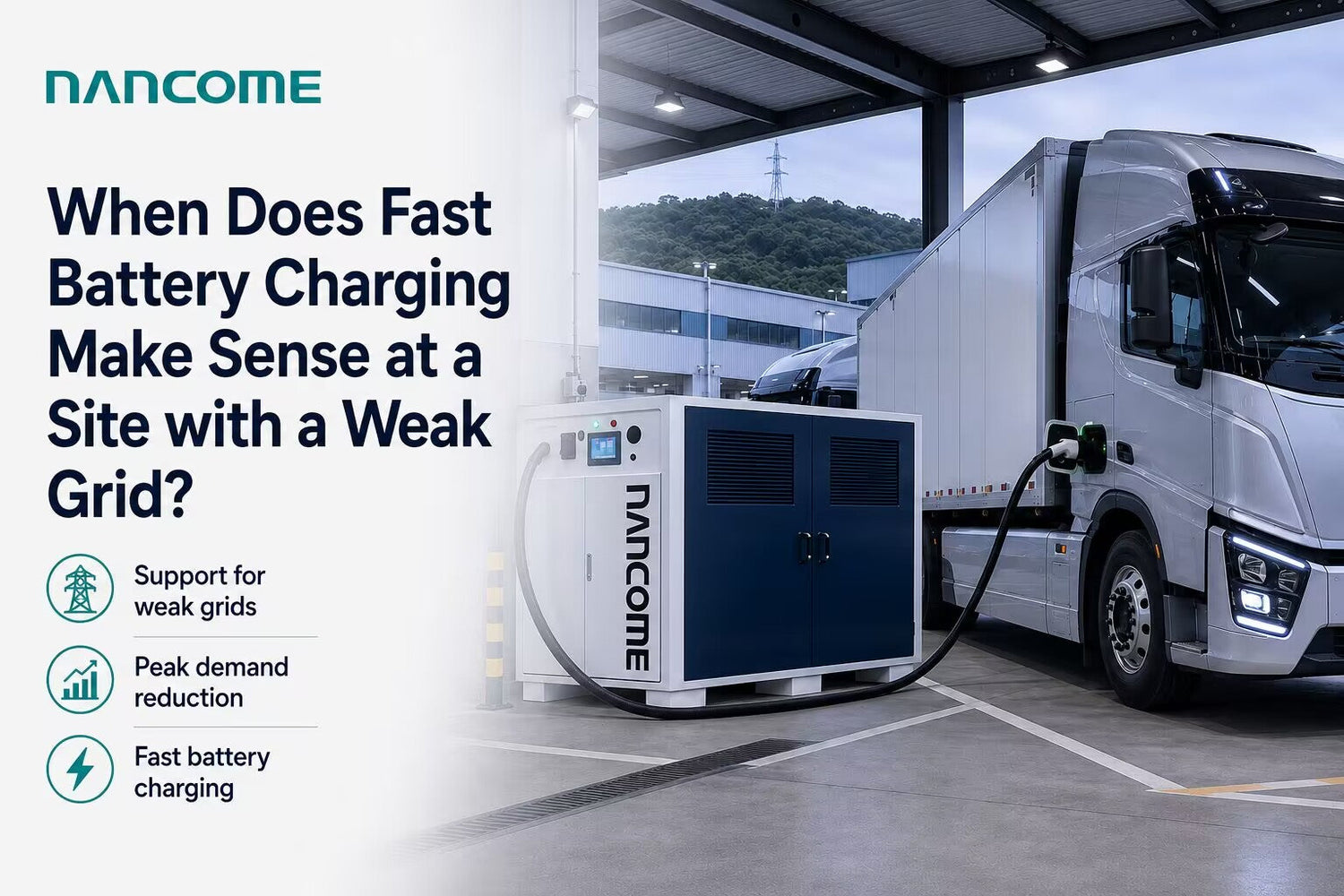
A method for Brazilian EPCs, operators, and site owners to compare electrical expansion, a fixed DC charger, a portable solution, and energy storage before investing
Clean Energy at National Scale, Electrical Limitations at Local Scale
• Brazil's electricity mix had an 86.8% renewable share in 2025; wind and solar accounted for 26.4% of generation, according to EPE's BEN 2026.
• At the same time, the expansion to 25,429 charging points in 2026 is increasing demand for new commercial sites and charging corridors.
• A renewable national electricity mix does not mean that every location has a transformer, feeder, or available demand for a fast charger; the limitation must be verified at the site.
1) Short answer: a limited grid does not automatically mean energy storage
• A battery-backed fast charging solution can reduce input peaks, support temporary power, or avoid immediate electrical expansion, but it adds a battery, conversion, control, maintenance, and losses.
• Before selecting energy storage, compare the cost of electrical expansion, expected utilization, and the possibility of operating with fixed 40kW, 60kW, or 80kW chargers.
• If the charger will be used only a few times per day, a simpler solution may deliver a better return on investment.
2) Confirm whether the grid limitation is real
• Request the voltage, transformer capacity, contracted demand, maximum load, consumption curves, and utility conditions.
• Check whether the limitation occurs throughout the day or only during peak periods; a nighttime window may allow operation without a battery.
• Evaluate power reduction, load management, or a change in operating hours before adding an energy storage system.
3) Calculate the actual charging frequency
• How many sessions will occur per day, at what times, and with how many kWh per vehicle?
• A low-utilization system can remain expensive and underused even when it technically solves the power peak.
• A battery is more justifiable when there is recurring, predictable demand capable of generating measurable savings or revenue.
4) Understand the difference between output power and input power
• The charger can deliver more power than the input during a charging session by using energy stored earlier.
• The system must then replenish that energy. If input power is very low and sessions are frequent, the battery level may not recover in time.
• Sizing must balance input power, DC power, capacity in kWh, losses, reserve, and recharge time.
5) Compare four options before deciding
• Lower-power fixed DC charger: the simplest option when the available dwell time allows it.
• Transformer and service-entrance expansion: a larger initial investment, but it may support long-term growth.
• Portable DC charger connected to the grid or a generator: useful for temporary operation, but it does not necessarily replace a permanent charging station.
6) When energy storage may be technically appropriate
• The cost or lead time for electrical expansion is high, and there is clear commercial demand before the work is completed.
• The site has energy available during low-load periods to recharge the battery and uses the charger during peak periods.
• The operation requires mobility, contingency support, a temporary event, or service in a remote area with defined logistics.
7) When energy storage is probably not the first option
• The site does not yet know the number of sessions, vehicles, energy per service, or expected revenue.
• The electrical limitation has not been measured and exists only as a customer assumption.
• The equipment would be used only occasionally, without a clear plan to recharge, transport, and maintain the battery.
8) How to evaluate 75kWh, 100kWh, 141kWh, and higher capacities
• Capacity should be calculated from usable daily energy and the longest sequence of charging sessions before the system can be recharged.
• 75kWh can support controlled pilot projects; 100kWh and 141kWh increase availability, but also increase cost, weight, and recharge time.
• Higher capacities should be justified by utilization data, not by a generic safety margin.
9) Tariffs, demand, and project return
• Compare the energy tariff, demand charges, penalties, expansion cost, maintenance, battery life, and revenue per session.
• Include conversion losses and energy reserved for battery protection, avoiding project calculations based on the full nominal capacity.
• The return on investment should be analyzed under low-, medium-, and high-utilization scenarios.
10) Engineering, safety, and local responsibility
• The system requires coordination of the battery, BMS, converters, AC/DC protection, ventilation, fire protection, grounding, and emergency stop.
• Electrical design, installation, approval, fire protection, and compliance should be handled by local professionals and authorities in Brazil.
• An energy storage solution does not eliminate the need to study grid connection and safe site operation.
11) How NANCOME can support the analysis
• NANCOME combines DC chargers, energy storage systems, and electrical distribution equipment in its portfolio, enabling an integrated view of the system.
• It can support preliminary power and capacity selection, CCS2 configuration, electrical requirements, documentation, remote diagnostics, and software.
• The recommendation should preserve the Brazilian strategy: energy storage is a project-specific product, not an automatic alternative for every customer with a limited grid.
12) Information required for an initial proposal
• Site load profile, transformer, available demand, voltage, peak periods, and the cost of electrical expansion.
• Number of vehicles, energy per session, daily frequency, simultaneous charging requirements, and desired power.
• System recharge method and window, fixed or mobile installation, available space, environment, and project timeline.
Result:
Battery-backed fast charging makes sense when there is a verified electrical limitation, recurring utilization, a window to replenish energy, and an economic advantage over grid expansion or a lower-power fixed charger. Without this information, energy storage can increase cost and complexity without improving the project.
Market sources: ABVE Data (vehicle sales and charging infrastructure, 2026) and EPE/BEN 2026 (electricity mix, base year 2025).

Deixar comentário
Os comentários precisam ser aprovados antes da publicação.
Este site é protegido por hCaptcha e a Política de privacidade e os Termos de serviço do hCaptcha se aplicam.