
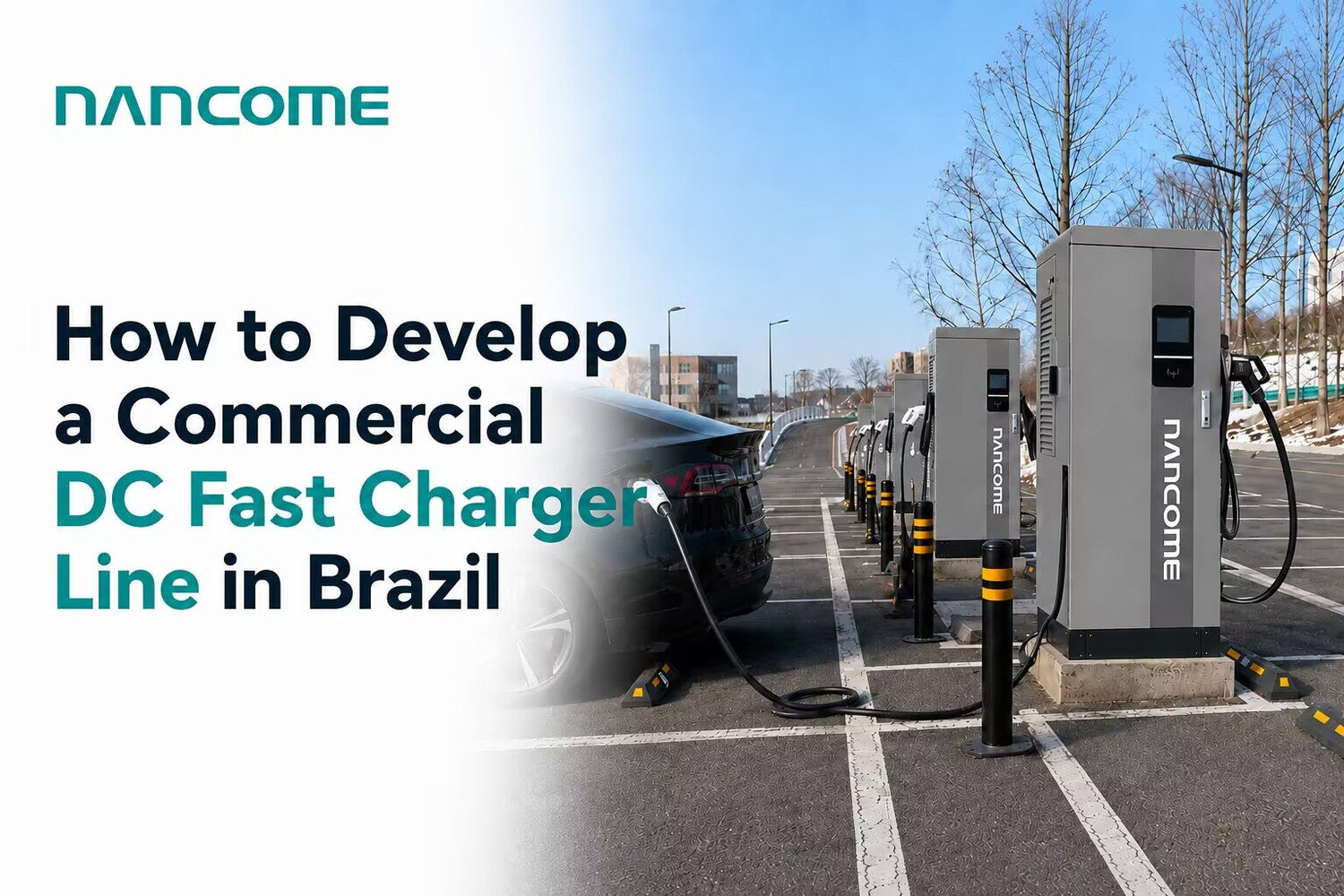
A portfolio strategy for distributors, integrators, and installation companies to start with 40kW, 60kW, and 80kW, CCS2, and clearly defined technical support
Channel Opportunity - DC Charging Infrastructure Is Growing Faster
• Brazil's public and semi-public charging network reached 25,429 points in May 2026, including 8,601 DC fast-charging points, according to ABVE.
• DC charging grew by 32.8% between February and May 2026, showing demand for companies capable of selecting, installing, integrating, and supporting the equipment.
• For new channel partners, the opportunity is not to offer every power level, but to build a clear commercial DC charger product line that applies to real projects.
1) Start with the mid-range market, not ultra-high performance
• Most initial opportunities for installers involve dealerships, parking facilities, hotels, workshops, small operators, rental companies, and fleets.
• In these environments, 40kW, 60kW, and 80kW are generally easier to match with budgets, transformer capacity, civil work, and the deployment stage.
• Higher power levels should be treated as special projects after traffic, utilization, electrical capacity, and return have been confirmed.
2) Structure a three-level portfolio
• 40kW DC charger: an entry-level model for workshops, dealerships, small parking facilities, and projects with limited space or power supply.
• 60kW DC charger: the core product for demonstrations, technical stock, or a first deployment at commercial sites.
• 80kW DC charger: an upgrade option for fleets, rental companies, adjacent fuel-station sites, and locations with proven higher turnover.
3) Why 60kW works as the main demonstration model
• 60kW clearly represents commercial fast charging while remaining applicable to medium-sized projects without assuming the infrastructure of an ultra-fast charging station.
• The model can demonstrate CCS2, one or two outputs, OCPP, 4G/LAN, RFID, monitoring, and customization.
• For the installer, it is a suitable platform for staff training, backend integration, and presentations to different customers.
4) Add a compact solution for sites with limited space
• A wall-mounted product line from 20kW to 40kW expands the portfolio for underground parking facilities, commercial buildings, workshops, and sites that do not want a floor-standing cabinet.
• NANCOME offers a wall-mounted DC solution with OCPP, three-phase input, a modular design, and optional IP54/IP65 protection depending on the configuration.
• The installer should avoid selling the compact solution without confirming ventilation, maintenance access, and the cable route.
5) Standardize CCS2 for the Brazilian market
• CCS2 should be the reference configuration for a commercial product line intended for Brazil.
• GB/T or other standards should be added only when the customer confirms a specific fleet that genuinely requires them.
• Standardization reduces spare-parts inventory, training complexity, proposal errors, and compatibility questions.
6) Define OCPP and the platform without promising a free system
• Customers with an existing platform need to provide the OCPP version, profiles, connectivity requirements, and testing process before ordering.
• Customers without a platform can evaluate a subscription-based partner solution and select the required user, billing, reporting, and multi-site functions.
• The installer should not present an app, Pix, card payment, or a backend as an automatic charger function.
7) Create a mandatory electrical checklist before quotation
• Request the input voltage, three-phase power supply, transformer capacity, current maximum load, distribution board, protection, grounding, and cable distance.
• Confirm the number of chargers, simultaneous power, operating hours, and expansion potential.
• Without this information, the proposal should be preliminary and subject to validation by the local engineer.
8) Materials and support a good supplier should provide
• Datasheet, connection diagram, installation requirements, inspection checklist, operating manual, and commissioning guidance.
• Remote diagnostic process, software updates, fault records, and recommendations for common spare parts.
• Clear definition of the responsibilities of the manufacturer, platform provider, installer, and operator.
9) How to evaluate a DC charger supplier
• Evaluate electrical experience, manufacturing control, documentation, customization capability, and project history, not only the unit price.
• Confirm that the supplier understands the charger, power distribution, and OCPP integration as related parts of the project.
• Avoid suppliers that promise local installation, a free platform, or universal compatibility without documentation and testing.
10) NANCOME's role in channel development
• NANCOME has an electrical manufacturing foundation dating back to 1992 and works with DC chargers, energy storage systems, and power distribution equipment.
• It can support the selection of 40kW, 60kW, and 80kW, CCS2 configuration, customized branding and appearance, OCPP integration, and technical documentation.
• Installation, approval, electrical design, local inventory, and on-site service should be organized by the Brazilian partner according to the commercial agreement.
11) Entry model for the installer
• Choose a 60kW CCS2 unit as demonstration equipment and keep documentation ready for 40kW and 80kW.
• Train the team in electrical site assessment, layout, OCPP, power distribution, commissioning, and first-level support.
• Focus prospecting on two or three local segments where the company already has relationships and service capabilities.
12) Information required to start a partnership
• Service region, customer profile, electrical team, and installation and maintenance capabilities.
• OCPP platforms already in use, spare-parts inventory, languages, and support structure.
• Demonstration target, ongoing projects, and the product configuration the channel intends to prioritize.
Result:
An effective commercial product line for Brazilian installers can begin with 40kW, 60kW, and 80kW, CCS2, OCPP, and clearly divided support responsibilities. The channel gains greater credibility when it sells a solution that fits the site rather than only a catalog of power ratings.
Market sources: ABVE Data (vehicle sales and charging infrastructure, 2026) and EPE/BEN 2026 (electricity mix, base year 2025).



Leave comment
所有评论在发布前都会经过审核。
此站点受 hCaptcha 保护,并且 hCaptcha 隐私政策和服务条款适用。