

A method based on routes, return windows, daily energy, simultaneous charging, and site capacity for corporate fleets and rental companies
Current Overview of Fleets and Electromobility in Brazil
• The rapid growth of electrified vehicles in 2026 is expanding model availability and creating new opportunities for rental companies, service businesses, urban delivery operations, and corporate fleets. Not all electrified vehicles are plug-in vehicles, so the project should begin with the actual plug-in fleet.
• The public and semi-public charging network had already exceeded 25,000 points in a survey released in June 2026, but a fleet should not depend only on the public network. Depot charging provides greater operational predictability.
• The high renewable share of Brazil's electricity mix strengthens the potential for emissions reduction, but deployment at depots and garages requires demand planning and coordination with local infrastructure.
1) A fleet project starts with operations, not power
• The main question is not "do we need 60kW or 80kW?" but "how much energy does each vehicle need to recover before the next shift?"
• Record the number of vehicles, models, battery capacity, daily mileage, average consumption, return time, and departure time.
• Two fleets with the same number of vehicles may need completely different projects if one returns overnight while the other has short intervals between shifts.
2) Calculate the daily energy that must be replenished
• Charging energy should be estimated from daily distance and the vehicles' actual consumption, with an operating margin added. Avoid sizing the project according to total battery capacity when the fleet normally returns with remaining charge.
• Consider process losses and variations in routes, traffic, temperature, transported load, and driving style.
• The result should be converted into energy per charging window and per vehicle group, not only a daily total.
3) Define the charging windows
• Vehicles that remain at the depot for eight hours can be served with a different strategy from vehicles that return for only 60 to 90 minutes.
• Organize the windows by shift and identify the periods of greatest concentration. This information determines power, number of outputs, and the need for load management.
• When the fleet can stagger vehicle arrivals, it can reduce simultaneous power demand and infrastructure cost.
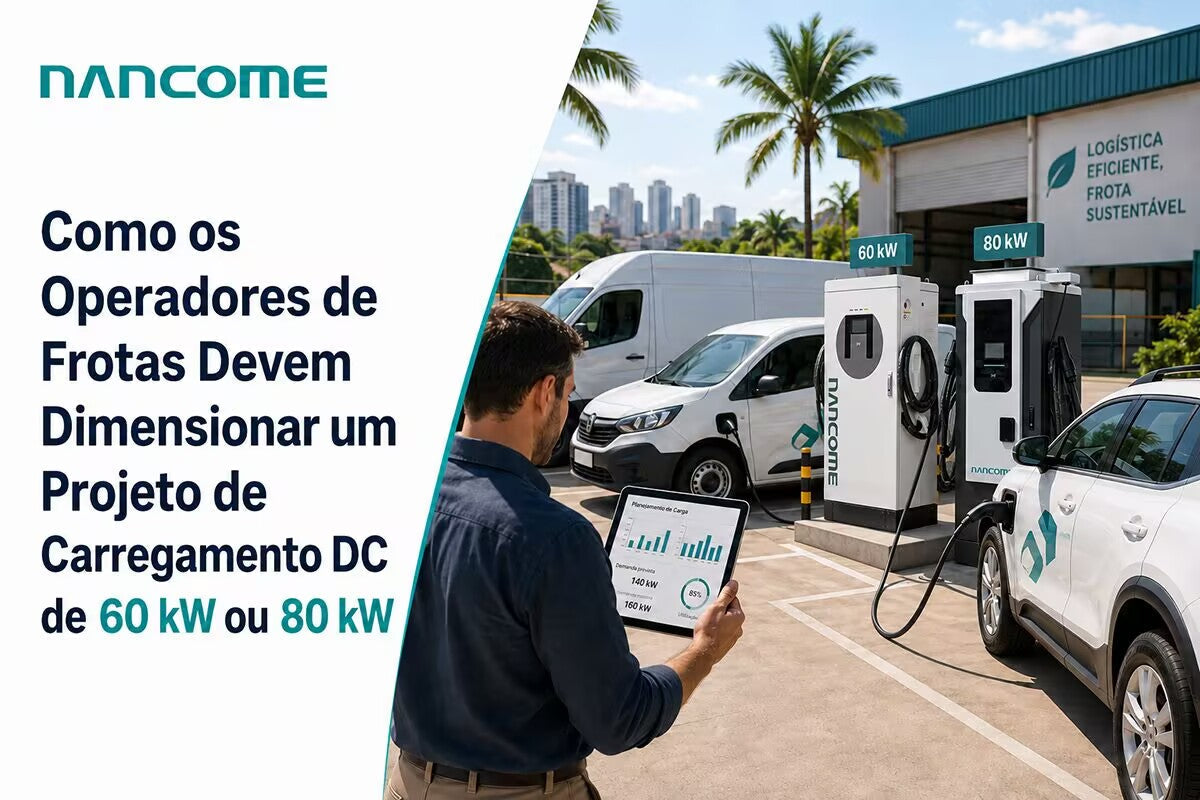
4) 60kW or 80kW for the fleet
• A 60kW DC charger for an electric fleet can serve operations with predictable windows, moderate charging between shifts, and a limited number of simultaneous vehicles.
• 80kW is more suitable when charging windows are shorter, charger utilization is more frequent, or higher vehicle turnover is required.
• The choice should be simulated using the energy required per vehicle and the time available. Additional power creates value only when both the fleet and the infrastructure can use it.
5) Simultaneous charging and one or two outputs
• Confirm how many vehicles need to charge at the same time. This number is more important than the fleet's total number of vehicles.
• A dual-output charger can reduce waiting time, but the power may be shared. The operator should understand the power available in each operating scenario.
• For some fleets, two lower-power units provide more redundancy than a single higher-power unit. The decision depends on availability requirements and cost.
6) Transformer, demand, and load management
• The project should assess transformer capacity, the depot's current maximum load, voltage, three-phase power supply, distribution board, protection, and cable distance.
• If charging demand coincides with other depot loads, the platform or controller may help schedule sessions and limit power. This must be tested with the selected architecture.
• NANCOME can provide charger requirements and support technical integration. The demand study and electrical design should be completed by local professionals.
7) OCPP, RFID, and operational data
• OCPP allows the charger to connect to a management platform. For fleets, this can support RFID identification, energy records, availability, alarms, and charging-session history.
• The data helps compare consumption by vehicle, utilization by shift, and occupancy time. It also supports expansion decisions.
• The platform should be selected according to the functions required. A complex system is unnecessary when the fleet uses only a few chargers and does not charge external users.
8) When to evaluate energy storage
• A limited grid does not automatically mean that the fleet needs a battery. First confirm charging frequency, grid-upgrade cost, tariff, demand, and the time available to recharge the energy storage system.
• Energy storage can be evaluated when there is a clear and recurring operational need that the grid cannot meet economically.
• NANCOME offers Energy Storage Charging Systems, but this equipment should be treated as a project-specific solution, not as the standard replacement for a grid-connected DC charger.
9) NANCOME support and experience
• NANCOME's electrical manufacturing foundation since 1992 helps connect chargers, distribution boards, and connection requirements.
• For Brazilian fleets, the initial configuration normally considers CCS2, 60kW or 80kW, one or two outputs, OCPP, and 4G/LAN connectivity.
• Support may include documentation, remote diagnostics, software updates, and spare-parts recommendations. On-site installation and maintenance depend on the local partner.
10) Fleet RFQ checklist
• Number, models, and interface of the vehicles.
• Mileage, consumption, and daily energy to be replenished.
• Return times, departure times, and simultaneous charging requirements.
• Voltage, transformer, available demand, and other depot loads.
• Platform, RFID, reports, expansion, and deployment timeline.
Result:
A properly sized fleet project converts routes and schedules into energy and power requirements. 60kW or 80kW should be selected after calculating the energy to be replenished, the charging window, and simultaneous charging demand. This approach improves predictability and avoids overinvestment.

Leave comment
所有评论在发布前都会经过审核。
此站点受 hCaptcha 保护,并且 hCaptcha 隐私政策和服务条款适用。