
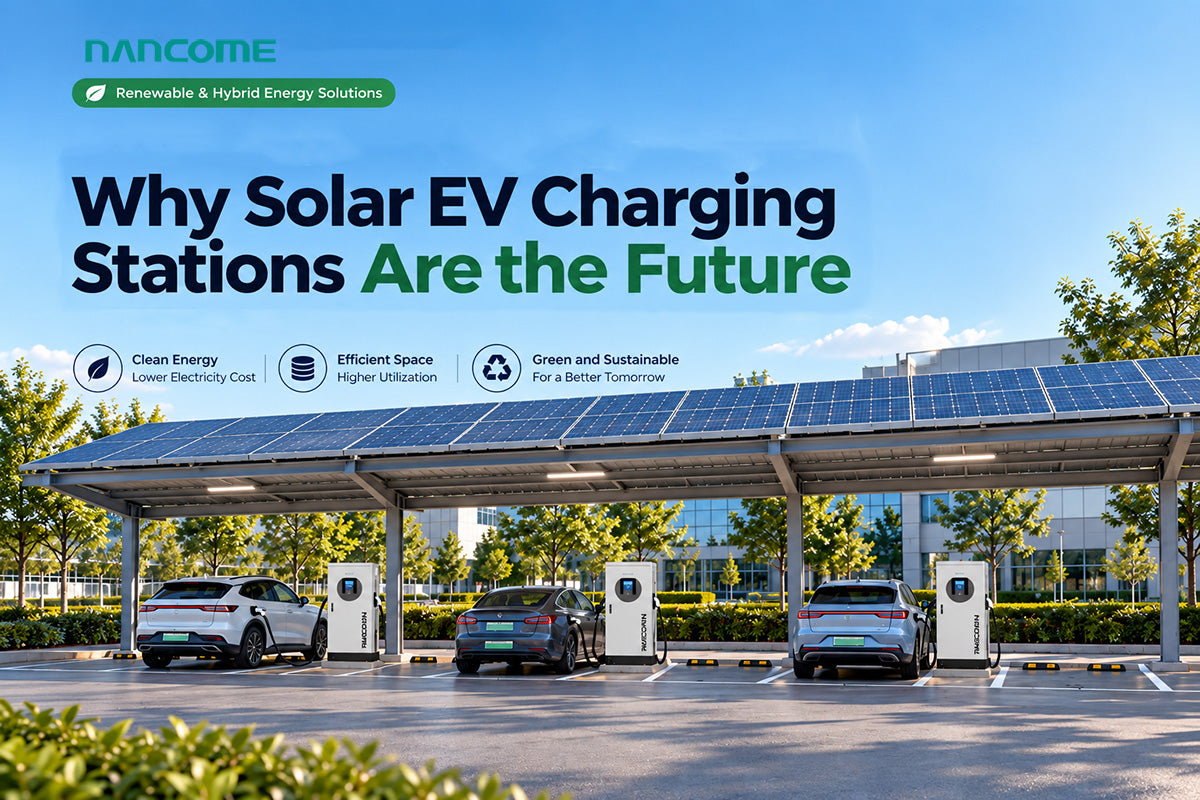
A 2026 business guide to solar-powered EV charging, energy storage, grid flexibility and smarter commercial station investment
The next generation of charging stations will manage energy, not simply deliver electricity.
Solar EV Charging Market Snapshot - 2026
The case for solar EV charging stations is getting stronger as two markets expand together: electric vehicle charging and distributed solar generation. The International Energy Agency (IEA) reports that the global stock of public charging points exceeded 7 million at the end of 2025, up more than 33% year on year. Average public charging power also increased to nearly 50kW as fast charging became more common. [1]
Meanwhile, the IEA expects solar PV to represent nearly 80% of global renewable electricity capacity additions during 2025-2030. In 2025, 108GW of new battery storage capacity was deployed worldwide, 40% more than in 2024. These are global trends, not a promise that every charging site will benefit from installing solar and storage. [2][3]
- EV charging is becoming a larger and more concentrated electrical load, especially at commercial and fleet sites.
- On-site solar can offset purchased electricity when generation and charging demand overlap.
- Battery storage and controlled charging can improve flexibility when solar production and charging peaks occur at different times.
- Project economics still depend on local tariffs, solar yield, vehicle traffic, available grid capacity and installed cost.
For NANCOME, the opportunity is not to sell a fixed solar package. It is to help customers evaluate a coordinated system that connects commercial charging equipment, energy storage options and power distribution engineering.
1. Why Solar and EV Charging Are Converging Now
Three structural changes are bringing solar generation closer to EV charging projects. First, public and commercial charging demand is growing. Second, solar PV is being deployed on rooftops, carports and commercial land at increasing scale. Third, power systems need more flexibility to integrate variable renewable generation and concentrated loads such as fast chargers. The IEA identifies grid capacity and demand flexibility as major electricity-system challenges in 2026. [1][2][4]
For charging operators, the practical question is changing from “How many chargers can we install?” to “How can we supply the required charging energy at a manageable total cost, without creating an unnecessary site peak?”
2. The Future Is an Integrated Energy Site, Not Just a Solar Canopy
A solar-powered EV charging station does not have to operate exclusively on sunshine. In most commercial projects, solar PV, the utility grid and EV chargers work together. Battery energy storage may be added when the operating profile justifies it.
Typical project architecture: Solar PV + grid connection + optional battery storage + site power distribution + AC/DC EV chargers + energy management.
Solar generates energy in daylight; the grid maintains supply when solar output is insufficient; storage can shift energy or support short charging peaks; and charging controls allocate available power to vehicles. The exact architecture must follow the site, not a universal product diagram.
3. On-Site Solar Can Improve the Economics of Commercial Charging
Electricity is a major operating cost for a charging business. Where solar generation is self-consumed, it can reduce the amount of electricity purchased from the grid. The benefit is strongest when daytime vehicle demand, solar output and the local electricity tariff align.
- Workplaces, shopping destinations and daytime fleet operations may have natural overlap between parking and solar generation.
- Commercial rooftops and solar carports can use existing developed space for electricity generation.
- Solar can improve cost predictability over the project life, but financial value depends on self-consumption, export rules, financing and maintenance.
Solar does not automatically eliminate demand charges or transformer costs. A high-power charging event may still occur during a cloudy period or after sunset, when the site must rely on the grid or battery storage.
4. Faster DC Charging Makes Energy Planning More Important
As commercial DC fast charger power increases from 60-120kW to 180-240kW and beyond, the difference between daily energy consumption (kWh) and instantaneous power demand (kW) becomes more important. Solar PV is usually described by its peak generation capacity (kWp), which cannot be treated as a guaranteed charger output.
A 120kWp solar installation does not continuously provide 120kW, and it cannot be assumed to operate a 120kW DC charger at full power throughout the day. Cloud cover, sun angle, temperature, inverter losses and vehicle demand all change the power balance.
A solar array is an energy resource. A fast charger is a power-demand asset. They must be designed together.
5. Battery Storage Can Bridge the Timing Gap
Solar generation often peaks around the middle of the day, while charging demand may peak in the morning, late afternoon or evening. A battery energy storage system can store some surplus solar energy for later use or supply additional power during short charging events.
The IEA describes batteries as a growing source of short-term flexibility for integrating solar generation and new electrical loads, including EVs. Battery storage is not automatically economical, however: its value depends on discharge power (kW), usable energy (kWh), cycling, efficiency, recharge time and electricity tariffs. [3][5]
- Solar self-consumption: store part of midday generation for later charging demand.
- Peak support: supplement a limited grid connection during brief high-power sessions.
- Operating flexibility: prioritize fleet departures or charging windows without always drawing the maximum site load.
- Resilience: backup operation is possible only when the system is specifically engineered and approved for it; ordinary grid-tied solar alone does not guarantee charging during a power outage.
6. The Best Solar Charging Strategy Depends on the Site
| Commercial site | Where solar may add value | Main design priority |
|---|---|---|
| Office / workplace | Daytime parking overlaps solar production | AC charging mix, roof/carport area, self-consumption |
| Retail / hotel / destination | Customer charging plus on-site renewable generation | Dwell time, utilization, shade and electricity tariffs |
| Fleet / logistics depot | Predictable daily energy and charging schedules | Fleet departure windows, charging power, BESS sizing |
| Public DC fast-charging hub | Partial energy offset and optional peak support | High coincidence, grid connection and 24/7 reliability |
| Remote / weak-grid site | Potential complement to limited grid supply | Storage autonomy, seasonal yield, backup and site safety |
The strongest business case is usually found where the project can use a high share of its solar generation on site. A high-traffic highway charging station may still require a substantial grid connection, even if its solar carport is large.
7. Solar Carports Can Deliver More Than Electricity
A solar carport can combine generation, shade and parking-space use. For commercial properties, the value proposition may include customer comfort, improved use of existing land and visible support for cleaner transport. But the canopy is a civil-engineering asset as well as an electrical one.
- Verify wind and structural loading, foundations, vehicle clearance and impact protection.
- Check drainage, maintenance access, cable routing and fire-safety separation.
- Evaluate whether rooftop PV, carport PV or ground-mounted PV gives the best cost per usable kWh.
A visually attractive solar canopy is not enough. Its economics depend on usable area, local solar irradiation, installation cost, structural requirements and the site charging pattern.
8. Solar + Storage Helps Some Grid-Constrained Sites - With Limits
The IEA reports that grid capacity has become a bottleneck for connecting new electricity generation, storage and demand in many regions. [4] This makes solar + storage + EV charging attractive to evaluate at sites where grid upgrades are expensive or slow.
However, a solar array does not create a reliable 24-hour power supply by itself. If vehicles require high-power charging continuously, a small battery cannot replace an undersized grid connection. For temporary or weak-grid projects, the engineering study must include worst-case weather, recharge opportunities, seasonal demand and backup strategy.
NANCOME’s mobile energy-storage charging equipment can be part of the discussion for temporary, roadside, fleet or grid-limited applications, but its suitability and capacity must be checked against the actual duty cycle.
9. Three Commercial Architectures to Compare
| Architecture | When it may work best | Main trade-off |
|---|---|---|
| Grid + PV + EV chargers | Reliable grid; strong daytime self-consumption | PV offsets energy but may not reduce peak demand |
| Grid + PV + BESS + EV chargers | Evening demand, short peaks or limited grid input | Higher investment, battery losses and maintenance |
| PV + BESS + limited / no grid | Remote sites with engineered autonomy and backup | Seasonal reliability, storage size and capital cost |
The best choice is the architecture with the strongest lifecycle business case for the specific site - not the most complex configuration.
10. A Practical Solar EV Charging Sizing Example
Consider a commercial site with two 120kW DC fast chargers and a proposed 120kWp solar PV installation. Assume 4.2 equivalent full-sun hours per day and an illustrative system performance ratio of 0.78, which accounts for modeled system losses. These assumptions are examples only, not site-specific forecasts.
| Planning item | Illustrative calculation / result |
|---|---|
| PV installed capacity | 120kWp |
| Daily solar energy | 120kWp x 4.2h x 0.78 = about 393kWh/day |
| Daily EV demand | 12 sessions x 25kWh delivered to vehicles = 300kWh/day |
| Charger AC input energy | 300kWh / 0.95 assumed efficiency = about 316kWh/day |
| Installed charger output | 2 x 120kW = 240kW maximum nameplate output |
| Key result | PV daily energy could exceed charger daily energy on paper; it cannot guarantee 240kW charging power or nighttime supply |
This is an energy-balance illustration, not a claim of full solar-powered operation. Hourly solar production, vehicle arrival times, battery state of charge, site auxiliary loads, weather, seasonal variation and export/self-consumption rules determine how much solar electricity actually offsets charging purchases.
A serious feasibility study therefore needs both an hourly kW profile and a daily/annual kWh forecast. PV area alone cannot answer whether the station will be profitable or how much grid capacity it needs.
11. What Really Determines Solar Charging Station ROI?
The return on a solar EV charging station should be evaluated as a complete electrical and commercial project. Solar equipment can reduce energy purchases, but it also adds investment, maintenance and possible inverter replacement costs. Battery storage adds another layer of capital cost and cycling assumptions.
- Energy savings: annual PV kWh actually self-consumed x avoided electricity price, adjusted for the tariff structure.
- Export value: revenue or credits for surplus electricity, where permitted and economically relevant.
- Charging revenue: paid charging sessions, average kWh sold, utilization and margin per kWh.
- Peak-cost exposure: demand charges and contracted capacity costs, which PV alone may not consistently reduce.
- Total lifecycle cost: PV/carport, chargers, transformer, switchgear, civil works, BESS, maintenance, insurance and financing.
12. What Will Change Between 2026 and 2030?
The most important direction is greater coordination between local generation, flexible loads and storage. The IEA projects strong solar PV growth to 2030 and identifies demand flexibility as an important tool for integrating renewable power and rising EV demand. [2][5]
- More sites will evaluate solar generation at the initial charging-station design stage rather than adding it as a later accessory.
- Charging schedules and available site power will increasingly influence equipment selection and operating cost.
- Modular charger configurations, expandable distribution equipment and reserved space for storage can support phased investment.
- Regional economics will remain different: sunlight alone does not determine project payback; tariffs, grid rules and vehicle utilization matter just as much.
13. Why NANCOME Is Relevant to Solar-Integrated EV Charging
NANCOME approaches solar-integrated charging as a project solution rather than a single product. Four capabilities make this discussion relevant to overseas commercial buyers:
- Commercial charging equipment: AC chargers and multiple DC fast charger power levels for public sites, parking facilities, fleets and other business applications.
- Electrical manufacturing foundation since 1992: experience with power distribution equipment, electrical protection and system-level engineering considerations.
- Energy storage charging options: mobile energy-storage charging equipment for selected temporary, weak-grid and flexible-deployment applications.
- Project-oriented customization: charger power, connector standard, installation configuration, language and branding can be discussed according to the destination market and project requirements.
NANCOME can support early discussions on charger selection, available site power, distribution arrangements and charging scenarios. Solar PV design, utility approval, construction permits and final system integration should be confirmed with the qualified local EPC and engineering team.
14. Buyer Checklist Before Investing in Solar EV Charging
- Define the business case: public charging revenue, workplace service, fleet operations or commercial property value.
- Measure or forecast vehicle arrivals, average kWh per session and the busiest charging hour.
- Confirm available grid capacity, transformer spare capacity and future site loads.
- Check usable roof, canopy or land area, shading, orientation and local solar resource.
- Model hourly PV output against hourly charging demand - not just annual kWh totals.
- Choose the AC/DC charger mix from dwell time and vehicle acceptance, not marketing power alone.
- Assess whether battery storage has a clear role in self-consumption, peak support or resilience.
- Compare electricity tariffs, demand charges, export compensation and grid-upgrade costs.
- Plan electrical protection, civil works, fire safety, maintenance access and future expansion.
- Request a site-specific lifecycle model before selecting the final PV, BESS and charger sizes.
Result
Solar EV charging stations are part of the future because EV charging demand is rising at the same time that solar generation and battery storage are expanding. When designed around real vehicle demand and local electricity conditions, solar can reduce grid energy purchases, while storage and controlled charging may improve flexibility.
But the future is not a fully off-grid fast charger at every location. Many commercial stations will continue to rely on the grid, with solar and storage providing targeted value. For overseas project owners, the winning design will be the one that balances reliable charging service, grid capacity, renewable generation and lifecycle cost.
NANCOME brings charging equipment, electrical distribution experience and flexible energy-storage charging options into that project discussion. Share the site location, available grid power, expected daily charging demand and proposed solar area to begin a practical equipment and deployment assessment.


Leave comment
所有评论在发布前都会经过审核。
此站点受 hCaptcha 保护,并且 hCaptcha 隐私政策和服务条款适用。