
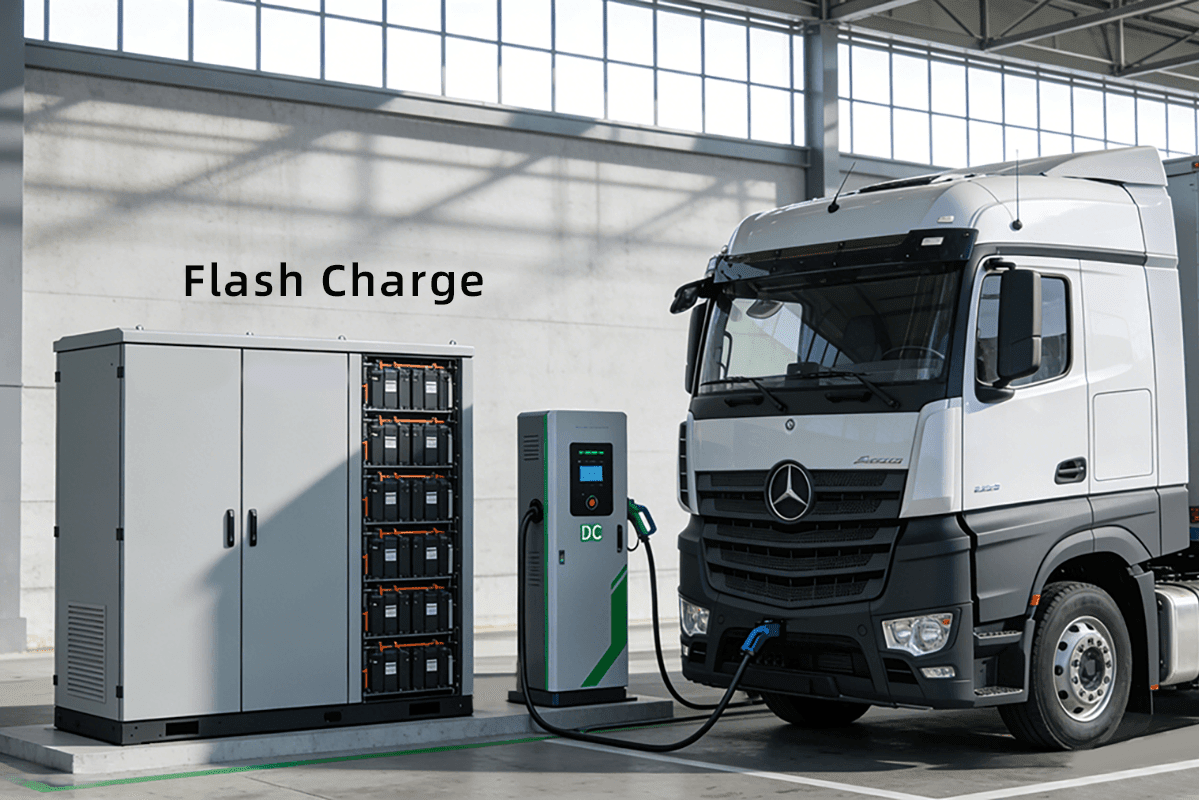
How Nancome helps commercial sites launch high-power charging faster under real grid constraints
The recent industry attention around ultra-fast charging has made one thing clear: the market no longer asks only whether a station can be built, but whether it can be launched quickly, operate reliably, and scale without waiting for every utility upgrade to finish first. That is exactly where a storage-backed fast charging solution becomes valuable.
Public reporting around BYD’s March 2026 launch highlighted two ideas that matter far beyond one brand: first, faster charging is now a mainstream market expectation; second, on-site storage can help reduce the grid bottleneck that slows down high-power station rollout. The same reporting also described a station-in-station upgrade path, where higher-power equipment can be added inside existing charging sites instead of rebuilding everything from zero.
Why this matters for real charging projects
For most site owners, the problem is not a lack of interest in fast charging. The real obstacles are more practical: limited transformer headroom, long utility approval cycles, civil works that take too long, and existing stations that already have traffic but not enough high-power capacity. A commercial EV quick-refill station must therefore solve a project problem, not just advertise a peak number.
What Nancome’s approach focuses on
Nancome’s approach is to turn high-power charging into a deployable project package. Instead of treating storage as a marketing add-on, the design uses energy storage buffered DC fast charging to support faster site rollout, smoother peak-time output, and a more practical path to later expansion.
·A storage system can support high-power charging during peak windows and recharge when site demand is lower.
·An existing site can add a high-power quick-refill zone first, then optimize the long-term capacity plan later.
·A customer can launch a charging service earlier instead of waiting for a full utility upgrade before starting operations.
Where this solution fits best
This kind of grid-constrained charging site deployment is especially suitable for four common project types.
Shopping centers and office parking
Drivers usually stay for 30–60 minutes, not overnight. That makes faster refill more valuable than simply adding more low-power points.
Industrial parks, factories, and logistics depots
These sites often see strong charging peaks during shift changes, lunch breaks, or return-to-base windows. A fleet and depot charging upgrade benefits from storage-supported peak output and phased expansion.
Existing public charging stations
If traffic already exists, a station-in-station upgrade path can add a high-power refill area without rebuilding the entire station.
Cold-weather or complex environments
Real projects need stable output, thermal control, and long-term serviceability, not just a headline power figure.
Why the project view matters more than the headline number
High-power charging is never a stand-alone parameter. It only becomes commercially useful when the site design, power distribution, storage sizing, protection logic, and operational platform all work together. That is why a high-power charging with storage support strategy should always be evaluated as a full station concept.
For operators who need platform interoperability, OCPP-compatible charging site integration is also an important part of long-term flexibility, especially for stations that may expand or connect to third-party management systems later.
What customers typically need from a solution provider
A real customer rarely asks for a single piece of equipment. Most projects require a coordinated delivery that can include charger selection, storage sizing, power distribution planning, site layout guidance, platform integration, and future expansion logic. That is why the most useful offer is not a box on a datasheet, but a site-ready solution package.
A more practical way to think about storage + fast charging
Not every project needs to chase extreme charging power. But almost every project benefits from a plan that launches faster, runs more steadily, and expands more easily. That is the real role of a storage-backed fast charging solution in today’s market.
References
·Gasgoo, March 2026: coverage of BYD’s flash charging launch, including on-site storage support and station-in-station deployment logic: https://auto.gasgoo.com/news/202603/10I70449510C109.shtml
·UL Solutions: Energy Storage System Testing and Certification, including system-level safety context relevant to battery energy storage system safety: https://www.ul.com/services/energy-storage-system-testing-and-certification
·Open Charge Alliance: OCPP 1.6 certification program and ecosystem background for OCPP-compatible charging site integration: https://openchargealliance.org/new-certification-program-ocpp-1-6/

Leave a comment
All comments are moderated before being published.
This site is protected by hCaptcha and the hCaptcha Privacy Policy and Terms of Service apply.