
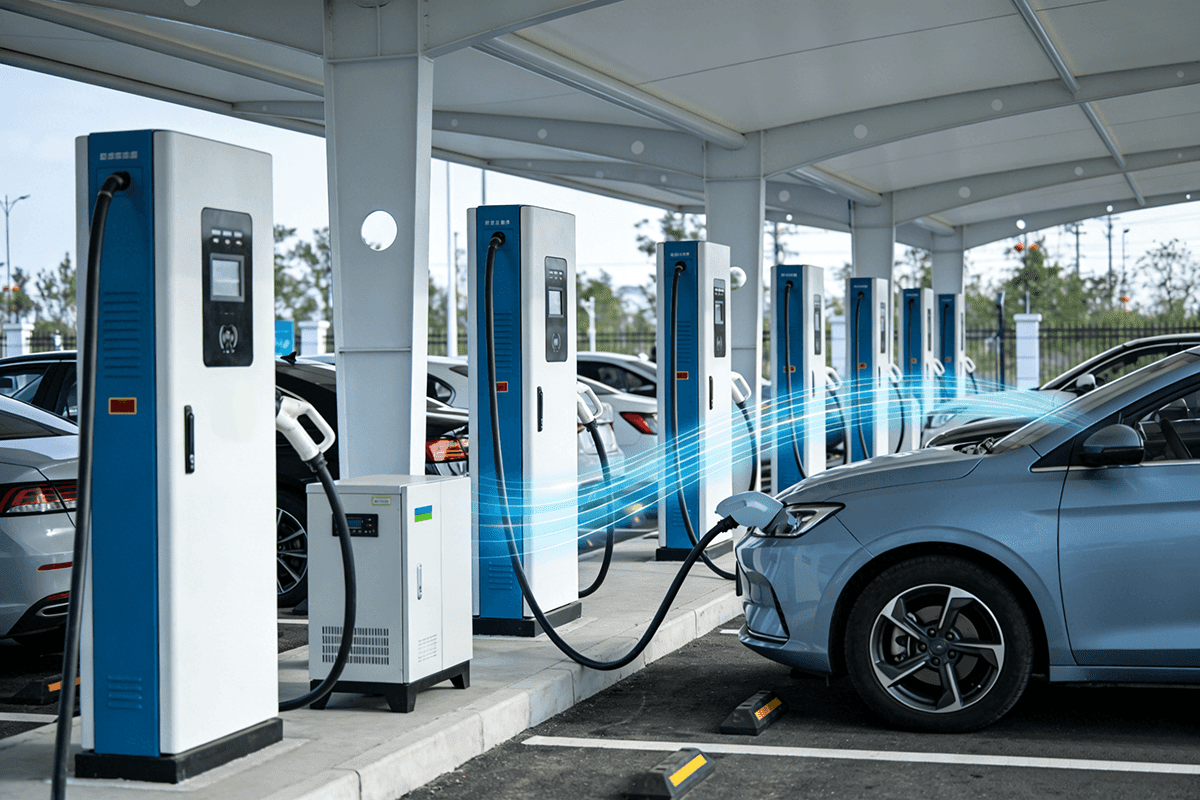
Scenario: A customer has already installed four 120 kW air-cooled DC fast chargers and the site is performing great. Now the customer wants to add more chargers—but the transformer and incoming utility feed are already at the limit. In other words, you’re facing a transformer capacity constraint and a utility service capacity limit.
The key takeaway is simple: when the grid can’t deliver more power, you must expand chargers without increasing grid capacity. This article shows two practical routes that real sites use: (A) power sharing + load management, and (B) a battery buffer to handle peak hours.
1) Why ‘Just Add Another 120 kW Charger’ Usually Doesn’t Work
If your site power is capped by the transformer, adding another 120 kW unit does not create new power—it only creates more places to plug in. Without control, more units can increase simultaneous demand and trigger trips or derating. That’s why the correct goal is to add more connectors with the same electrical capacity while keeping the site safe and stable.
2) Solution A (Recommended First): Site-Wide Power Cap + Dynamic Power Sharing
This is the fastest and most cost-effective option for most expanding sites. You keep a site-wide power cap (a hard limit for the whole station), then distribute power dynamically across chargers. When fewer vehicles are charging, each vehicle can receive more power; when more vehicles are charging, the system automatically shares power so everyone can charge.
In practical terms, this becomes a power-sharing expansion plan: you can install more dispensers or add more plugs, but the total site power never exceeds the approved limit. This approach is designed for queue reduction strategy for EV charging stations—because it reduces waiting time by letting more cars charge at once (even if each car charges a bit slower during peaks).
How it works (plain language)
Step 1: Set the station’s total power limit based on your transformer and main breaker rating.
Step 2: Use a load management controller (EMS) to allocate power across all active sessions—for example, 2 cars can share more power, while 6 cars share less power.
Step 3: Apply rules like ‘first 10–15 minutes priority’ to boost turnover: a car gets higher power early, then slightly lower power later, so fewer vehicles occupy a plug for too long. This is a fast-charging site throughput improvement technique.
What you need from the hardware/software side
• Chargers that support adjustable output limits and remote configuration (many DC chargers do).
• A backend that supports OCPP smart charging (charging profiles) or a local EMS that can impose power limits per charger/session.
• A clear definition of the maximum site power based on electrical panel and breaker headroom.
When Solution A is enough
Solution A is usually enough when your biggest problem is queues at peak times, not the absolute energy delivered per vehicle. If drivers mainly need a ‘quick top-up’ rather than a deep charge to 90–100%, power sharing typically improves the customer experience immediately.
3) Solution B (When Peaks Are Still Painful): Battery-Buffered DC Fast Charging
If the station still cannot meet peak demand after power sharing—especially during sharp rush-hour surges—consider battery-buffered DC fast charging. This adds a local battery that acts like a ‘water tank’: the grid fills it slowly, and the station draws from it during peak periods to support more simultaneous charging.
In energy terms, peak support is often shorter than people expect. If your bottleneck is the 15-minute demand window, a battery can supply extra power for that short window and then recharge later. This is commonly referred to as behind-the-meter BESS peak shaving.
What Solution B does (and does NOT do)
• It DOES help you add more charging capacity during peaks without waiting for the utility.
• It does NOT replace a full grid upgrade for unlimited growth—but it can bridge the gap during long grid upgrade lead time.
4) The ‘Real’ Expansion (Run in Parallel): Utility Upgrade Process
Even if you deploy power sharing or a battery buffer, you should still start the utility upgrade request early. Grid upgrade lead time can be long (permits, design review, construction windows). The best practice is: stabilize operations now with Solution A/B, while pursuing an upgrade for long-term scaling.
5) A Simple Decision Checklist
• Do we know the transformer rating and current peak demand at the site?
• Is the main distribution panel near its limit (breakers, busbar, cable size)?
• Is the pain point mainly queues (throughput), or also ‘charge speed’ per vehicle?
• Can the chargers accept EMS/OCPP power limits?
• Do peak surges happen in short bursts (rush hour) or all day?
• What is the realistic timeline for a utility upgrade?
6) What to Propose (A Ready-to-Use Offer Structure)
Offer Option 1: Add more plugs with dynamic power sharing across chargers, keeping a strict site-wide power cap to stay inside the electrical limit. This is the lowest-cost way to reduce queues.
Offer Option 2: Add more plugs + a small battery buffer (battery-buffered DC fast charging) to cover peak bursts and improve peak-hour service.
Offer Option 3: Start utility upgrade paperwork now, while deploying Option 1 (and optionally Option 2) so the business can keep growing without losing customers to long waits.
References (traceable)
• Open Charge Alliance (OCPP & Smart Charging): https://openchargealliance.org/protocols/open-charge-point-protocol/
• AFDC (Charging station operations & costs, demand charges overview): https://afdc.energy.gov/
• NREL (Behind-the-Meter Storage Analysis): https://www.nrel.gov/transportation/behind-the-meter-storage-analysis

Leave a comment
All comments are moderated before being published.
This site is protected by hCaptcha and the hCaptcha Privacy Policy and Terms of Service apply.