
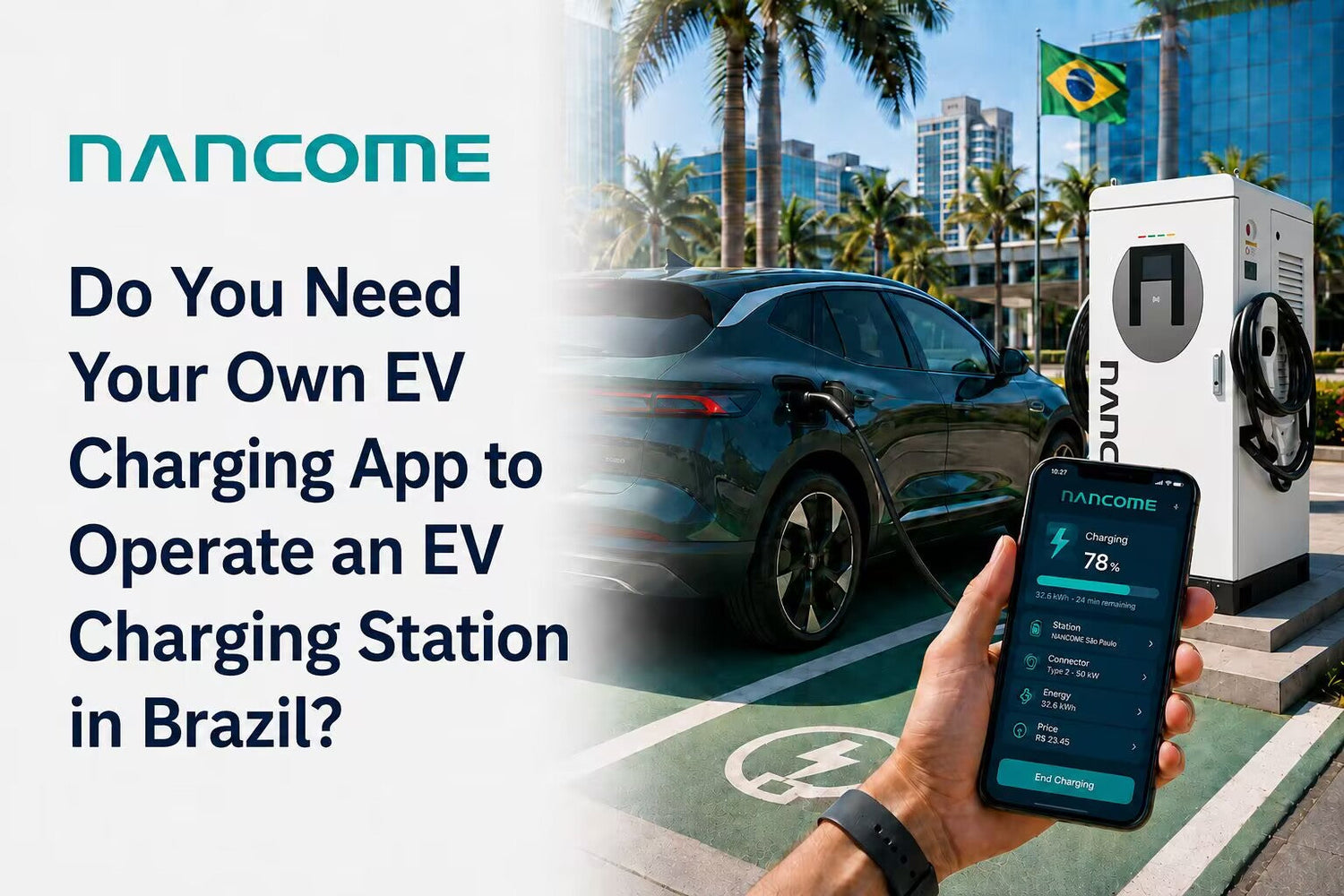
How new Brazilian operators can choose hardware and software in the correct order without confusing OCPP with an app or payment.
The New Stage of Charging Operations in Brazil
• The growth to 215,023 electrified light vehicles in the first half of 2026 and the expansion of the network to more than 25,000 points show that charging is becoming an operational activity, not merely an equipment installation.
• As more sites offer charging, the need for monitoring, customer service, tariffs, availability, and integration between different chargers increases.
• OCPP creates an open communication foundation, but the operator still needs to choose which platform functions are truly necessary for the business model.
1) Short answer: not necessarily, but the operating model should come first
• A buyer does not need to have a platform under contract to begin selecting the charger. However, the buyer needs to know whether the site will be internal, free to use, paid for by the public, or integrated into an existing network.
• This definition changes the requirements for OCPP, RFID, connectivity, payment, reports, and support.
• Purchasing hardware without considering the operation can cause rework, incomplete integration, or dependence on an unsuitable system.
2) When a platform may not be necessary at the beginning
• Dealerships, workshops, companies, and small fleets that use a charger internally may operate with local control or RFID, depending on the configuration.
• When there is no billing, public app, or multiple sites, a complete platform may add cost and complexity before real demand exists.
• Even so, choosing a charger with OCPP preserves the possibility of future connection.
3) When the platform should be defined before deployment
• Paid public operations, parking facilities with external users, hotel networks, small CPOs, and multi-site projects normally need a platform from the beginning.
• The system should manage users, tariffs, sessions, availability, customer service, and financial data.
• When Pix, card payment, or an app is part of the commercial offering, the integrations need to be confirmed before launch.
4) The risk of buying the charger first
• The charger may support OCPP, but its version, profiles, and optional functions may not match the backend selected later.
• The hardware may not include the modem, reader, or configuration required for the planned authentication model.
• The operation may promise payment or an app without having a gateway, contract, and local support in place.
5) Customer with an existing platform
• Send the platform's technical requirements before placing the order: OCPP 1.6J or 2.0.1, security, mandatory messages, connectivity, and testing process.
• NANCOME can prepare the equipment and participate in remote integration. Compatibility should be demonstrated through testing, not only through a general statement.
• The platform provider should support configuration, credentials, and session validation.
6) Customer without an existing platform
• Define the number of chargers, users, sites, billing requirements, reports, and expected support.
• Compare subscription-based platforms according to the functions that are actually needed. Avoid selecting one only by monthly price without assessing integration and service.
• NANCOME can recommend a partner, but the platform remains a separate service with its own contract and costs.
7) Platform, app, and payment are not the same thing
• The platform manages chargers and data. The app is one possible user interface. Payment involves a gateway, acquirer, bank, and commercial rules.
• Pix, card payment, or a QR code should not be promised only because the equipment has a screen or supports OCPP.
• For some projects, RFID and contractual billing are simpler than direct payment for each session.
8) Why OCPP reduces lock-in risk
• OCPP facilitates communication between hardware and management systems from different suppliers, giving the operator more options for integration and expansion.
• However, real interoperability depends on version, profiles, security, and testing. The protocol reduces lock-in risk but does not eliminate technical management.
• The Open Charge Alliance maintains OCPP as an open standard. OCPP 1.6 remains common, while OCPP 2.0.1 offers more advanced capabilities.
9) How to choose the charger configuration
• For new Brazilian operators, start with 40kW, 60kW, or 80kW according to traffic and electrical capacity, using CCS2 as the standard.
• Define one or two outputs, 4G/LAN, RFID, and OCPP according to the platform and the way the charger will be used.
• Do not select energy storage or higher power without confirming grid limitations, frequency of use, and expected return.
10) NANCOME's role
• NANCOME combines the manufacturing of chargers, energy storage systems, and electrical distribution equipment. This structure makes it possible to discuss hardware, connection requirements, and integration without confusing each supplier's responsibilities.
• The company has electrical experience dating back to 1992 and provides support for selection, documentation, remote diagnostics, software, and common spare parts.
• Installation, approval, compliance, local service, and platform operation should be organized with qualified Brazilian partners.
11) Decision checklist
• Will the charger be used internally, offered free of charge, or operated as a paid service?
• How many sites and users will be managed?
• Is there an OCPP platform, or will one need to be contracted?
• Which functions are truly necessary: RFID, app, Pix, card payment, reports, or multiple sites?
• Who will be responsible for integration, user support, installation, and local maintenance?
Result:
You do not necessarily need to contract a platform before starting the purchase, but you do need to define the operating model before finalizing the charger configuration. When hardware, OCPP, platform, and payment are treated as separate layers, the project gains flexibility and reduces risks.


Leave a comment
All comments are moderated before being published.
This site is protected by hCaptcha and the hCaptcha Privacy Policy and Terms of Service apply.