

How to select a commercial power level compatible with operations, electrical infrastructure, and the current stage of Brazilian e-mobility
Current E-Mobility Landscape in Brazil
• According to ABVE, Brazil registered 215,023 electrified light vehicles in the first half of 2026, reaching 15.8% of the market. This growth increases the need for more professional charging projects, although direct charging demand is concentrated among plug-in vehicles.
• The ABVE/Tupi survey released in June 2026 recorded 25,429 public and semi-public charging points, of which 8,601 were DC fast chargers. The DC network expanded by 32.8% in just three months.
• According to EPE's Brazilian Energy Balance 2026, 86.8% of Brazil's electricity mix was renewable in 2025. This context strengthens the environmental potential of e-mobility, but it does not eliminate the need to verify the transformer, available demand, and local connection conditions.
1) Why 40kW, 60kW and 80kW Have Gained Commercial Relevance
• The Brazilian market is growing rapidly, but many new projects still begin at dealerships, repair shops, hotels, parking facilities, shopping centers, small fleets, and regional operators. These sites normally need to balance charging speed, investment, and electrical capacity.
• For this reason, the first decision should not be to choose the highest number on the specification sheet. The 40kW to 80kW range is often more compatible with entry-level projects and gradual expansion, especially when initial utilization still needs to be proven.
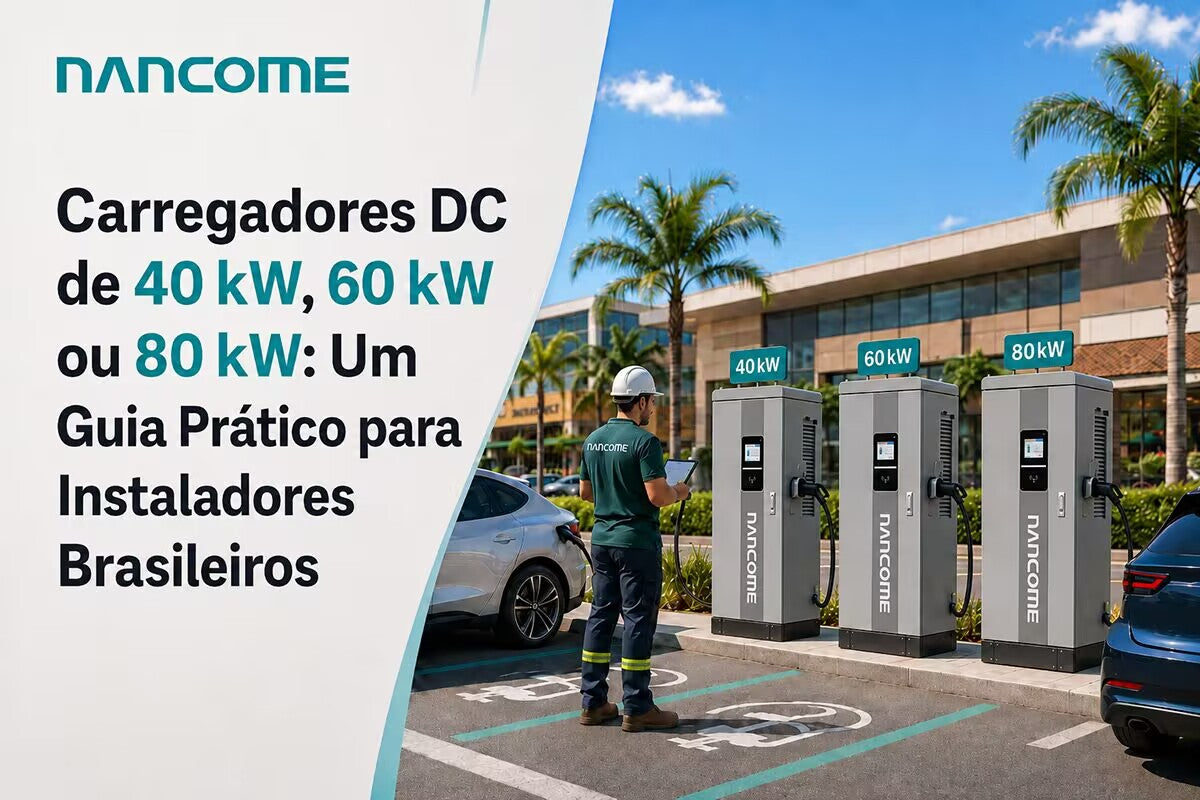
• NANCOME works with a broader global portfolio of DC charging equipment, energy storage, and power distribution solutions. For Brazil, however, the recommendation should begin with a 40kW DC charger, 60kW DC charger or 80kW DC charger according to the actual application.
2) When a 40kW DC Charger Is Sufficient
• 40kW is a practical option for dealerships, service centers, repair shops, lower-traffic parking facilities, and companies that want to test DC charging before expanding the operation.
• This power level can reduce pressure on the transformer and the deployment budget, particularly when vehicles remain at the site for a moderate period and there is no continuous queue of users.
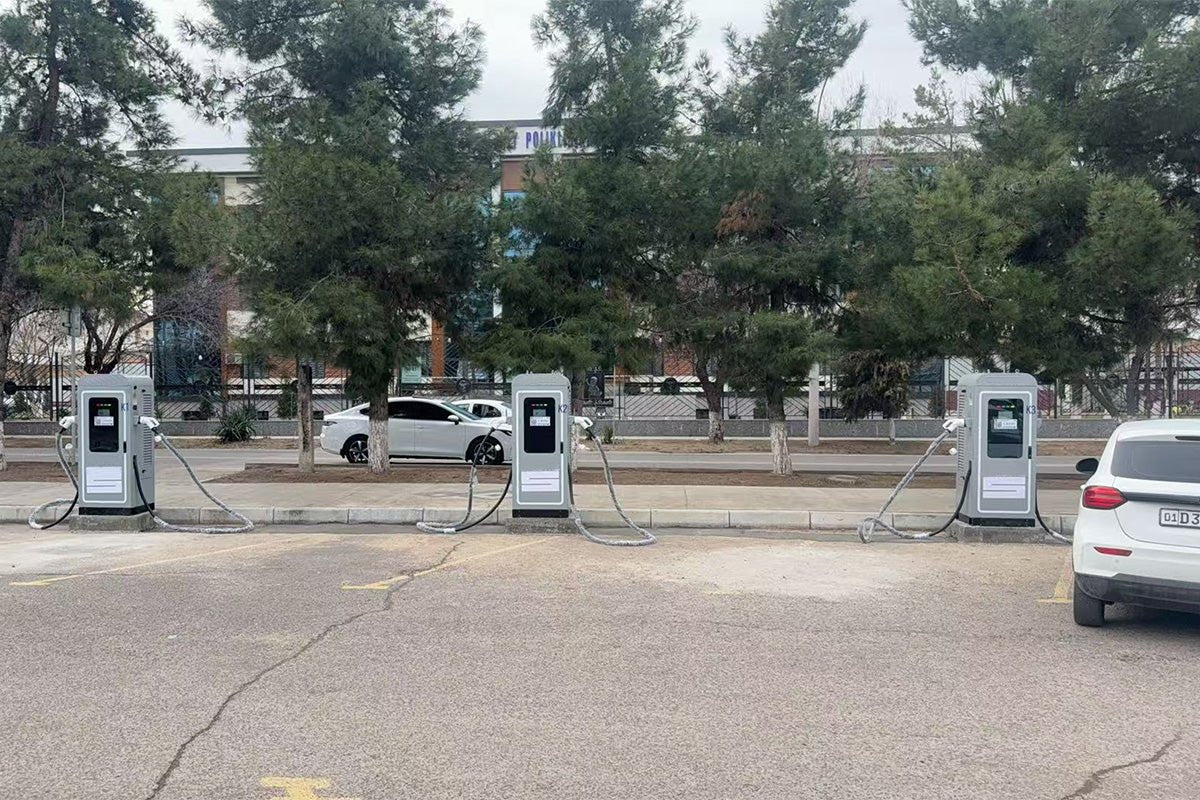
• For projects with limited space, a compact or wall-mounted DC solution may be evaluated. The final configuration should confirm CCS2, the number of outputs, the installation environment, and three-phase power availability.
3) Why 60kW Is Often the Point of Balance
• A 60kW CCS2 DC charger provides a clearly commercial charging experience without automatically requiring the same infrastructure as a high-power project. For this reason, it is a recurring choice for hotels, parking facilities, dealerships, shopping centers, and small operators.
• 60kW also works well as a core model for distributors and installers that want to present a commercial DC product line in Brazil. It can be specified with one or two outputs, OCPP communication, 4G/LAN, and RFID according to the project.
• The rated power does not guarantee that every vehicle will receive 60kW throughout the entire session. The charging curve depends on the vehicle, battery state of charge, temperature, and the vehicle's own acceptance capability.
4) When 80kW Is the More Appropriate Choice
• 80kW begins to make sense when there is a higher frequency of sessions, less time available per vehicle, or a need to release the parking space more quickly. Examples include rental companies, small fleets, service-station sites, and higher-turnover parking facilities.
• The benefit must be compared with the additional electrical cost. The transformer, cables, protection devices, distribution board, and contracted demand may have a greater impact on the investment than the price difference between two chargers.
• Before recommending 80kW, it is important to confirm the number of daily sessions, peak periods, site capacity, and the expansion plan.
5) CCS2, One or Two Outputs, and Power Distribution
• For Brazilian commercial projects supported by NANCOME, CCS2 should be the starting point. GB/T should not be included as a standard option without a specific compatibility requirement.
• A dual-output charger does not necessarily mean that two vehicles will receive the full rated power at the same time. The buyer should confirm the power-sharing logic and priority between sessions.
• The decision between one or two outputs should consider traffic flow, parking-space layout, charging-port positions, cable length, and the actual likelihood of two vehicles arriving at the same time.
6) Electrical Checks Before the Final Selection
• Confirm the input voltage, availability of three-phase power, transformer capacity, current maximum load, distribution-board location, and approximate cable distance.
• NANCOME's electrical manufacturing experience since 1992 helps evaluate the charger as part of a power system, including connection requirements and integration with power distribution boards.
• Local electrical design, utility approval, civil works, installation, and compliance should remain the responsibility of qualified engineers and contractors in Brazil.
7) OCPP, Platform, and Commercial Operation
• If the customer already has a platform, the equipment can be prepared for OCPP integration and communication testing. NANCOME works with OCPP 1.6J and can evaluate OCPP 2.0.1 according to the configuration and project.
• If the buyer does not yet have a platform, a partner solution with subscription fees and contracted functions can be recommended. OCPP does not mean that a free application or local payment system is automatically included.
• RFID, user management, tariffs, reports, Pix, card payments, and other payment methods depend on the selected platform and local providers.
8) Why Consider NANCOME
• On nancome.com, the portfolio is organized into DC EV Charger, Energy Storage Charging System, and Power Distribution Cabinet & Box, allowing customers to discuss both the charger and its relationship with the electrical side of the project.
• For commercial applications, NANCOME can support power selection, CCS2, OCPP, connection requirements, preparation documentation, remote diagnostics, software updates, and recommendations for common spare parts.
• The floor-standing charger range includes options for outdoor operation, remote service, and project-based customization. For Brazil, these capabilities should be applied objectively, without turning high power or energy storage into an automatic recommendation.
9) Checklist for Requesting a Recommendation
• Site type, number of chargers, and project stage: sample, pilot, or formal deployment.
• Vehicles to be served, CCS2 interface, available charging time, and number of vehicles charging simultaneously.
• Voltage, transformer, available demand, cable distance, and indoor or outdoor environment.
• Free, internal, or paid operation; existing OCPP platform or need to evaluate a partner.
• Purchasing schedule, local technical contact, and person responsible for the commercial decision.
Result:
In today's Brazilian market, 40kW, 60kW, and 80kW represent three levels of commercial deployment. 40kW lowers the entry barrier, 60kW provides a practical balance, and 80kW serves operations with higher turnover. The correct choice depends on the application, vehicle, infrastructure, and platform, not only on rated power.

Оставить комментарий
Все комментарии перед публикацией проверяются.
Этот веб-сайт защищается hCaptcha. Применяются Политика конфиденциальности и Условия использования hCaptcha.