
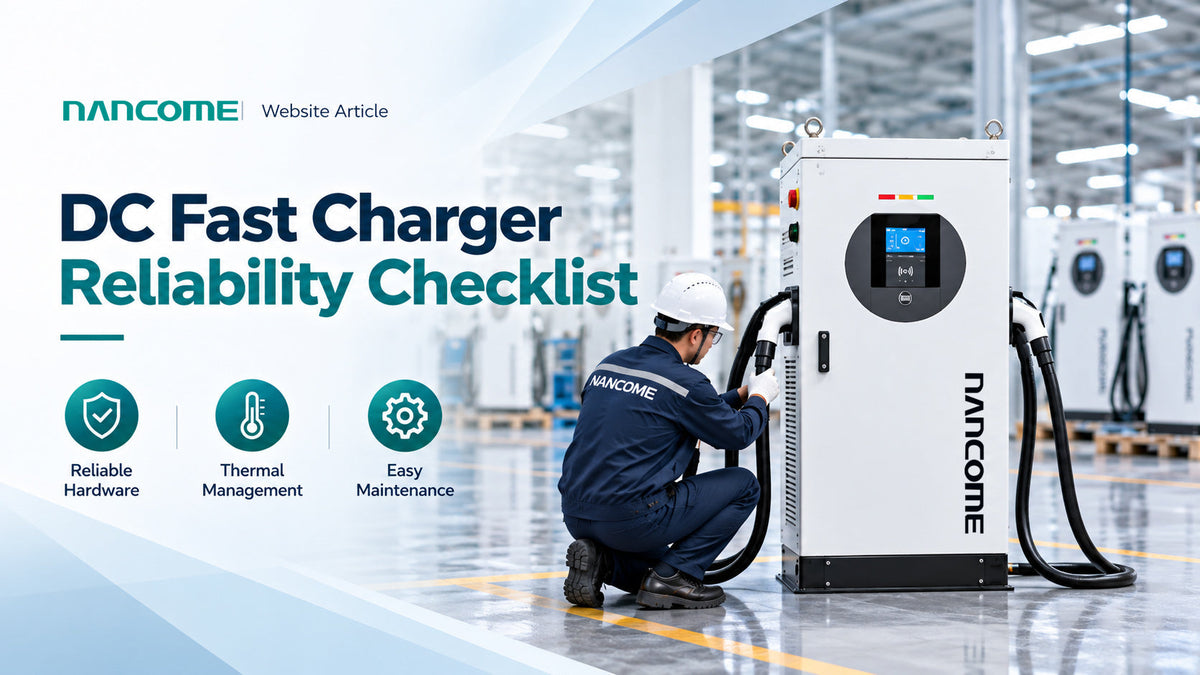
A practical 2026 guide to hardware durability, thermal management, installation, maintenance, spare parts and lifecycle availability
For a commercial charging station, reliability is not a brochure specification — it is operating time, successful charging sessions and service continuity.
DC Fast Charging Reliability Snapshot — 2026
Public charging infrastructure continues to expand rapidly. According to the IEA Global EV Outlook 2026, the global stock of public charging points exceeded 7 million at the end of 2025 after growing more than 33% in one year. Fast and ultra-fast charging are also taking a larger share of new deployment. As charging networks scale, the business focus is shifting from simply installing chargers to keeping them available, maintainable and productive over their operating life.
- Public charging networks are getting larger and faster, increasing the importance of charger uptime and maintainability.
- The U.S. NEVI framework uses greater than 97% annual uptime per charging port as a minimum reliability benchmark for funded infrastructure.
- Research summarized by NREL shows that charging failures can come from multiple layers: power, internal hardware, connectors, communications, software, payment systems and vehicle-charger interaction.
- A procurement decision should therefore evaluate design, manufacturing quality, installation, commissioning, preventive maintenance, spare parts and after-sales response together.
This article focuses on hardware and operational reliability rather than OCPP protocol selection.
1. Why Reliability Is Becoming a Purchasing Criterion
A DC fast charger can have competitive rated power and still become a weak commercial asset if it is frequently unavailable. For a public charging station, downtime can mean lost charging revenue and poor driver experience. For a fleet EV charging solution, downtime can interfere with vehicle dispatch and daily operations.
The Joint Office of Energy and Transportation has emphasized that uptime alone is not sufficient: a charger also needs to initiate and complete charging successfully. This is an important distinction for B2B buyers. Reliability should be evaluated as the ability of the complete charging system to operate repeatedly under real site conditions.
2. Reliability Starts Before the Charger Reaches the Site
Many reliability problems are easier to prevent during specification and engineering than to repair after deployment. Before ordering a commercial DC fast charger, buyers should confirm the electrical environment, target vehicles, climate, installation method, duty cycle and expected simultaneous charging load.
| Before purchase | What to confirm | Why it matters |
|---|---|---|
| Grid input | Voltage, frequency, transformer capacity, voltage fluctuation | Incorrect or unstable supply can affect charger operation |
| Vehicle profile | Connector, voltage platform, charging curve, fleet mix | Reduces compatibility and power-selection risk |
| Duty cycle | Sessions/day, peak hours, continuous high-load periods | Influences thermal and component loading |
| Environment | Temperature, dust, humidity, rain, altitude | Influences enclosure and thermal design |
| Installation | Cable route, ventilation clearance, foundation, protection | Poor installation can create avoidable field failures |
| Service plan | Local technician, remote support, spare parts | Determines recovery time after a fault |
3. Power Modules: Modular Design Reduces the Impact of a Single Failure
The power conversion stage is one of the most important subsystems in a DC fast charger. A modular architecture can simplify diagnosis and replacement because individual power modules can be serviced without replacing the entire charger.
For NANCOME's commercial DC charging projects, modularity is particularly relevant across higher-power configurations such as 180kW, 240kW DC fast charger, 320kW DC fast charger and 480kW DC fast charger systems. The project should define module arrangement, redundancy strategy where required, service access and spare-module planning before delivery.
- Ask whether failed modules can be identified and replaced independently.
- Confirm module access without unnecessary disassembly of unrelated systems.
- Define whether reduced-power operation is possible after a module fault; this depends on the specific charger architecture.
- Keep project-specific spare modules where downtime has high operational cost.
4. Thermal Management Is a Reliability Issue, Not Just a Temperature Specification
High-power charging generates heat in power modules, busbars, contactors, cables and other electrical components. Effective thermal management helps keep components within their intended operating range and reduces thermal stress during repeated charging sessions.
Buyers should not evaluate only the stated ambient operating-temperature range. They should also ask how airflow is arranged, how heat-producing components are separated, how filters or air paths are maintained, and how the system behaves during sustained high-load operation.
A charger that reaches rated power once is different from a charger designed to repeat the duty cycle day after day.
5. Connectors and Cables Are High-Contact Field Components
Charging cables and connectors are repeatedly handled, dropped, pulled and exposed to outdoor conditions. NREL's review of charging reliability research identifies connector and cable issues among observed causes of charging failures.
- Inspect connector locking, pins, seals and cable strain relief.
- Provide cable management that keeps heavy cables away from vehicle paths and sharp bends.
- Check for heat, cuts, abrasion or deformation during routine maintenance.
- For high-current projects, confirm cable and connector configuration against the charger's intended output and local standard.
6. Protection and Power Distribution Must Be Designed as One System
A charger is only one part of the electrical system. Transformer capacity, upstream breakers, surge protection, grounding, cable sizing, distribution cabinets and protection coordination all affect safe and stable operation.
This is where NANCOME's electrical-engineering manufacturing background is relevant. Since 1992, the company has worked with power distribution equipment as well as charging products. For commercial projects, charger selection can therefore be considered together with site distribution, protection design and installation conditions rather than treating the charger as an isolated cabinet.
7. Installation Quality Can Determine Field Reliability
Even well-designed charging equipment can perform poorly when installed incorrectly. Common project risks include inadequate cable sizing, poor terminal torque, insufficient ventilation clearance, weak grounding, water ingress through improperly sealed entries and incorrect upstream protection.
| Installation checkpoint | Practical verification |
|---|---|
| Foundation / mounting | Stable, level, correct anchoring and service clearance |
| AC input cable | Correct cross-section, termination and routing |
| Grounding | Verified protective earth and site grounding arrangement |
| Protection | Breaker/protection selection coordinated with charger and site |
| Cable entry | Sealed and mechanically protected |
| Ventilation | Required inlet/outlet clearance maintained |
| Network / communication | Required communication path tested if applicable |
| Commissioning | Real charging test with target vehicle or suitable test equipment |
8. Factory Testing Should Match the Real Duty of the Product
A commercial charger should pass more than a cosmetic inspection. Procurement teams should ask the manufacturer what is checked during production, final inspection and aging or load testing.
NANCOME's quality approach can include component inspection, assembly checks, electrical safety checks, functional verification and aging/load testing according to the applicable product and project configuration. For customized export projects, the final acceptance checklist should also confirm connector type, language, power configuration, labels and project-specific functions.
- Record serial numbers and configuration before shipment.
- Keep test records for project traceability.
- Verify emergency stop, screen, charging output and protection functions.
- For customized projects, test the exact delivered configuration rather than only a generic sample.
9. Preventive Maintenance Is Cheaper Than Waiting for a Failure
The U.S. Alternative Fuels Data Center recommends routine charging station maintenance such as securing cables, checking parts periodically and keeping equipment clean. It also recommends defining responsibility, response time, repair time and uptime expectations in maintenance contracts.
A preventive maintenance program should be adjusted to environment and usage. A lightly used indoor charger and a high-utilization outdoor highway charger should not automatically receive the same inspection interval.
| Maintenance item | What to inspect | Typical purpose |
|---|---|---|
| Cabinet / seals | Damage, door seal, water/dust entry | Environmental protection |
| Air path / filters | Blockage, dust accumulation | Thermal performance |
| Fans / cooling | Noise, airflow, alarms | Heat removal |
| Cable / connector | Wear, cuts, pins, locking | Charging continuity |
| Terminals | Signs of looseness or overheating | Electrical integrity |
| Emergency stop | Physical and functional condition | Safety function |
| Modules | Fault history, abnormal behavior | Early fault detection |
| Site area | Impact risk, drainage, cable hazards | Operational protection |
10. Spare Parts Strategy Determines Mean Time to Repair
For overseas projects, a small fault can create long downtime if the replacement component must travel internationally after the failure occurs. Spare parts planning should therefore be part of the purchase decision.
- Identify critical replaceable components before shipment.
- Define recommended spare quantities according to charger count and project location.
- Keep common consumable or field-replaceable parts locally when appropriate.
- Confirm who is authorized to replace modules and components.
- Maintain configuration and serial-number records so replacement parts match the installed unit.
NANCOME can coordinate spare-parts recommendations and remote technical support according to project scale and local service capability.
11. Remote Diagnosis Can Shorten Troubleshooting — But It Does Not Replace Field Service
Networked chargers can provide operating status, alarms and charging records that help technical teams narrow down a fault before a technician reaches the site. Remote diagnosis can reduce unnecessary travel and help determine which spare part may be needed.
However, physical failures still require field inspection and repair. A practical service model combines remote diagnosis, clear troubleshooting procedures, trained local personnel and stocked spare parts. Buyers should evaluate this service chain during procurement, not after the first failure.
12. Reliability Requirements Change by Application
| Application | Reliability priority | Recommended planning focus |
|---|---|---|
| Public fast charging | Availability and driver success | Rapid fault response, connector/cable inspection, local spares |
| Highway charging | High utilization and short dwell | Redundancy, thermal management, fast repair |
| Fleet / logistics depot | Vehicle departure continuity | Charger count, spare capacity, load plan, service response |
| Bus depot | Scheduled daily energy delivery | Preventive maintenance and operational redundancy |
| Hotel / commercial parking | Guest availability | Simple operation, periodic inspection, clear service contact |
| Remote / grid-constrained site | Access to service may be difficult | Spare parts, remote diagnosis, robust site engineering |
| Mobile energy-storage charging | Transport + charging duty | Battery, cable, cooling and mobile chassis inspection |
13. How to Evaluate a DC Fast Charger Manufacturer
A DC fast charger manufacturer should be evaluated on more than rated kW and unit price. Commercial buyers should look at the manufacturer's electrical engineering capability, production controls, test process, customization discipline and after-sales structure.
NANCOME combines four capabilities that are relevant to reliability:
- Intelligent EV charging equipment manufacturing — DC fast chargers, commercial AC chargers, portable DC chargers and mobile energy-storage charging systems.
- Electrical-engineering manufacturing foundation — experience in distribution equipment, protection design and electrical integration.
- Project-oriented solution support — site power, target vehicles, duty cycle and deployment conditions are considered before configuration.
- Flexible manufacturing and customization — connector, power, language, communication, branding and installation configuration can be adapted while keeping manufacturability in view.
14. DC Fast Charger Reliability Checklist Before Purchase
- Has the manufacturer confirmed site input voltage and power conditions?
- Is the charger power matched to the target vehicle voltage and charging capability?
- Is the power stage modular and field-serviceable?
- How is thermal management designed for sustained operation?
- Are cable and connector specifications appropriate for the expected current and duty cycle?
- Are cabinet sealing, ventilation and environmental conditions clearly defined?
- What factory functional and aging/load tests are performed?
- Will the delivered customized configuration be tested before shipment?
- Is there a documented installation and commissioning procedure?
- What preventive maintenance items and intervals are recommended?
- Which spare parts should be stocked locally?
- What is the technical support response process?
- Can faults be diagnosed remotely where the selected configuration supports it?
- Is local field-service capability available or can local technicians be trained?
- Are warranty scope, exclusions and repair responsibilities clearly written?
15. Reliability Should Be Measured Across the Lifecycle
The 97% uptime benchmark used in the U.S. NEVI program is useful because it makes availability measurable, but uptime should not be the only KPI. The Joint Office has also emphasized first-time charging success and the ability to deliver the requested power.
For commercial operators, useful internal metrics can include charger uptime, successful-session rate, fault frequency, mean repair time, energy delivered, utilization, repeated fault categories and spare-parts consumption. Tracking these metrics helps distinguish isolated incidents from recurring design, installation or maintenance problems.
Result
As global public charging expands and fast charging becomes more common, reliability is becoming a lifecycle requirement rather than a final specification line. A reliable commercial EV charging station depends on the interaction of charger design, power modules, thermal management, cables and connectors, site electrical engineering, installation quality, preventive maintenance, spare parts and service response.
For NANCOME, this fits naturally with a project-oriented approach: the goal is not only to supply a DC fast charger, but to help customers define a configuration that can be installed, operated and maintained under real project conditions.
The best charger is not the one with the longest specification sheet. It is the one that keeps delivering energy when the operation needs it.

Leave a comment
All comments are moderated before being published.
This site is protected by hCaptcha and the hCaptcha Privacy Policy and Terms of Service apply.