
A technical and commercial checklist to help Brazilian installers and buyers reduce rework, delays, and unexpected costs
Why Planning Has Become More Important in Brazil
• According to ABVE, Brazil registered 215,023 electrified light vehicles in the first half of 2026, reaching 15.8% of the market. This growth increases the need for more professional charging projects, although direct charging demand is concentrated among plug-in vehicles.
• The ABVE/Tupi survey released in June 2026 recorded 25,429 public and semi-public charging points, of which 8,601 were DC fast chargers. DC charging infrastructure expanded by 32.8% in only three months.
• The rapid growth of the network increases the importance of consistent installations. Equipment, platform, electrical infrastructure, civil work, and local compliance need to be treated as separate parts of the same project.
1) Confirm the purpose and usage profile
• Define whether the charger will be used in a parking facility, hotel, dealership, workshop, fleet, adjacent fuel-station site, or paid public charging operation.
• Estimate charging sessions per day, dwell time, peak hours, and simultaneous vehicles. This information guides the choice of 40kW, 60kW, or 80kW.
• Avoid purchasing the equipment before identifying the technical person responsible, the operator, and the billing model.
2) Verify vehicles and interface
• For NANCOME commercial projects in Brazil, CCS2 should be the standard interface. Confirm the actual vehicles before manufacturing.
• Do not include GB/T or other standards without a specific requirement. More connectors can increase complexity without improving the operation.
• Define one or two outputs, shared power, and cable reach.
3) Assess the electrical supply
• Confirm input voltage, frequency, three-phase availability, transformer capacity, and the current maximum load.
• Assess whether the charger power will be available during the building's or operation's period of highest consumption.
• When capacity is insufficient, compare electrical expansion, load management, and a change in charger power before considering energy storage.
4) Distribution board, protection, and grounding
• The local design should specify circuit breakers, surge protection, isolation, grounding, cables, and protection coordination according to applicable standards.
• The distance between the distribution board and the charger affects cable cross-section, voltage drop, installation method, and cost.
• NANCOME can provide equipment connection requirements and discuss integration with Power Distribution Cabinet & Box solutions. Final selection must be made by the local engineer.
5) Civil work and equipment position
• Check the base, leveling, drainage, ventilation, maintenance access, collision protection, lighting, and signage.
• For outdoor areas, confirm weather exposure, a canopy when necessary, and a safe cable route. NANCOME's floor-standing charger line includes models with IP54 protection for outdoor applications.
• The charger must not block circulation, accessibility routes, or emergency areas.
6) Data network and connectivity
• Define whether the site will use 4G, LAN, or another available connection. Test coverage and stability before commissioning.
• Unstable connectivity can affect monitoring, authentication, updates, and platform integration even when the charger remains capable of local operation according to its configuration.
• Prepare addresses, credentials, firewall rules, and platform-provider contacts.
7) OCPP and platform before commissioning
• Confirm the OCPP version, server URL, charger identifier, certificates, and the functions to be tested.
• OCPP does not guarantee complete compatibility without testing. The hardware and platform should validate initialization, authorization, session start and stop, metering, alarms, and updates.
• If the customer does not have a platform, evaluate a subscription-based partner solution before promising an app or payment functions.
8) Payment and user access
• Define RFID, app, QR code, Pix, card payment, or internal use. Each option depends on the platform, gateway, and selected local providers.
• Do not confuse a reader, terminal, or physical interface with an enabled payment service. The complete process must be validated.
• For fleets and dealerships, RFID and a user list may be sufficient without public billing.
9) Safety, standards, and local responsibility
• Charging installations must comply with applicable electrical standards, fire-department requirements, accessibility rules, building regulations, and utility requirements for the site.
• NANCOME does not replace the Brazilian engineer or assume responsibility for grid approval or civil work. The manufacturer provides equipment data and support; the local partner assumes responsibility for the design and regulated execution.
• This division of responsibility should appear in the contract and commissioning plan.
10) Preparation for support and maintenance
• Record the model, serial number, configuration, software version, installation photos, and final electrical diagram.
• Define common spare parts, the local person responsible, and the remote diagnostic procedure.
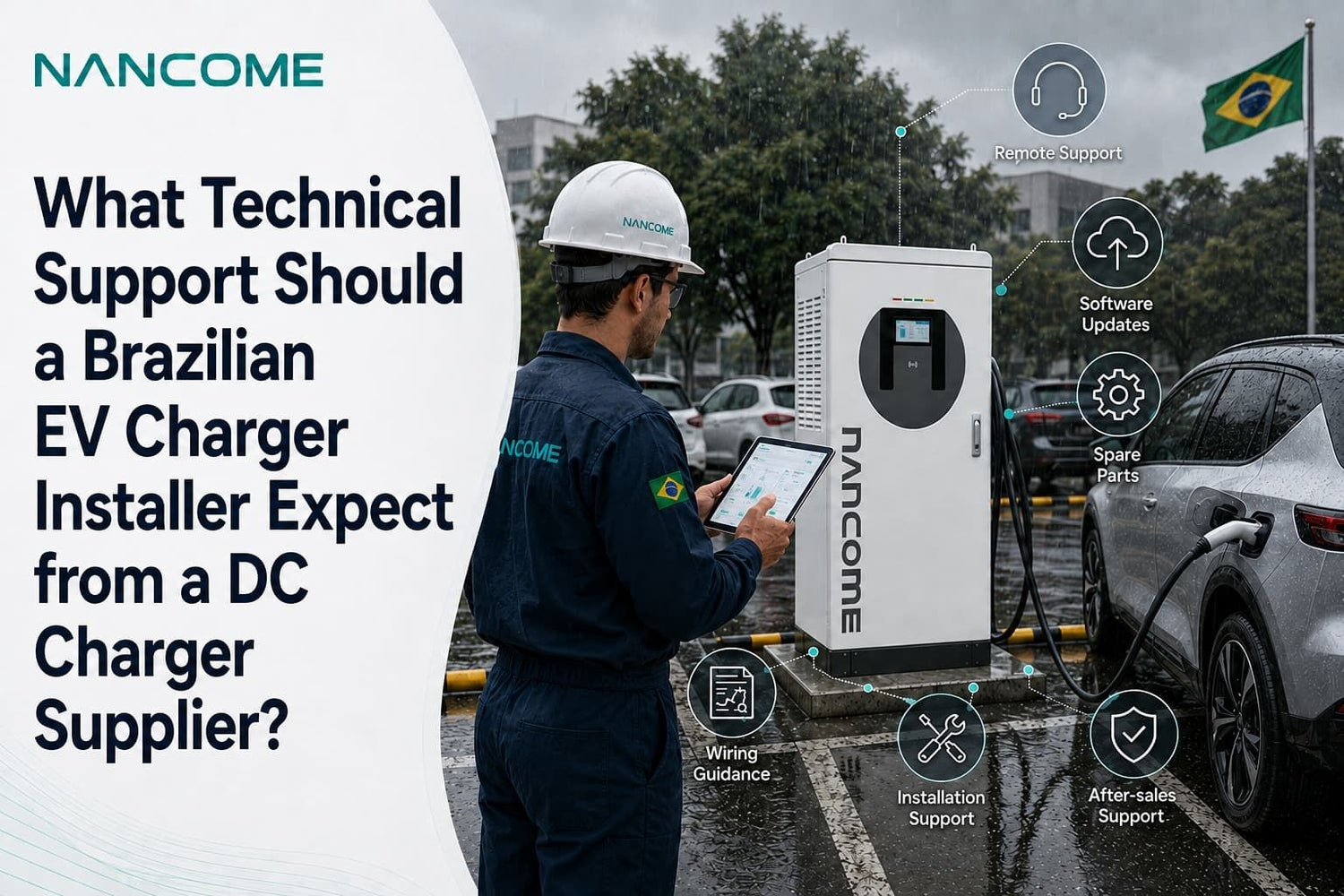
• NANCOME can support remote fault analysis, software updates, and technical guidance. Secure equipment access and the availability of a local technician reduce downtime.
11) Final checklist before energization
• Tightness, protection, grounding, insulation, phase sequence, and voltage verified by the installer.
• Cables, connectors, ventilation, and maintenance area clear.
• Network and OCPP configured; RFID and operating functions tested.
• A charging session with a compatible vehicle completed and data received by the platform.
• Documentation delivered to the operator and support responsibilities recorded.
Result:
Installing a DC charger begins long before energization. When usage, power supply, protection, civil work, connectivity, OCPP, and responsibilities are confirmed in advance, the project reduces rework and increases the likelihood of stable operation.

Leave a comment
All comments are moderated before being published.
This site is protected by hCaptcha and the hCaptcha Privacy Policy and Terms of Service apply.