
In 2025, Europe sold a total of 2,585,187 units of Battery Electric Vehicles (BEV). Compared with 1,992,803 units in 2024, full-year EV sales in Europe grew strongly by 29.7% in 2025. Following the record-breaking EV sales in 2025, the first quarter of 2026 continues to move toward the widespread adoption of electric vehicles.
In the first three months of 2026, Europe registered a total of 723,704 new Battery Electric Vehicles. Compared with the first quarter of 2025, this represents a 26.2% increase, when 573,439 electric vehicles were sold across the same 31 markets.
Among the 31 surveyed countries, only 4 experienced a decline at the beginning of the year.
What is the share of electric vehicles in Europe’s automotive market?
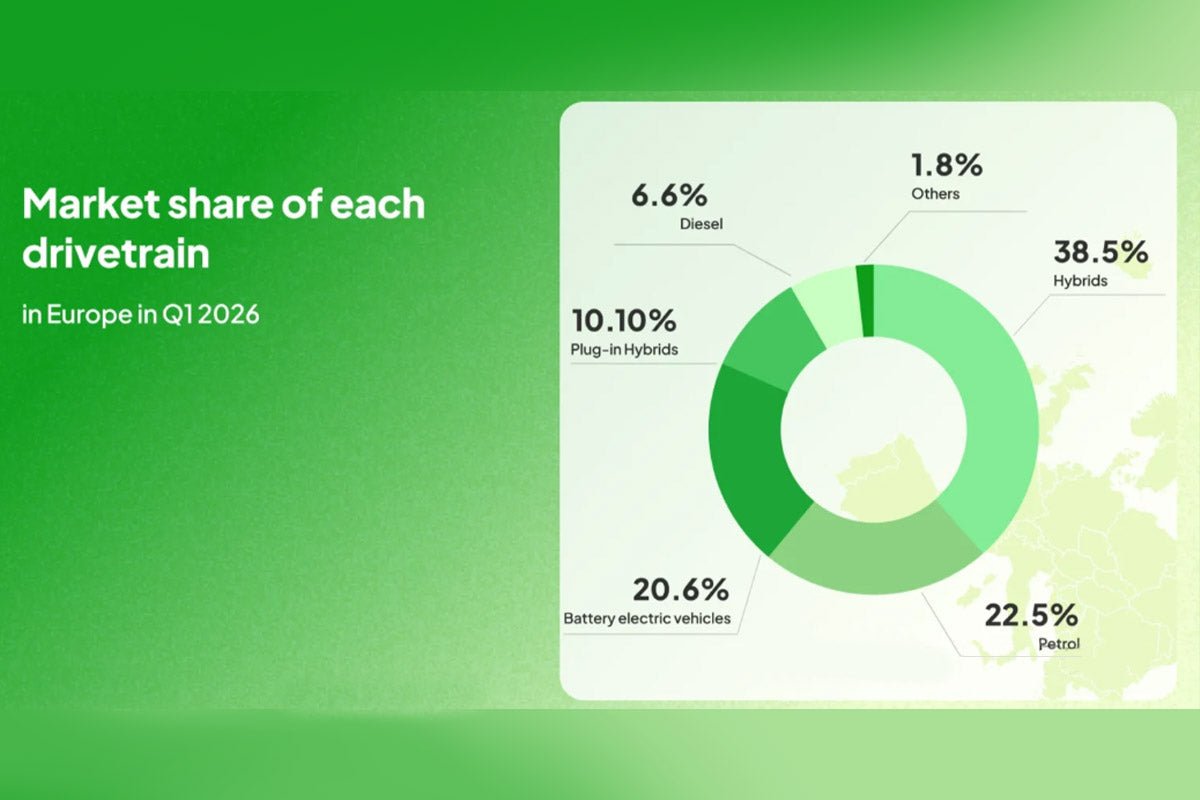
As of Q1 2026, the market share of Battery Electric Vehicles in Europe has reached 20.6%. This means that currently, one out of every five cars sold in Europe is a pure electric vehicle.
Currently, Battery Electric Vehicles in Europe have already significantly surpassed diesel vehicles in market share, while the gap with gasoline vehicles is rapidly narrowing.
One year ago, gasoline vehicles held a 28.7% share of the European market, while BEVs accounted for only 15.2%. Today, gasoline vehicles account for 22.5%, while BEVs have reached 20.6%.
The same trend is also reflected in EU BEV sales, which follow a similar structural shift pattern.
Germany, the United Kingdom, and France are the three leading countries in electric vehicle sales.
Germany, the United Kingdom, and France collectively registered 409,327 Battery Electric Vehicles (BEV) in Q1 2026. This accounts for 56.6% of all BEV sales in Europe in 2026, representing a 33.0% increase compared with Q1 2025.
Germany: In Q1 2026, electric vehicle sales reached 159,630 units, representing a 41.3% year-on-year growth. The market share of Battery Electric Vehicles increased from 17.0% to 22.8%.
Germany is the largest automotive market in Europe and also the country with the highest EV sales volume in Europe (by total units sold). After the turbulence caused by the end of environmental subsidies in late 2023, the recovery momentum that began in 2025 remained strong into 2026.
In Q1 2026, one out of every five cars sold in Germany was a Battery Electric Vehicle (BEV). With such a large market achieving 41.3% year-on-year growth, Germany has become one of the fastest-growing major EV markets in Europe.
United Kingdom: In Q1 2026, electric vehicle sales reached 137,614 units, representing a 14.5% year-on-year increase. The market share of electric vehicles rose from 20.7% to 22.4%.
Although this growth rate has slowed compared with the 23.9% full-year level in 2025, it is understandable given the already large base of the market.
In Q1 2026, nearly one out of every four cars sold in the United Kingdom was an electric vehicle.
France: In Q1 2026, electric vehicle sales reached 112,083 units, representing a 50.4% year-on-year growth. The market share of Battery Electric Vehicles rose sharply from 18.2% to 27.9%.
The environmental subsidy policy, reintroduced at the end of September 2025, clearly had a significant impact.
In a market of this scale, BEV share increased by 9.7 percentage points in Q1 2026. However, the overall French automotive market actually contracted by 2.1% during the same period.
In Q1 2026, nearly one out of every three new cars sold in France was a BEV.
Eight European countries now have an electric vehicle market share exceeding 30%.
Norway: In Q1 2026, electric vehicle sales reached 26,617 units, representing a 7.0% year-on-year decline. The market share of BEVs increased from 89.0% to 98.0%.
Norway’s EV market is essentially at its peak stage. With a BEV penetration rate as high as 98.0%, only 2 out of every 100 new cars sold in Norway are not BEVs.
A 7.0% decline in BEV sales does not necessarily indicate weakening demand. However, the overall Norwegian automotive market contracted by 15.5% year-on-year, meaning that sales across all vehicle types declined. Despite this, the share of electric vehicles continues to increase.
Denmark: In Q1 2026, electric vehicle sales reached 34,970 units, representing a 42.6% year-on-year increase. The market share of Battery Electric Vehicles rose sharply from 65.5% to 80.0%.
In Q1 2026, four out of every five new cars sold in Denmark were BEVs.
Finland: In Q1 2026, electric vehicle sales reached 8,063 units, representing a 43.0% year-on-year increase. The market share of Battery Electric Vehicles rose from 33.8% to 46.9%.
After a relatively stable 2024, Finland’s BEV market share increased by 13 percentage points within one year. Previously, in full-year 2025, BEV market share had already reached 37.2%.
In Q1 2026, nearly one out of every two new cars sold in Finland was a BEV.
Sweden: In Q1 2026, electric vehicle sales reached 25,235 units, representing a 20.6% year-on-year increase. The market share of Battery Electric Vehicles rose from 33.0% to 40.7%.
Sweden’s EV sales continue to grow, significantly outperforming the European average in 2026. Together with Denmark, Finland, and Norway, Sweden forms the Nordic EV market, where all four countries now have BEV market shares exceeding 40%.
It seems that the claim that “cold climates are not suitable for electric vehicles” does not hold up anymore.
Belgium: In Q1 2026, electric vehicle sales reached 39,469 units, representing a 2.3% year-on-year decline. The market share of Battery Electric Vehicles (BEV) rose from 33.4% to 34.7%.
BEV sales actually saw a slight decline, but because the overall Belgian automotive market contracted more sharply (-5.9%), the share of BEVs increased as a result. Therefore, this does not indicate weak BEV demand, but rather a broader slowdown in Belgium’s overall automotive market compared with Q1 2025. Belgium’s BEV sales remain significantly above the EU average.
Malta: In Q1 2026, electric vehicle sales reached 505 units, representing a 67.2% year-on-year increase. The market share of Battery Electric Vehicles (BEV) rose from 23.7% to 32.4%.
Although Malta’s absolute EV sales volume is relatively small compared with Europe overall, its adoption rate is quite high. After a difficult year in 2025, this small island nation rebounded strongly, increasing its BEV market share by nearly 9 percentage points in just one quarter, making it one of the top eight European countries in terms of EV penetration in 2026.
Iceland: In Q1 2026, electric vehicle sales reached 1,122 units, representing a 17.4% year-on-year increase. The market share of Battery Electric Vehicles (BEV) declined from 42.1% to 32.2%.
Among countries with EV penetration above 30%, Iceland is the only country where BEV market share actually declined, even though its sales volume remains above the European average in 2026.
While Europe’s BEV sales overall still grew by 17.4% in Q1 2026, the Icelandic automotive market expanded much faster overall, with total vehicle sales increasing by 53.4% year-on-year.
Netherlands: In Q1 2026, electric vehicle sales reached 24,869 units, representing a 23.3% year-on-year decline. The market share of Battery Electric Vehicles (BEV) fell from 35.5% to 30.5%.
The Netherlands has long been one of the earliest EV markets in Europe. However, in Q1 2026, BEV sales declined by nearly one quarter year-on-year, while the overall Dutch automotive market also contracted by 10.8%.
The BEV market share decreased by 4.9 percentage points within one year.
European countries with the highest electric vehicle sales growth in Q1 2026
Croatia: In Q1 2026, electric vehicle sales reached 780 units, representing a 282.4% year-on-year increase. The market share of Battery Electric Vehicles (BEV) rose from 1.3% to 4.6%.
Croatia ranks at the bottom in Europe in terms of both total EV sales volume and market share. However, it has now climbed to the top of Europe in EV sales growth rate, despite a very low base of only 204 units in Q1 2025.
Slovenia: In Q1 2026, electric vehicle sales reached 2,297 units, representing a 78.2% year-on-year increase. The market share of Battery Electric Vehicles rose from 8.8% to 13.9%.
Slovenia’s EV development has fluctuated over the years. In Q1 2026, the country’s EV market returned to a growth trajectory, with sales nearly doubling and BEV market share increasing by more than 5 percentage points.
Poland: In Q1 2026, electric vehicle sales reached 8,841 units, representing a 73.1% year-on-year increase. The market share of Battery Electric Vehicles rose from 3.6% to 5.8%.
Poland continued the strong momentum from 2025. Last year, EV sales more than tripled, with 161.5% full-year growth in 2025, making it the fastest-growing country in Europe. In Q1 2026, sales again increased by 73%.
Although BEV market share remains relatively low at 5.8%, the upward trend is very clear and aligns with the broader European EV growth trajectory in 2026.
Italy: In Q1 2026, electric vehicle sales reached 38,084 units, representing a 65.7% year-on-year increase. The market share of Battery Electric Vehicles rose from 5.2% to 7.9%.
Italy is the third-largest automotive market in Europe. In Q1 2026, BEV sales grew by 65.7%, and compared with the previous year, this translates into more than 15,000 additional BEVs on the road.
Lithuania: In Q1 2026, electric vehicle sales reached 758 units, representing a 56.3% year-on-year increase. The market share of Battery Electric Vehicles rose from 5.4% to 7.9%.
Like its Baltic neighbors, Lithuania’s EV development is still in an early stage.
Bulgaria: In Q1 2026, a total of 747 electric vehicles were sold, representing a 50.0% year-on-year increase. The market share of Battery Electric Vehicles rose from 4.3% to 6.5%.
Although Bulgaria’s market size remains relatively small in the context of European EV sales in 2026, the 50% year-on-year growth rate is steadily driving the expansion of its electric vehicle market.
Spain: In Q1 2026, electric vehicle sales reached 27,226 units, representing a 41.6% year-on-year increase. The market share of Battery Electric Vehicles rose from 6.9% to 9.1%.
Spain is the fifth-largest automotive market in Europe, and its EV sales continue to grow, making a significant contribution to Europe’s total EV volume in 2026.
A 41.6% increase means that, compared with the same period last year, approximately 8,000 additional BEVs have been added to Spain’s roads.
Ireland: In Q1 2026, electric vehicle sales reached 13,982 units, representing a 40.3% year-on-year increase. The market share of Battery Electric Vehicles rose from 15.4% to 21.5%.
In just one quarter, BEV market share increased by more than 6 percentage points. By Q1 2026, more than one in five cars sold in Ireland was a BEV, slightly above the European average level of electric vehicle sales.
Other European countries
Hungary: In Q1 2026, electric vehicle sales reached 3,192 units, representing a 32.6% year-on-year increase. The market share of Battery Electric Vehicles rose from 7.3% to 8.8%.
Hungary has consistently been one of the most stable EV growth markets in Central Europe. There are no dramatic fluctuations—only steady, continuous growth, with each quarter showing further expansion.
Portugal: In Q1 2026, electric vehicle sales reached 15,136 units, representing a 24.3% year-on-year increase. The market share of Battery Electric Vehicles rose from 20.8% to 23.6%.
In Q1 2026, nearly one out of every four new cars sold in Portugal was a BEV.
Regulatory policies introduced at the end of 2025 opened up the local charging market, which is expected to further support EV adoption throughout the rest of the year.
Slovakia: In Q1 2026, electric vehicle sales reached 1,014 units, representing a 22.0% year-on-year increase. The market share of Battery Electric Vehicles (BEV) rose from 4.1% to 5.1%.
Tesla officially entered the Slovak market at the beginning of 2025, and its presence is gradually starting to have an impact. However, compared with the European average, Slovakia’s EV market still has a long way to go.
Austria: In Q1 2026, electric vehicle sales reached 17,347 units, representing a 22.4% year-on-year increase. The market share of Battery Electric Vehicles rose from 21.5% to 22.5%.
Austria’s EV sales have maintained steady growth, and it is expected that by 2026, its BEV market share will be above the European average level.
Romania: In Q1 2026, electric vehicle sales reached 2,587 units, representing a 19.7% year-on-year increase. The market share of Battery Electric Vehicles rose from 6.4% to 9.5%.
After a decline in 2025, Romania has now reversed its downward trend. Last year, the sudden suspension of the Rabla Plus program suppressed electric vehicle sales.
Cyprus: In Q1 2026, electric vehicle sales reached 425 units, representing a 17.7% year-on-year increase. The market share of Battery Electric Vehicles rose from 8.1% to 11.6%.
In Q1 2026, one out of every ten cars sold in Cyprus was a BEV.
Estonia: In Q1 2026, electric vehicle sales reached 260 units, representing a 16.1% year-on-year increase. The market share of Battery Electric Vehicles fell from 10.6% to 6.1%.
Estonia stands out in the 2026 European EV sales landscape. Despite a 16.1% increase in EV sales, the overall automotive market grew by more than 100.4% year-on-year, causing BEV market share to drop significantly. This distortion is largely attributed to the introduction of a new vehicle tax in 2025, and conditions are expected to improve over the coming quarters.
Tesla officially entered the Estonian market on April 24, 2026. Given that the two most registered EV models in Estonia have historically been the Model 3 and Model Y, Tesla’s entry is expected to provide a boost to the market, as owners will no longer need to travel to Finland or Lithuania for vehicle servicing and maintenance.
Czech Republic: In Q1 2026, electric vehicle sales reached 3,439 units, representing a 10.5% year-on-year increase. The market share of Battery Electric Vehicles rose from 5.2% to 5.7%.
Economic growth in the Czech Republic has slowed significantly. After exceeding 70% growth in both 2023 and 2024, followed by 26.5% full-year growth in 2025, Q1 2026 growth has moderated to 10.5%.
BEV market share remains low at 5.7%, leaving significant room for future growth, although the pace of expansion has clearly slowed for the time being.
Switzerland: In Q1 2026, electric vehicle sales reached 11,414 units, representing a 6.3% year-on-year increase. The market share of Battery Electric Vehicles rose from 20.4% to 21.5%.
Switzerland continues in its usual manner—low-key and steady, with modest quarterly growth, consistently staying slightly above the European average (currently 20.6%).
Latvia: In Q1 2026, electric vehicle sales reached 323 units, representing a 9.9% year-on-year increase. The market share of Battery Electric Vehicles rose from 6.2% to 6.5%.
Like its Baltic neighbors, Latvia’s BEV market share remains below 10%.
Luxembourg: In Q1 2026, electric vehicle sales reached 3,381 units, representing a 9.4% year-on-year decline. The market share of Battery Electric Vehicles fell from 29.5% to 27.0%.
This quarter, there are several notable highlights in Europe’s electric vehicle sales:
•The three major economies are accelerating. In Q1 2026, total BEV sales in Germany, the United Kingdom, and France increased by 33.0% compared with Q1 2025. France recorded the largest increase among major markets, with its BEV market share jumping to 27.9%.
•Italy’s momentum is becoming more evident. As Europe’s third-largest automotive market, Italy saw BEV sales grow by 65.7%, while plug-in hybrid electric vehicle (PHEV) sales surged by 110.1%. This represents a genuine structural shift, and if the trend continues, it will significantly lift Europe’s average EV adoption rate.
•The Netherlands is worth attention. In what was previously a strong EV market, BEV sales declined by 23.3%. This is not merely a quarterly fluctuation, and the next developments will be worth monitoring.
•Nordic countries continue to expand their lead. Norway, Denmark, Finland, and Sweden all recorded BEV market shares above 40%, with Denmark reaching 80% and Norway approaching saturation at 98%. By 2026 and beyond, these markets are set to be among the first in Europe to complete a full EV transition, serving as pioneers of the broader electrification wave
In the 31 markets analyzed, only four recorded a decline in BEV sales in Q1 2026: Belgium (-2.3%), Norway (-7.0%), Luxembourg (-9.4%), and the Netherlands (-23.3%). All remaining 27 markets showed growth, with most experiencing rapid expansion.
Perhaps the direction of the electric vehicle transition is already consistent across the entire European continent: full electrification.


Leave a comment
All comments are moderated before being published.
This site is protected by hCaptcha and the hCaptcha Privacy Policy and Terms of Service apply.