
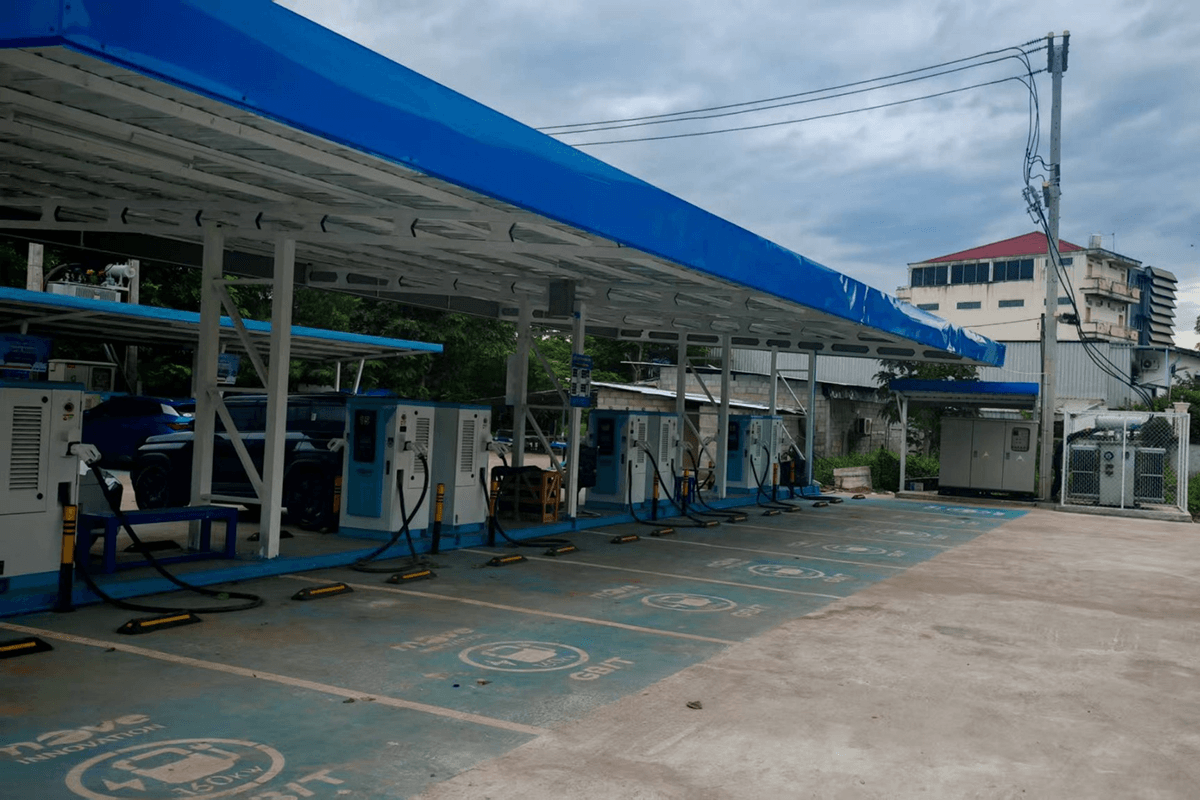
Successful charging sites are rarely “plug-and-play.” Even when the chargers are ready, the real work is coordinating space, cable routes, civil works, and safety clearances. In this project, the customer provided an EV charging station site plan, and our engineering team produced a charging station layout design based on a site plan—including DC fast charger installation positioning, parking bay layout, and cable trench routing—so the on-site contractor could build with fewer reworks.
Figure 1 | On-site photo of the installed charging station (reference image)
 Installed EV charging station with multiple DC fast chargers under a canopy.
Figure 2 | Engineering drawing derived from the customer’s site plan (layout + cable routing reference)
 EV charging station site plan showing charger positions, parking bays, and power cable trench routing.
1) Project background
The customer had already prepared the site and shared the EV charging station site plan with dimensions and parking layout. The key request was straightforward: confirm practical charger placement and provide an install-ready plan for construction—including charging pile foundation and civil works plan, power cable trench routing for EV chargers, and safe working clearances.
2) What we delivered (solution + drawings)
Based on the site plan, we produced a coordinated package that connected engineering intent to field execution:
• Charging equipment placement: DC fast charger installation positioning aligned with parking bay layout for DC fast charging and vehicle movement.
• Cable routing and trench guidance: power cable trench routing for EV chargers to minimize crossing paths and reduce civil work risk.
• Civil works references: charging pile foundation and civil works plan to help contractors set anchor points and conduits correctly.
• Electrical integration notes: guidance for power distribution cabinet for EV charging station and coordination with transformer and switchgear container for charging site.
• Commissioning readiness: documentation that supports as-built charging station commissioning support and future maintenance.
3) Why site-plan-based layout matters (less rework, faster opening)
In many international projects, delays come from “small” layout mistakes: a charger ends up too close to a curb, cables interfere with traffic flow, or the trench route conflicts with drainage. A charging station layout design based on a site plan helps prevent these issues early. It also makes it easier to estimate trench length, conduit needs, and the construction sequence—so the station can reach revenue operation sooner.
4) Operations-ready design: monitoring and long-term service
Beyond physical installation, commercial sites benefit from operational visibility. Where required by the operator, we can support OCPP remote monitoring for DC fast chargers to enable basic status monitoring, alarms, and session records (CSMS integration depends on the customer’s backend). For readers who want to understand the protocol ecosystem, Open Charge Alliance provides public OCPP resources (Reference [1]).
5) Standards and compliance references (country-specific, engineering-led)
Charging projects follow local inspection pathways, but most designs reference internationally recognized standards for conductive charging systems and electrical safety. For example, IEC 61851 conductive charging system standard is widely referenced for EV conductive charging requirements (Reference [2]). If the project involves grid-parallel interaction or distributed energy resources, IEEE 1547 interconnection guidance for DER is commonly referenced in many markets (Reference [3]).
6) What customers can request next (customization and drawing support)
For new charging sites, customers typically request one of the following extensions:
• Updated layout options for phased expansion (additional chargers, parking bay re-marking).
• Coordination drawings that link charger placement to the power distribution cabinet for EV charging station and the utility interconnection point.
• Optional branding and enclosure customization (paint, logo, signage) to match site identity.
• Preventive maintenance checklist aligned with as-built documentation and commissioning records.
Conclusion
This case shows a repeatable engineering workflow: start from a customer EV charging station site plan, deliver a coordinated layout drawing package, and support commissioning so the site can open with fewer surprises. For operators scaling across multiple locations, this “plan-to-install” approach often reduces civil rework, improves safety, and shortens the path to stable operation.
References (traceable)
[1] Open Charge Alliance – OCPP overview: https://openchargealliance.org/protocols/open-charge-point-protocol/
[2] IEC Webstore – IEC 61851-1 publication entry: https://webstore.iec.ch/en/publication/33644
[3] IEEE Standards Association – IEEE 1547-2018 overview: https://standards.ieee.org/standard/1547-2018/

Deixar comentário
Os comentários precisam ser aprovados antes da publicação.
Este site é protegido por hCaptcha e a Política de privacidade e os Termos de serviço do hCaptcha se aplicam.