
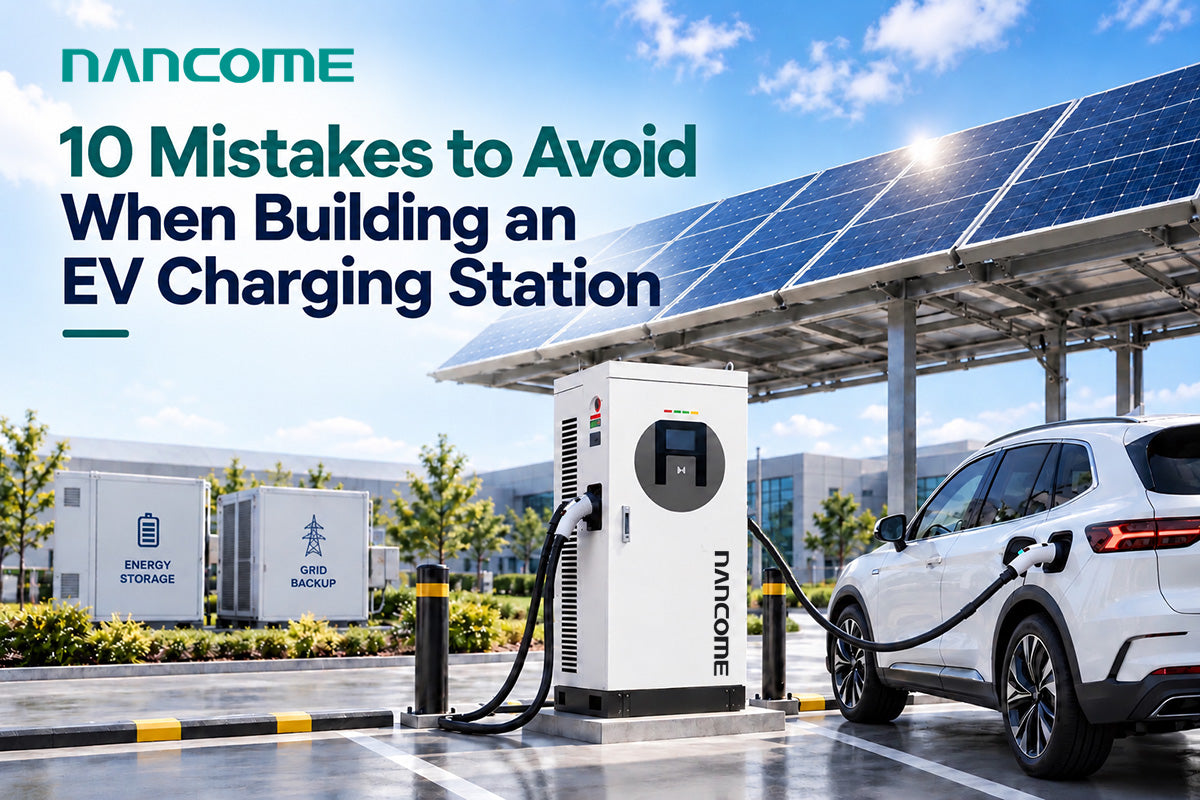
A 2026 commercial project guide covering grid capacity, charger power, civil works, safety, commissioning and long-term operating cost
A charging station succeeds when equipment, electricity, site design and daily operations are planned together.
Commercial EV Charging Project Snapshot - 2026
The global charging market is expanding, but building a commercial EV charging station has become more complex than choosing a charger and marking parking spaces. The International Energy Agency (IEA) reports that public charging points exceeded 7 million worldwide at the end of 2025, with the stock growing by more than 33% that year. Public charging is also getting faster: the average rated power of public charging points approached 50kW in 2025.
For project owners, faster charging brings new requirements for transformer capacity, cable routing, cooling, vehicle compatibility and site utilization. The U.S. Department of Energy also advises early utility engagement, while its charging-infrastructure guidance highlights installation, electricity costs and maintenance as part of the same investment decision.
- The ten mistakes below focus on avoidable project decisions, not isolated product faults.
- Each section explains the risk, the better decision and the information a B2B buyer should confirm.
- Examples are illustrative; final electrical design and local compliance require qualified professionals.
1. Buying Chargers Before Confirming Available Grid Capacity
What goes wrong: A buyer orders multiple DC fast chargers and later discovers that the existing utility connection, transformer or main distribution board cannot support the planned peak demand.
Why it matters: A late transformer upgrade can delay opening, increase civil-work costs and require changes to switchgear, protection and cable sizing. Even when the charger itself is ready, the station may not be.
How to avoid it: Request a site power assessment before confirming the charger configuration. Verify service voltage, existing peak demand, transformer spare capacity, utility upgrade requirements and connection lead time.
- Buyer question: How much usable charging power remains after existing site loads and an engineering margin?
2. Selecting the Highest kW Without Checking Vehicles and Dwell Time
What goes wrong: The project chooses 320kW or 480kW equipment simply because the nameplate power looks more competitive, without checking the target vehicles' charging curves or how long they normally park.
Why it matters: A vehicle may accept much less than the charger's maximum output, particularly at higher battery state of charge or unfavorable battery temperature. The IEA notes that ultra-fast chargers above 250kW are expanding, but the number of car models able to use such speeds remains limited.
How to avoid it: Match charging power to vehicle acceptance, target energy per visit, dwell time and expected traffic. A 60kW or 120kW DC fast charger may be adequate for some sites; a 180kW or 240kW DC fast charger may be more appropriate for higher turnover. Use 320-480kW where the business case and vehicle mix justify it.
- Buyer question: What percentage of actual sessions will benefit from the higher-power tier?
3. Ignoring Simultaneous Charging and Peak-Hour Demand
What goes wrong: The designer adds charger nameplate power or assumes every charger will be fully loaded, without modeling actual arrival patterns, simultaneous sessions and any load-sharing strategy.
Why it matters: Both underestimating and overestimating the coincident peak can be expensive. Underestimation risks overload and service restrictions; overestimation can trigger unnecessary transformer and grid investment.
How to avoid it: Build an hourly load profile for the busiest realistic day. For fleets, include route return times, required kWh and departure deadlines. Evaluate dynamic load management only where charging schedules and service expectations allow it.
Illustrative Peak-Load Calculation
Suppose a commercial site plans four 180kW DC chargers. Total installed output is 720kW. If an engineering study supports an illustrative 65% coincident output assumption, peak charging output would be about 468kW. At 95% charger efficiency, that is about 493kW of charger AC input. Add 35kW of coincident building and auxiliary load: total active demand is approximately 528kW. At an illustrative aggregate power factor of 0.98, apparent demand is about 538kVA before reserve, derating or future expansion.
This example is not a recommendation to use a particular transformer size or coincidence factor. The final design must use real load data, actual charger specifications and the local utility's rules.
4. Underbudgeting Transformer, Distribution and Civil Works
What goes wrong: The project budget covers charger cabinets but misses transformer work, distribution cabinets, switchgear, protection, underground cables, trenching, foundations, bollards, drainage, signage or installation labor.
Why it matters: The charger purchase price is only one part of EV charging station cost. Utility connection work and civil construction can materially affect the schedule and return on investment.
How to avoid it: Prepare a bill of quantities and site-specific installed-cost estimate before ordering. Keep separate allowances for utility approvals, electrical engineering, commissioning and future expansion.
| Cost group | Items buyers often overlook | Early-stage action |
|---|---|---|
| Utility / transformer | Connection application, transformer upgrade, metering | Request utility feasibility and lead-time confirmation |
| Distribution / protection | Switchgear, breakers, earthing, surge protection | Review one-line diagram and fault/protection studies |
| Civil works | Trenching, concrete, drainage, canopy, bollards | Verify drawings and actual site quantities |
| Operations | Connectivity, maintenance, spares, site staffing | Build a multi-year operating budget |
5. Choosing a Site Layout That Looks Good but Operates Poorly
What goes wrong: Charging cabinets are placed without checking vehicle turning radius, cable reach, accessible routes, heavy-vehicle parking geometry, emergency access or the path of underground services.
Why it matters: A charger can be electrically correct but inconvenient or unsafe to use. Long cable runs can also increase installation cost and voltage-drop concerns.
How to avoid it: Test the layout against real vehicle dimensions and charging-port positions. Consider front-in versus reverse parking, dual-gun cable paths, pedestrian separation, service clearance, drainage and future charger locations.
- Buyer question: Can the largest target vehicle reach a usable connector without blocking another bay or creating a cable hazard?
6. Assuming One Connector, Voltage or Approval Fits Every Market
What goes wrong: An overseas project copies a specification from another country without checking vehicle connector standards, supply voltage, local electrical codes, certification requirements or utility practices.
Why it matters: Equipment that fits one market may need a different connector, labeling, input arrangement or conformity documentation elsewhere. Europe, Brazil, the Middle East and Central Asia should not be treated as identical markets.
How to avoid it: Confirm the target country and vehicle fleet first. Specify CCS2, CCS1, GB/T or CHAdeMO only where relevant to the actual product and market. Request applicable test reports and approvals for the exact model and destination, rather than assuming a logo or standard is universal.
For example, the EU Alternative Fuels Infrastructure Regulation (AFIR) sets specific public charging requirements for defined parts of the TEN-T road network. Those corridor obligations are not a universal requirement for every private charging site or every country.
7. Neglecting Grounding, Protection, Cooling and Weather Exposure
What goes wrong: The installer focuses on connecting the input cable while overlooking protection coordination, grounding/earthing, cable-entry sealing, ventilation clearances, heat rejection and environmental conditions.
Why it matters: High-power DC equipment produces significant heat and depends on correct electrical protection. Poor ventilation, dust, water ingress or incorrect upstream protection can undermine reliability and safety.
How to avoid it: Confirm the electrical single-line diagram, grounding system, protective devices, cable ratings and installation clearances. Match enclosure protection and cooling requirements to actual site conditions, including temperature, humidity, dust and altitude.
- Buyer question: Has the installation design been reviewed against the manufacturer's instructions and applicable local electrical standards?
8. Treating Battery Storage as an Automatic Substitute for Grid Upgrades
What goes wrong: A grid-constrained project adds a battery system without calculating peak discharge power, usable kWh, recharge time, daily cycles or the number of back-to-back charging sessions.
Why it matters: Storage can support short charging peaks, but it does not create energy. A battery that is not recharged between events cannot sustain repeated high-power sessions indefinitely.
How to avoid it: Compare three options: grid upgrade, lower or managed charger power, and battery-buffered EV charging. Size storage in both kW and kWh and test the full operating day, including battery reserve, efficiency and aging.
NANCOME's mobile energy storage charging systems and power-distribution engineering capability are relevant where temporary deployment or grid-constrained charging makes a storage-assisted solution worth evaluating. Storage should still be selected only when the project economics and duty cycle support it.
9. Skipping Factory Acceptance, Site Testing and Real-Vehicle Commissioning
What goes wrong: The project considers installation complete once the cabinet powers on, without testing charging performance, emergency stop, protection functions, connector behavior, site communications, user access and actual target vehicles.
Why it matters: A charger may look operational while failing under real vehicle load or peak site conditions. Unclear handover documents make later troubleshooting and warranty discussions harder.
How to avoid it: Agree on factory acceptance tests (FAT), site acceptance tests (SAT), commissioning records and responsibilities before shipment. Where practical, test representative vehicles and simultaneous charging scenarios at the site.
| Acceptance stage | Minimum practical evidence |
|---|---|
| Before shipment / FAT | Correct model, power, connector, labels, configuration, safety and functional test records |
| Installation inspection | Electrical connections, grounding, protection, cable sealing, clearances, signage |
| SAT / real-vehicle test | Charging start/stop, delivered power, alarms, emergency stop, concurrent use |
| Handover | As-built drawings, serial numbers, manuals, training, warranty and support contacts |
10. Planning the Opening Date but Not Long-Term Operations
What goes wrong: The business plan ends at commissioning and does not define charger utilization, electricity tariffs, demand charges, preventive maintenance, spare parts, fault response or expansion triggers.
Why it matters: The U.S. Department of Energy's Alternative Fuels Data Center highlights electricity costs, maintenance responsibilities and utilization data as core operating considerations. A high-power station with low use or slow repairs can produce weak returns even if installation was successful.
How to avoid it: Define uptime and response expectations in service contracts. Track energy delivered, session success, utilization, fault history and maintenance cost. Reserve local critical spares where long international delivery times could extend downtime.
- Buyer question: Who owns the repair process, how quickly can a technician respond, and how will charger utilization be measured?
Quick Reference: 10 Mistakes and Their Prevention
| No. | Mistake | Better decision |
|---|---|---|
| 1 | Order chargers before utility study | Confirm usable site power and upgrade timeline |
| 2 | Choose kW from the catalogue alone | Match power to vehicles, dwell and traffic |
| 3 | Ignore simultaneous demand | Model peak-hour load and scheduling |
| 4 | Budget only for hardware | Estimate complete installed cost |
| 5 | Ignore real vehicle circulation | Validate bay geometry and cable reach |
| 6 | Copy standards across countries | Check local connectors, voltage and compliance |
| 7 | Underdesign protection and cooling | Review site electrical and environmental conditions |
| 8 | Assume storage replaces the grid | Calculate BESS power, energy and recharge window |
| 9 | Skip real-world commissioning | Document FAT, SAT and vehicle tests |
| 10 | Forget operations after opening | Plan maintenance, spares, utilization and support |
How NANCOME Helps Avoid These Project Mistakes
NANCOME approaches commercial EV charging projects through four connected capabilities rather than treating a charging station as an isolated hardware purchase:
- Intelligent EV charging equipment manufacturing - commercial AC chargers, floor-standing DC fast chargers, portable DC equipment and mobile energy-storage charging systems for public, fleet, parking and temporary charging applications.
- Electrical-engineering manufacturing foundation - experience dating to 1992 in power distribution equipment, protection design, thermal management and system safety.
- Project-oriented charging solution support - discussions covering site power, charger power, transformer/distribution coordination, vehicle connectors, installation conditions and deployment planning before equipment delivery.
- Flexible manufacturing and customization - power configuration, connector type, language, communication features, branding and installation method can be evaluated for the target market and verified model.
For buyers considering 40-480kW DC fast charging configurations, the goal is to align equipment selection with the real site load and operating profile. For grid-limited projects, NANCOME can also discuss mobile energy-storage charging or staged deployment as alternatives to immediate overbuilding.
Pre-Purchase Checklist for Commercial EV Charging Projects
- Confirm country, site application and target vehicle connector/voltage requirements.
- Collect actual site input voltage, utility service conditions and transformer spare capacity.
- Estimate daily energy demand, busiest-hour sessions and simultaneous charging load.
- Select charger power from vehicle acceptance and required dwell time, not nameplate power alone.
- Prepare civil layout, cable route, parking geometry and service-access drawings.
- Include transformer, distribution, protection, civil works, commissioning and contingency in the budget.
- Verify site climate, cooling, enclosure and installation requirements.
- Compare load management, storage buffering and utility upgrade options where grid capacity is limited.
- Agree on factory tests, site acceptance tests and representative vehicle trials.
- Define maintenance ownership, spare-parts strategy, response times and expansion triggers.
Result
The most expensive EV charging station construction mistakes often happen before the first charger is installed. A poor site power assumption, mismatched charger power, missing civil works, unsuitable layout or weak commissioning plan can turn an otherwise viable commercial project into a delayed and costly one.
In 2026, faster public charging and growing fleet electrification make integrated planning even more important. The right charging station is not necessarily the one with the highest installed kW. It is the station that can reliably deliver the required energy, fit the available grid, serve the target vehicles and support a sustainable operating model.
NANCOME's combination of EV charging equipment manufacturing, electrical-engineering experience and project-oriented configuration support helps overseas buyers address these questions before procurement.
Build around the site and its users - then choose the charger.

Deixar comentário
Os comentários precisam ser aprovados antes da publicação.
Este site é protegido por hCaptcha e a Política de privacidade e os Termos de serviço do hCaptcha se aplicam.