
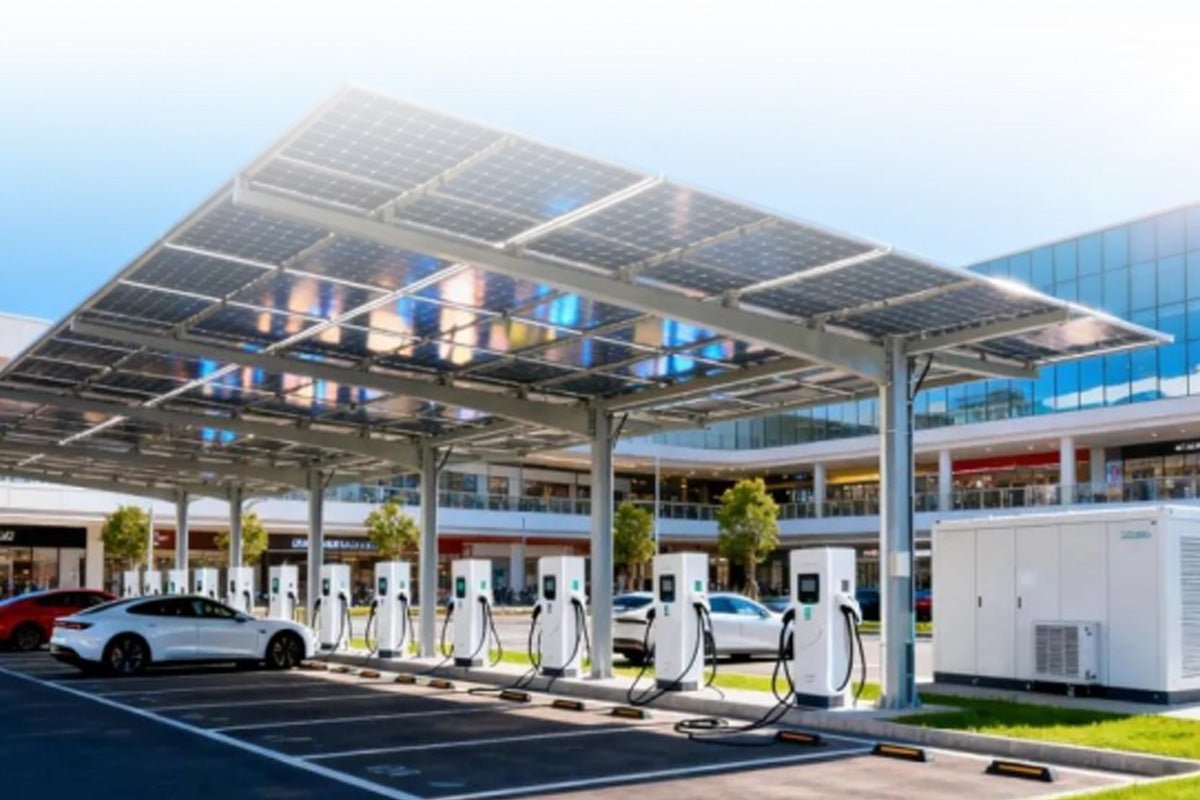
The Solar-Storage-Charging Integrated Charging Station is a smart charging station that integrates photovoltaic power generation, energy storage systems, and electric vehicle (EV) charging and discharging. It features three core advantages: on-site consumption of renewable energy, ultra-fast charging, and intelligent energy dispatch.
At present, traditional electric vehicle charging stations commonly face two major pain points: land resource constraints and limited access to the power grid. In contrast, the Solar-Storage-Charging Integrated Charging Station model can resolve challenges in distribution grid expansion and grid access under conditions of limited land and grid capacity. Furthermore, by leveraging energy storage peak-shaving and intelligent energy optimization, it enables local balance between renewable energy generation and electricity demand, achieving efficient self-sufficiency.
“Solar-Storage-Charging” Solution Value
01 Smoothing Load Fluctuations
The energy storage system can effectively smooth the impact load generated by high-power charging at charging stations, balance instantaneous grid load, and reasonably reduce the design capacity of the AC distribution system. It also helps fundamentally address key operational pain points such as transformer overload saturation and frequent capacity expansion and upgrades in charging station operations.
02 Reducing Charging Costs
By integrating energy storage and photovoltaic power generation systems, the solution fully leverages time-of-use electricity price differentials for peak-valley arbitrage, while maximizing the self-consumption rate of photovoltaic power. This reduces reliance on grid electricity and provides a dual boost to effectively lower the daily operating electricity costs of charging stations, achieving both cost reduction and efficiency improvement.
“Solar-Storage-Charging Integrated” Charging Solution
Characteristics of the Solution
The energy storage battery system is directly connected to the DC bus, significantly improving overall operational efficiency.
The DC bus centrally aggregates photovoltaic power, energy storage, and charging units, enabling efficient coordinated energy management and control of the entire system.
The utilization rate of photovoltaic energy is significantly improved, enabling real-time consumption and storage of surplus electricity, maximizing the absorption of clean energy.
For scenarios with insufficient distribution capacity, the system relies on energy storage to achieve dynamic capacity expansion, allowing it to support higher-power charging loads.
Each power conversion stage adopts a multi-module parallel architecture, ensuring strong system stability and efficient operation and maintenance.
Operating Strategy
During peak charging periods: the power grid, photovoltaic system, and energy storage batteries jointly supply energy for vehicle charging.
During idle charging intervals: the power grid and photovoltaic system charge and store energy in the energy storage batteries.
During nighttime off-peak periods: the power grid simultaneously charges both vehicles and energy storage systems, fully absorbing photovoltaic energy.
In the event of power grid anomalies: the energy storage system ensures stable power supply for the charging station.
Charging Station BOM Composition
01 Cooperation Model and Revenue Sharing
Party A: land/property owner, responsible for providing the site.
Party B: investor, responsible for investment, construction, and operation.
The common cooperation models are typically divided into two types: “ fixed rent (fixed monthly rent)” and “revenue sharing (sharing station revenue with Party A based on a percentage)”.
02 Net Income from Management Service Fees
Net income = total revenue of the charging station − operating costs.
Total revenue = electricity fees charged to users + total service fees.
Operating costs = electricity fees paid to the power supply bureau + online and offline operational expenses + platform traffic acquisition fees.

Оставить комментарий
Все комментарии перед публикацией проверяются.
Этот веб-сайт защищается hCaptcha. Применяются Политика конфиденциальности и Условия использования hCaptcha.