
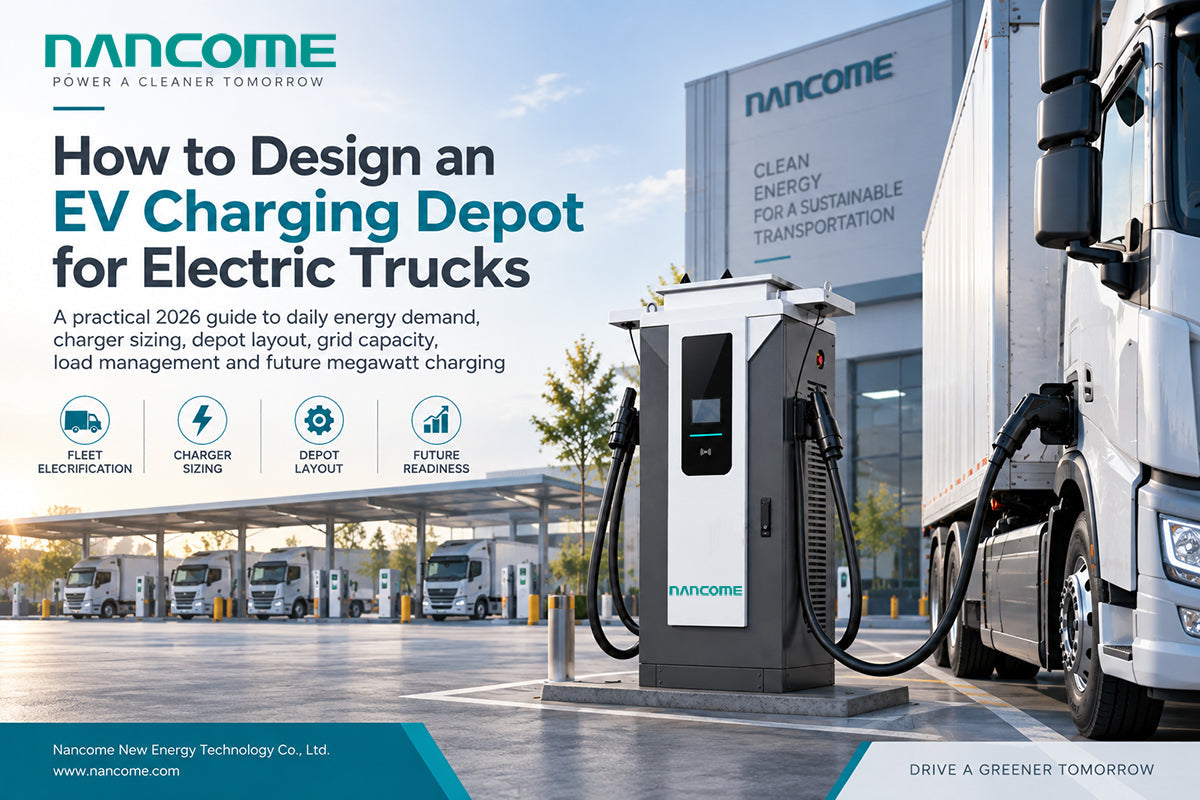
A practical 2026 guide to daily energy demand, charger sizing, depot layout, grid capacity, load management and future megawatt charging
Electric Truck & Fleet Charging Snapshot - 2026
Electric truck electrification is moving from pilot projects toward commercial deployment. According to the IEA Global EV Outlook 2026, global electric truck sales more than doubled in 2025 and reached about 9% of worldwide truck sales. Growth remains strongest in China, while Europe and North America are also expanding from a smaller base.
For charging infrastructure, the most important trend is not simply higher charger power. The IEA notes that depot charging remains the backbone of heavy-duty vehicle electrification because many trucks return to predictable bases and can charge during scheduled dwell periods. At the same time, public and en-route charging suitable for heavy-duty vehicles is expanding to support longer-distance operations.
For fleet operators, logistics companies, bus depots, ports, industrial parks and EPC contractors, this changes the planning question from “Which charger should we buy?” to “How should the entire electric truck charging depot be designed around vehicle operation, available power and future growth?”
| For heavy-duty fleets, the charging depot should be designed around the operating schedule first - charger power comes second. |
|---|
1. Start With Fleet Operations, Not Charger Power
A practical fleet EV charging solution begins with the vehicles and their daily work. Buying the highest-power charger first can lead to unnecessary grid upgrades, poor charger utilization or a site layout that does not match truck movements.
Before selecting equipment, collect at least five operating inputs:
- Number of electric trucks or buses in the current phase and the planned fleet size.
- Average and maximum daily driving distance for each vehicle group.
- Vehicle battery capacity and typical energy consumption per kilometre.
- Time each vehicle returns to the depot and the required departure time.
- How many vehicles may need to charge at the same time.
These inputs determine whether a depot can rely mainly on lower-power overnight charging, needs higher-power opportunity charging, or should combine both strategies.
2. Calculate Daily Energy Before Calculating Charger Quantity
The first useful calculation is daily energy demand. A simple planning formula is:
| Daily depot energy demand (kWh) = Number of vehicles x Average daily distance x Average energy consumption per km |
|---|
For example, a fleet of 20 electric trucks travelling an average of 180 km per day at an assumed 1.2 kWh/km would require approximately 4,320 kWh of traction energy per day before charging losses and reserve margins are considered. This is an illustrative planning example, not a universal truck-consumption value.
The next step is to distribute this energy across the available charging window. If most vehicles return between 18:00 and 20:00 and must leave before 06:00, the depot has a very different load profile from a fleet whose vehicles rotate through the site throughout the day.
This is why the planning document provided for NANCOME correctly prioritizes daily replenishment energy, parking duration, simultaneous charging quantity, distribution capacity and operational continuity for electric truck and fleet content.
3. Match Charger Power to Dwell Time and Vehicle Acceptance
A truck does not automatically charge at the full rated power of the charger. Actual charging power depends on the vehicle battery, state of charge, temperature, charging curve, connector and communication compatibility, and site-side power availability.
For many depot applications, a mix of charger power levels can be more practical than installing the same high-power charger at every bay.
| Charging Role | Typical Planning Power | Where It Fits |
|---|---|---|
| Long overnight dwell | 60-120kW | Vehicles parked for many hours; lower peak demand and easier grid integration. |
| Faster depot turnaround | 120-240kW | Logistics fleets, buses or trucks with shorter dwell windows and larger daily energy needs. |
| High-power opportunity charging | 350kW and above | Selected vehicles and operational windows where faster turnaround justifies higher site power. |
| Megawatt charging | MCS / 1MW-class and above | Emerging long-haul and very high-energy use cases; requires compatible vehicles, connectors and major site infrastructure. |
NANCOME can connect current project demand to its existing DC charging range, including 60kW DC fast charger, 120kW DC fast charger, 180kW DC fast charger and 240kW DC fast charger configurations. For MCS and megawatt charging system topics, the current market should be discussed as an industry trend unless a specific NANCOME project configuration has been technically confirmed.
4. How Many DC Chargers Does an Electric Fleet Need?
Charger count should not simply equal vehicle count. The correct number depends on energy demand, available charging time, charger sharing, vehicle arrival patterns and the required operating reserve.
A useful first-pass relationship is:
| Required average charging power = Total energy to replenish / Effective charging window |
|---|
Then the project team can test different combinations of charger power and simultaneous charging. For example, a depot may compare eight 60kW charging points, four 120kW points or a smaller number of higher-power chargers with scheduled vehicle rotation. The best option is the one that meets departure requirements without creating unnecessary peak demand or operational bottlenecks.
For mission-critical fleets, charger redundancy also matters. Designing every vehicle around a single charging point can create an operational risk if that charger is unavailable. A practical design considers spare charging capacity, maintenance access and the ability to reassign vehicles.
5. Fleet Charging Load Management Can Reduce Grid Pressure
One of the biggest challenges in a large electric truck charging depot is simultaneous demand. If ten 240kW chargers all operate at full power, the theoretical charger load alone could reach 2.4 MW before other site loads and system losses are considered.
However, every vehicle may not need maximum power at the same moment. Fleet charging load management can allocate available power according to departure priority, state of charge, vehicle schedule and site capacity.
The IEA reports that, in some depot cases, shifting part of the charging load to daytime or off-peak periods can reduce maximum depot power demand by up to 60%. The exact saving is project-specific, but the principle is important: intelligent scheduling can sometimes reduce the size or urgency of grid upgrades.
Dynamic load balancing should therefore be considered together with transformer capacity, feeder design, protection coordination and the fleet schedule - not treated as a software feature added at the end.
6. Grid Capacity Can Become the Real Project Bottleneck
Electric trucks carry large batteries, and fleet depots concentrate charging demand in one location. Even when individual chargers are commercially available, the local transformer, utility connection or upstream distribution network may not be ready for the required peak load.
Before finalizing a DC charger for logistics fleet project, the EPC team should verify:
- Existing transformer capacity and spare capacity.
- Utility connection limit and expected upgrade timeline.
- Other building, warehouse or industrial loads sharing the same connection.
- Cable route, switchgear, protection and voltage-drop requirements.
- Future fleet expansion and the possibility of adding higher-power chargers later.
This is where NANCOME’s electrical-engineering manufacturing background becomes relevant. With experience in power distribution equipment as well as EV charging, NANCOME can discuss the charger as part of the wider electrical system rather than as isolated hardware.
7. When Battery-Buffered EV Charging Makes Sense
Battery-buffered EV charging is becoming more relevant where the desired charging output is higher than the grid can conveniently provide. Instead of requiring the grid to supply every charging peak directly, a battery energy storage system can charge at a lower or controlled rate and support the charger during high-demand periods.
For an EV charging solution for grid-constrained sites, this can help in several situations:
- The utility connection is limited or an upgrade will take a long time.
- The fleet needs short periods of high charging power but not continuous peak power.
- A temporary depot or project site does not justify permanent electrical construction.
- The operator wants to combine charging with on-site solar or other energy resources.
- A phased fleet rollout needs charging capacity before the final grid upgrade is completed.
NANCOME’s mobile energy storage charging systems and distribution capabilities make this a differentiated content and project direction. However, battery sizing must be based on the actual energy deficit, charging schedule, recharge opportunity and required power - not only on the charger’s nameplate kW.
8. Depot Layout Matters as Much as Electrical Capacity
Heavy-duty vehicles need more space than passenger cars. A depot designed around car-charging geometry can create cable reach problems, blocked lanes, difficult reversing and unsafe interactions between trucks, people and charging equipment.
A truck depot layout should consider:
- Vehicle length, trailer configuration and turning radius.
- Drive-through versus reverse-in charging bays.
- Charging inlet position on the vehicle.
- Cable reach and cable-management method.
- Protection of chargers from vehicle impact.
- Pedestrian routes and emergency access.
- Drainage, ventilation and environmental conditions.
- Space for switchgear, transformer, BESS and future charger expansion.
For public or semi-public heavy-duty charging, truck-accessible geometry is especially important. IEA analysis shows that only a small share of conventional public charging sites can physically accommodate heavy-duty vehicles, illustrating why site design cannot be copied directly from passenger-car charging stations.
9. Depot Charging and En-Route Charging Serve Different Jobs
The current market is developing two complementary charging models for electric trucks.
| Model | Primary Purpose | Planning Priority |
|---|---|---|
| Depot charging | Replenish vehicles while parked at their base | Lower energy cost, predictable scheduling, fleet load management and reliable overnight readiness. |
| Opportunity / terminal charging | Add energy during operational pauses | Short dwell time, higher charger power and vehicle scheduling. |
| Public / corridor charging | Support long-distance and flexible routes | Truck-accessible layout, high-power charging, interoperability and dependable uptime. |
| Mobile / temporary charging | Bridge infrastructure gaps or support special operations | Flexible deployment, available stored energy and controlled recharge strategy. |
IEA projects that depot charging will continue to dominate the number of heavy-duty charging points through 2035, while public en-route charging becomes increasingly important for long-distance trucks. This means fleet operators should not view public charging as a replacement for depot planning; in many cases it is a complementary layer.
10. MCS Is Important - But It Should Not Be Overpromised
The megawatt charging system is one of the most important technology trends for heavy-duty transport. CharIN positions MCS as a high-power charging solution for large battery vehicles, and IEC TS 63379 was officially published in 2026 for conductive DC charging connectors, vehicle inlets and cable assemblies at megawatt power levels.
At the same time, deployment is still developing. ICCT reported that only four operational MCS charging points had been identified across Europe by June 2026, even as conventional high-power truck charging infrastructure continued to expand.
For buyers, the practical conclusion is not that every depot needs 1 MW charging immediately. A better approach is to evaluate current vehicle acceptance, duty cycles and grid conditions, while reserving electrical space, cable routes and site layout for future high-power expansion where justified.
| Future-proofing a truck depot does not mean installing maximum power today. It means avoiding design decisions that make tomorrow’s expansion unnecessarily difficult. |
|---|
11. Communication, OCPP and Fleet Operations
A networked fleet depot often needs more than charger hardware. Operators may need charger status, session records, remote diagnostics, access control, load-management logic and integration with a fleet or charging-management platform.
OCPP can provide a communication framework between compatible chargers and backend systems, but OCPP itself is not the same as a fleet app, payment system or complete energy-management platform. Project requirements should define which functions are provided by the charger, which are provided by the backend, and which require third-party integration.
Depending on the model and project configuration, NANCOME can evaluate OCPP 1.6J or OCPP 2.0.1 requirements and support communication integration. Functional scope and interoperability should be confirmed during project definition and testing.
12. A Practical Electric Truck Depot Planning Workflow
| Step | Key Question | Output |
|---|---|---|
| 1. Fleet profile | How many vehicles, how far do they drive, and when do they return? | Daily energy demand and charging windows |
| 2. Vehicle compatibility | What DC power and connector can each vehicle accept? | Usable charger power range |
| 3. Charging strategy | Overnight, opportunity, en-route or mixed? | Charging operating model |
| 4. Power study | How much grid and transformer capacity is available? | Maximum site power budget |
| 5. Charger mix | How many 60/120/180/240kW points are needed? | Equipment configuration |
| 6. Load management | Can charging be scheduled or dynamically allocated? | Peak-demand strategy |
| 7. Layout | Can trucks enter, charge and leave safely? | Civil and parking plan |
| 8. Grid-gap solution | Is BESS or mobile charging needed? | Battery-buffered / temporary option |
| 9. Communication | What backend and operational data are required? | OCPP / platform integration scope |
| 10. Expansion | What happens when the fleet doubles? | Reserved capacity and phased roadmap |
13. Where NANCOME Fits in an Electric Truck & Fleet Project
Intelligent EV Charging Equipment Manufacturer
NANCOME manufactures commercial DC fast charging equipment across multiple power levels, as well as AC charging, portable DC charging and mobile energy storage charging systems. For truck and fleet projects, this allows charger selection to be matched to dwell time, vehicle acceptance and site capacity rather than forcing every application into one power level.
Electrical Engineering Manufacturing Foundation
Since 1992, NANCOME has accumulated experience in electrical manufacturing and distribution equipment. That foundation supports project discussions around switchgear, protection, power distribution, thermal management and system safety - issues that become more important as fleet charging loads increase.
Project-Oriented Charging Solution Partner
A fleet charging project is a system decision. NANCOME can support evaluation of site power conditions, charging power selection, protection coordination, communication integration and deployment planning before equipment delivery.
Flexible Manufacturing and Customization
Different export markets may require different connector standards, languages, communication configurations, branding and installation methods. NANCOME can evaluate CCS1, CCS2, GB/T or CHAdeMO configurations according to the target market and product model, while avoiding unsupported claims about standards or functions that have not been confirmed for the project.
14. Procurement Checklist for Fleet Operators, EPCs and Logistics Companies
- Define current and 3-5 year fleet size.
- Provide vehicle battery capacity, connector and maximum DC charging acceptance.
- Provide daily mileage and return/departure schedule by vehicle group.
- Confirm existing transformer and utility connection capacity.
- Define the maximum number of simultaneous charging sessions.
- Compare 60kW, 120kW, 180kW and 240kW charging against real dwell time.
- Evaluate dynamic load balancing before assuming every charger runs at full power simultaneously.
- Assess whether battery-buffered EV charging can solve a temporary or structural grid constraint.
- Reserve truck turning space, cable reach and maintenance access in the layout.
- Define OCPP/backend responsibilities and testing requirements before shipment.
- Plan redundancy, spare parts and maintenance procedures for operational continuity.
- Reserve space and electrical pathways for future high-power or MCS expansion where the business case supports it.
Result
Electric truck charging is becoming a major new infrastructure category, but successful projects will not be defined by charger power alone. The depot must connect vehicle operation, daily energy demand, dwell time, grid capacity, charger quantity, load management, site layout and future expansion into one coordinated plan.
The strongest fleet EV charging solution is therefore not necessarily the one with the most chargers or the highest kW rating. It is the one that reliably returns every required vehicle to service on time while controlling electrical investment and leaving a practical path for growth.
For NANCOME, this is where charging equipment manufacturing, mobile energy storage, power distribution experience and project-oriented engineering can work together. From a 60kW DC fast charger for long dwell periods to 240kW DC fast charger configurations for faster fleet turnaround, and from battery-buffered EV charging to future megawatt charging system planning, the objective is the same: build charging infrastructure around the real operating needs of the fleet.


Leave comment
所有评论在发布前都会经过审核。
此站点受 hCaptcha 保护,并且 hCaptcha 隐私政策和服务条款适用。