
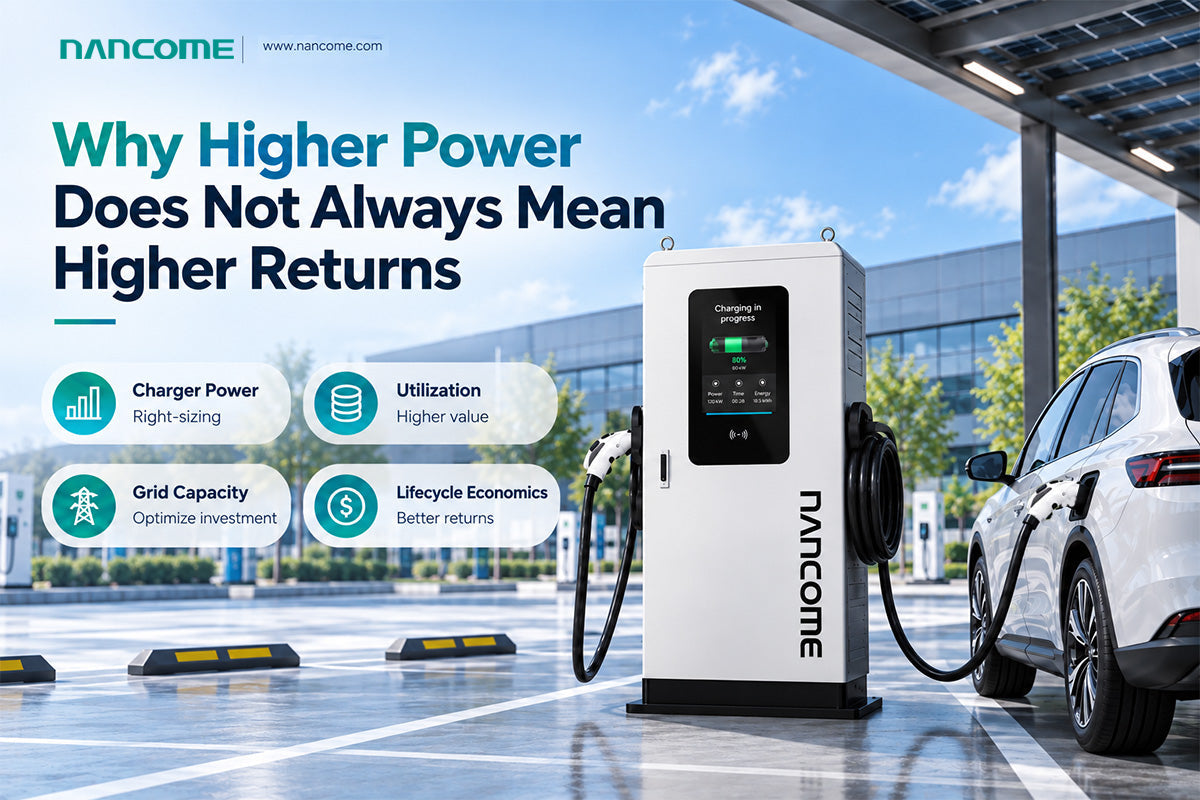
A practical 2026 guide to charger power, utilization, grid capacity and lifecycle economics for commercial EV charging projects
Higher power is a specification. Better utilization is a business result.
Commercial EV Charging Investment Snapshot — 2026
The global charging market is moving toward faster equipment, but the business case is becoming more disciplined. IEA data shows that public charging points are getting faster, while only a limited share of today's electric cars can fully use charging above 250kW. At the same time, charging network utilization is expected to rise as EV adoption grows.
- A higher-rated charger does not force every vehicle to accept that power; actual charging power is limited by the vehicle, battery state, temperature and charging curve.
- Higher site power can increase transformer, switchgear, cable, civil-work and grid-connection requirements.
- Low utilization can make electricity and fixed infrastructure costs harder to recover.
- For fleets and depots, load management can sometimes reduce peak demand without reducing the required daily energy delivered.
For B2B buyers, the right question is therefore not simply “What is the highest kW available?” It is “What power mix delivers the required energy, throughput and service level at an acceptable lifecycle cost?”
1. Why the Market Is Moving Toward Higher-Power Charging
Higher-voltage vehicle platforms, improved battery systems and better power electronics are enabling faster charging. The IEA reports that the average rated power of public charging points increased in 2025, and ultra-fast charging is expanding for long-distance travel and future vehicle demand.
This trend is real, but it does not mean every commercial EV charging station should immediately select the highest available power. A 320kW DC fast charger or 480kW DC fast charger can be appropriate for high-throughput corridors, capable vehicles and constrained dwell times. The same equipment may be economically excessive at a hotel, low-traffic parking site or fleet depot with long overnight dwell periods.
2. Charger Nameplate Power Is Not the Same as Power Delivered to the Vehicle
The charger's rated output is only one side of the charging process. The EV decides how much power it can accept at each moment. Battery state of charge, pack voltage, thermal conditions and the vehicle's charging curve can all reduce actual power.
IEA's 2026 analysis notes that only a small share of electric cars can currently use charging above 250kW. This means installing an ultra-high-power charger does not automatically create an ultra-high-power charging session for every customer.
The useful kW is the kW that vehicles can actually absorb when the site needs it.
3. The Economics Depend on Utilization, Not Only Charging Speed
A charging station earns value when equipment is used. A high-power asset with few charging sessions can have weak capital productivity, even if individual sessions are fast. By contrast, a correctly sized station with steady traffic can achieve better charger utilization and spread fixed costs over more delivered energy.
NREL research on DC fast charging economics has shown that electricity cost can vary dramatically with site use and utility tariff structure. Demand charges can be particularly significant at low-utilization sites, while average electricity cost can decline rapidly as utilization improves.
| Project factor | Why it matters | Typical question |
|---|---|---|
| Traffic / sessions | Determines energy sales and equipment use | How many sessions per day? |
| Average kWh/session | Determines daily energy throughput | How much energy does each vehicle need? |
| Vehicle acceptance | Limits usable charging power | Can the target fleet use 240–480kW? |
| Dwell time | Defines required charging speed | Minutes, hours or overnight? |
| Grid capacity | Can constrain simultaneous output | How much site power is actually available? |
| Tariff / demand charge | Affects operating cost | How is peak kW billed? |
| Future growth | Affects expansion strategy | Can modules or dispensers be added later? |
4. A Simple Way to Think About Charging Station ROI
Charging station ROI should be evaluated as a system, not as a charger price comparison. A simplified commercial model can begin with:
- Annual gross margin = annual energy sold × margin per kWh, plus applicable service or parking revenue.
- Annual operating contribution = gross margin − electricity demand costs − network/platform costs − maintenance − site operating expenses.
- Project payback depends on total installed investment, not only the purchase price of the charger.
The total EV charging station cost can include transformer upgrades, distribution equipment, protection, cabling, trenching, foundations, communication, installation and commissioning. Moving from 120kW to 480kW may therefore change much more than the charger cabinet itself.
5. When 60–120kW Can Produce a Better Business Result
Moderate-power DC charging can be effective where dwell time is longer or traffic is predictable. Examples include dealerships, workshops, smaller commercial parking sites, mixed-use properties and some fleet operations.
- Lower peak site demand can simplify electrical integration.
- More charging points may sometimes be deployed within the same site power limit.
- Vehicles that cannot sustain very high charging power may see limited benefit from a much larger charger.
- A phased design can preserve future expansion without overbuilding the first stage.
6. When 180–240kW Becomes the Practical Middle Ground
A 180kW or 240kW DC fast charger can serve many public, commercial and fleet applications that require faster turnover but do not yet justify the electrical infrastructure of the highest power tier.
For NANCOME projects, this range can be evaluated together with dual-connector layouts, power allocation, OCPP communication, local connector requirements and site distribution capacity. The objective is to match charger power with the real operating profile rather than select power from a catalogue alone.
7. When 320–480kW Makes Commercial Sense
Higher-power charging becomes more compelling when time has a high operational value. Highway charging stations, high-traffic public hubs, electric truck applications and fleets with short turnaround windows can justify higher output when compatible vehicles and adequate site power are present.
- High traffic and short dwell-time targets.
- Vehicles capable of accepting high charging power.
- Sufficient transformer and distribution capacity, or a viable energy-storage strategy.
- A business model that values throughput and vehicle turnaround.
- Future demand that can realistically use the installed capacity.
For these projects, NANCOME can evaluate 320kW and 480kW DC configurations as part of the wider electrical system. The final configuration should still be confirmed against local grid conditions, connector standards, vehicle profiles and project economics.
8. Simultaneous Charging Can Matter More Than Maximum Single-Gun Power
Commercial sites rarely operate as a single charger in isolation. The critical design question is often how many vehicles need energy at the same time. Four chargers running simultaneously can create a very different grid requirement from one charger serving one vehicle.
Dynamic load balancing can distribute available power among active charging sessions and keep the site within an agreed electrical limit. For fleet EV charging solution design, the daily energy target and departure schedule can be more important than maximizing every connector at every moment.
IEA analysis indicates that optimized charging schedules at some bus and truck depots can substantially reduce peak power demand. This is why depot design should combine routes, dwell time, battery size, charger count and site power.
9. Battery-Buffered Charging Can Change the Power Equation
Where the grid cannot economically provide the desired peak charging output, battery-buffered EV charging can separate grid input power from short-duration charging output.
For example, a site may recharge an energy-storage system at a lower, steadier input rate and use stored energy to support higher-power EV charging during peaks. This does not create free energy; the battery must be sized around usable energy, recharge time, expected sessions and losses.
- Potentially reduce peak grid demand.
- Delay or reduce some grid-upgrade requirements where technically and economically appropriate.
- Support grid-constrained or temporary charging applications.
- Combine with solar or other distributed energy where the project supports it.
NANCOME's mobile energy-storage charging systems and electrical distribution background make this especially relevant for projects where the required charging output is higher than the immediately available grid capacity.
10. Power Selection by Application
| Application | Typical design priority | Power approach |
|---|---|---|
| Hotel / destination | Long dwell time, convenience | AC or moderate DC; avoid unnecessary peak power |
| Commercial parking | Mixed dwell time, turnover | Mix AC/DC; size by traffic and parking duration |
| Dealership / workshop | Operational flexibility | Moderate DC or portable/mobile DC depending on workflow |
| Public urban station | Throughput + utilization | 60–240kW commonly evaluated; higher where demand supports it |
| Highway charging | Short dwell + future vehicle capability | High-power DC, often 180–480kW depending on site |
| Fleet / logistics depot | Daily energy + departure schedule | Multiple chargers + load management |
| Grid-constrained site | Available input power | Battery-buffered or phased charging may be evaluated |
11. Regional Conditions Can Change the Correct Power Level
There is no globally correct charger power. Europe, Brazil and Latin America, the Middle East and Central Asia can differ in grid connection timelines, transformer availability, connector standards, climate, local vehicle mix, installation practice and electricity tariffs.
For export projects, NANCOME therefore recommends confirming the target country, vehicle connectors, site voltage, available capacity, expected sessions, operating temperature, backend requirements and local installation capability before finalizing the charger configuration.
12. NANCOME's Approach: Select the System Before Selecting the Number
NANCOME approaches commercial charging through four connected capabilities:
- Intelligent EV charging equipment manufacturing — commercial AC charging, DC fast charging, portable DC and mobile energy-storage charging solutions.
- Electrical-engineering manufacturing foundation — experience in power distribution, protection coordination, thermal management and system safety.
- Project-oriented charging solution support — site power, charging demand, connector, communication and deployment conditions are considered before final configuration.
- Flexible manufacturing and customization — power, connector, language, communication, branding and installation methods can be configured according to project requirements.
This approach matters because a DC fast charger manufacturer is not only supplying kW. The charger must operate inside a real electrical system, serve real vehicles and support a real business model.
13. Buyer Checklist Before Choosing Charger Power
- How many vehicles or charging sessions are expected per day?
- What is the expected kWh required per session?
- What are the target vehicles' maximum and typical DC charging rates?
- How long can each vehicle remain parked?
- How many vehicles must charge simultaneously?
- What transformer and site capacity are available today?
- What are the local electricity tariff and demand-charge rules?
- Would dynamic load balancing reduce the required peak connection?
- Would battery storage be more practical than immediate grid expansion?
- What traffic growth is realistic over the next three to five years?
- Can the charging system be expanded in phases?
- What connector, communication and local compliance requirements apply?
Result
The charging industry is moving toward higher power, but higher rated output does not automatically produce higher returns. The strongest commercial EV charging projects match charger power to vehicle capability, dwell time, utilization, simultaneous demand, grid capacity and lifecycle economics.
For some projects, 60–120kW may be sufficient. Others may justify 180–240kW, while high-throughput highway, truck or fleet applications can benefit from 320–480kW. In grid-constrained locations, load management or battery-buffered charging can sometimes create a better system than simply requesting the largest possible grid connection.
Choose power for the operating model — not for the specification sheet.

Leave comment
所有评论在发布前都会经过审核。
此站点受 hCaptcha 保护,并且 hCaptcha 隐私政策和服务条款适用。