
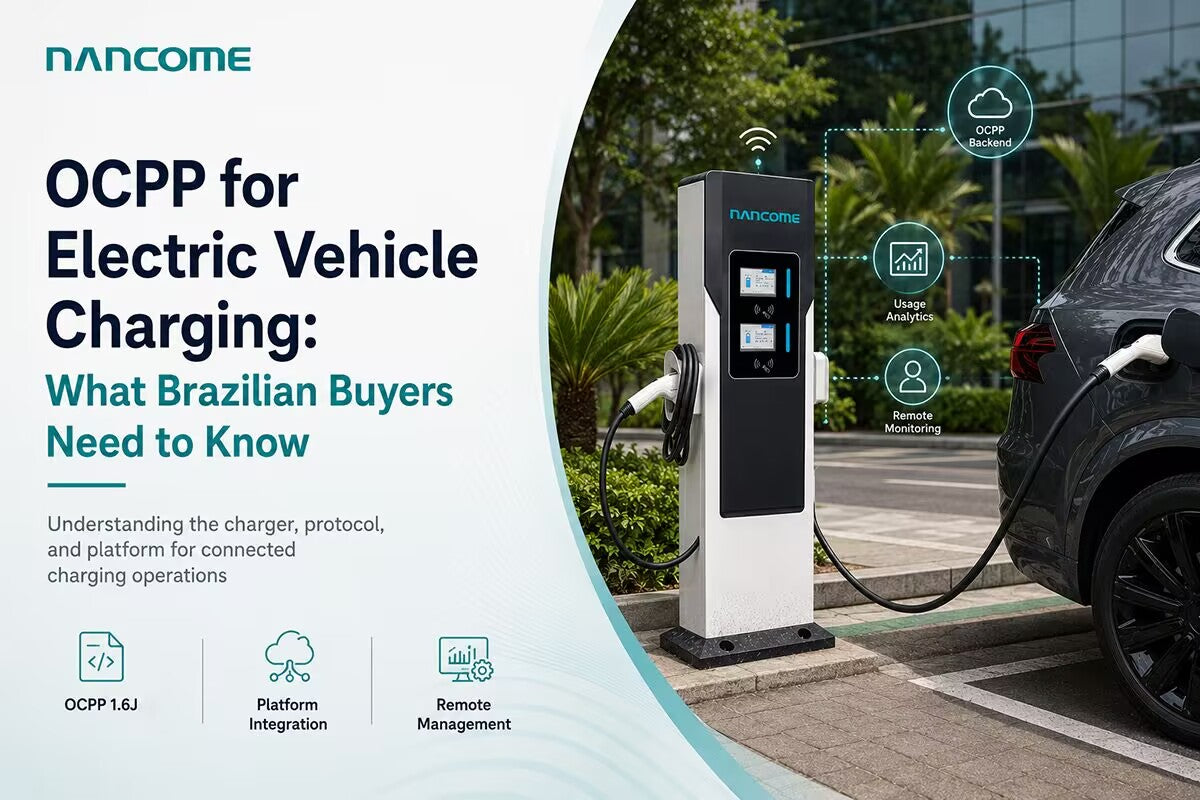
How to separate the charger, protocol, and platform to build a connected, scalable operation without incorrect promises
Why OCPP Is Becoming More Important in the Brazilian Market
• Brazil reached 25,429 public and semi-public charging points in a survey released in June 2026. As the network grows, operators need to monitor equipment, users, and charging sessions across different locations.
• DC fast chargers already represent approximately 34% of the public and semi-public network measured by ABVE/Tupi. This expansion increases the importance of integration, diagnostics, and remote management.
• The Open Charge Alliance defines OCPP as the open communication protocol between charging stations and management systems. OCPP 1.6 remains widely used, while OCPP 2.0.1 offers more advanced functions.
1) What is OCPP?
• OCPP stands for Open Charge Point Protocol. It works as a standardized language between the charger and the Charging Station Management System, or management platform.
• The protocol allows hardware and software to exchange messages about status, authorization, session start and stop, metering, faults, and remote commands.
• OCPP reduces dependence on a fully proprietary integration, but it does not guarantee that any hardware will work with any platform without configuration and testing.
2) The charger, OCPP, and the platform are different layers
• The charger performs power conversion, communicates with the vehicle, and controls the charging session.
• OCPP defines how the charger exchanges information with the backend.
• The platform provides operational functions such as users, tariffs, reports, applications, multiple sites, and payment integration.
• Buying an OCPP-enabled charger does not mean automatically receiving a free platform.
3) OCPP 1.6J or OCPP 2.0.1
• OCPP 1.6J remains widely used in commercial projects and supports the essential functions required by most operations: authorization, transactions, metering, status, diagnostics, and updates.
• OCPP 2.0.1 includes improvements in security, device modeling, management, and smart charging, but it requires the charger and platform to support the same version and the same functional profiles.
• NANCOME works with OCPP 1.6J and can evaluate OCPP 2.0.1 according to the model, configuration, and project. The version must be confirmed before the order is placed.
4) What OCPP can support
• Monitoring charger status and availability.
• User authorization and remote control of charging sessions.
• Recording energy, time, and transaction data.
• Fault reports, events, and remote support.
• Updates and parameters when supported by the implementation.
5) What OCPP does not solve by itself
• OCPP does not create an application, Pix, card payment, a financial gateway, or local support.
• The protocol does not replace a stable internet connection, correct electrical installation, or a properly configured platform.
• OCPP also does not eliminate the need for testing. Two implementations may interpret optional features differently.
6) Customer who already has a platform
• Send NANCOME the OCPP version, test URL, security requirements, mandatory messages, and function list.
• Plan a laboratory or pre-commissioning phase before sending the equipment to the site.
• Test the connection, BootNotification, authorization, session start and stop, metering, alarms, and updates. Record the results and responsible parties.
7) Customer who does not yet have a platform
• First define whether the charger will be used internally, billed to the public, or managed across multiple sites.
• For a simple operation, RFID and basic records may be sufficient. For CPOs and paid sites, a platform with users, tariffs, payment, and support is normally required.
• NANCOME can recommend a platform partner with subscription-based billing and contracted functions. This solution should not be presented as a free NANCOME backend.
8) Payment in Brazil
• Pix, card payment, QR code, and applications depend on the platform, gateway, and local integrations. The charger must receive the correct command, but it does not execute the entire financial process by itself.
• Before purchasing, confirm who issues charges, who supports the user, how refunds are handled, and which fees apply.
• For dealerships, fleets, and companies, public billing may not be necessary; RFID or authorized access can simplify the operation.
9) Connectivity and security
10) How NANCOME supports integration
• The nancome.com website presents DC chargers with connected architecture, control modules, and OCPP integration. For the Brazilian market, the configuration should prioritize CCS2 and commercial power levels of 40kW, 60kW, and 80kW.
• NANCOME can provide parameters, documentation, configuration support, remote diagnostics, and software updates according to the equipment.
• The platform provider and local integrator should participate in testing. NANCOME should not promise compatibility without receiving the backend requirements.
11) Questions before finalizing the order
• Which OCPP version and profiles does the platform use?
• Which functions need to be demonstrated during testing?
• How will the address, certificates, and credentials be provided?
• Who is responsible for payment, the application, and user support?
• How will updates, diagnostics, and support be handled after installation?
Result:
OCPP is essential for connecting chargers to an intelligent operation, but it must be treated as a protocol, not as a complete platform. Brazilian buyers should define the version, functions, security, connectivity, and testing before deployment. This clarity reduces incomplete integration and unnecessary dependence.


Leave a comment
All comments are moderated before being published.
This site is protected by hCaptcha and the hCaptcha Privacy Policy and Terms of Service apply.