
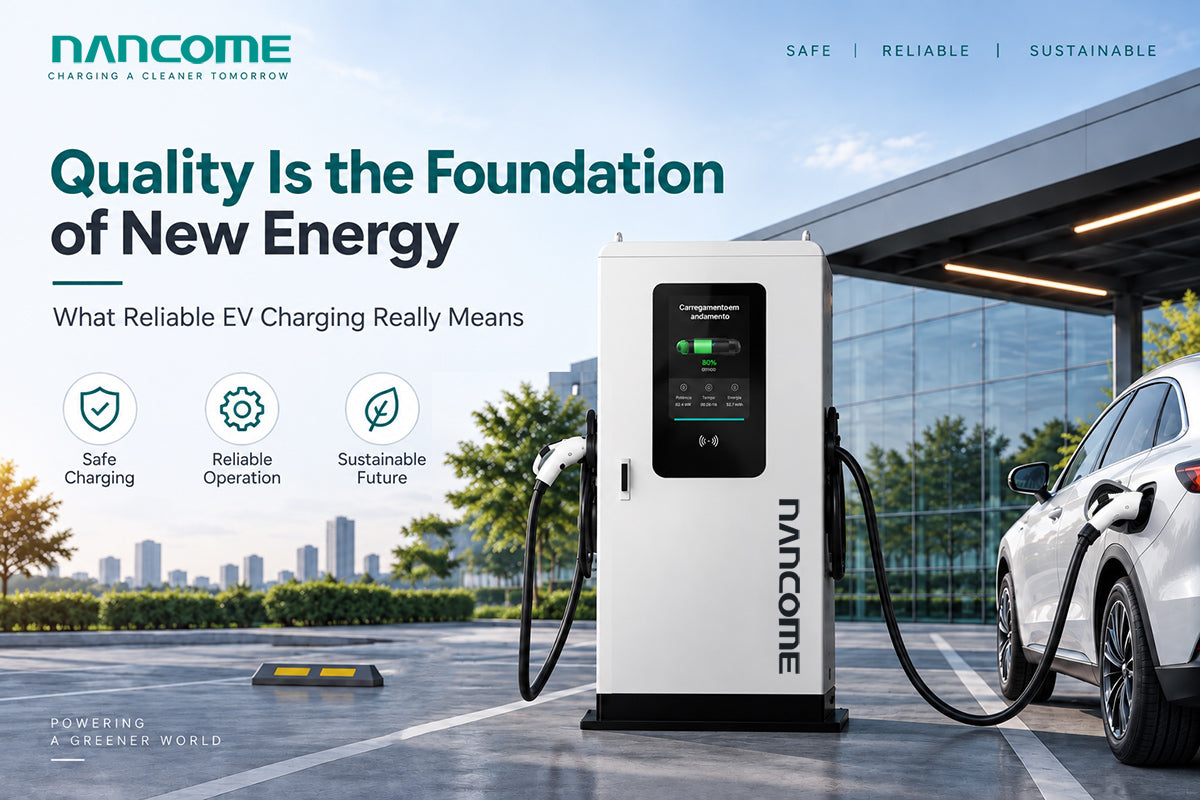
Inspired by the new energy industry's pursuit of safety, reliability, consistency and long service life, NANCOME believes real EV charging quality must be designed, manufactured and proven through long-term operation.
Quality Is Becoming the Real Competition in New Energy
As the global new energy industry grows, competition is no longer only about higher power, larger capacity, faster charging or lower prices.
It is increasingly about quality and trust.
At the 2026 World Power Battery Conference, CATL Chairman and CEO Dr. Robin Zeng shared a clear view of what quality means for the new energy industry: safety, reliability and long service life.
Behind these three principles is an even more important idea: quality cannot depend only on final inspection. It requires respect for risk, extreme consistency, and quality control that begins in product design and continues throughout manufacturing.
Although batteries and EV chargers are different products, this philosophy raises an important question for the charging industry:
What does real quality mean for an EV charger?
For NANCOME, the answer is not simply whether a charger can reach its rated output.
A reliable EV charger should be able to deliver power safely, consistently and dependably under real operating conditions throughout its service life.
Higher power is a specification. Reliable power is quality.
1. Safety Is the Foundation of EV Charging Quality
An EV charger is not simply a cabinet with a screen and charging connector.
It is an electrical system that continuously manages power between the grid and an electric vehicle.
As charging power increases from commercial AC charging to 60kW, 120kW, 180kW, 240kW and even higher-power DC charging systems, the consequences of poor electrical design become increasingly serious.
Quality therefore begins with respect for electrical risk.
- Electrical protection
- Insulation and grounding
- Overvoltage and overcurrent protection
- Temperature monitoring
- Thermal management
- Emergency protection
- Connector and cable reliability
- Power module operating conditions
- Communication and control logic
- Environmental operating conditions
This is one reason NANCOME's electrical manufacturing background matters.
With electrical manufacturing experience dating back to 1992, NANCOME's understanding of EV charging is built not only around charging functionality, but also around power distribution, protection coordination, thermal management and system safety.
Before asking how much power a charger can deliver, a more fundamental question should be answered: Can it deliver that power safely and reliably over time?
2. Reliability Is More Important Than a Successful Factory Test
A charger passing a factory test is important. But that alone does not define long-term quality.
Commercial EV charging equipment operates in much more complicated conditions than a controlled test environment.
- Repeated high-load charging sessions
- High or low ambient temperatures
- Grid voltage fluctuations
- Dust and humidity
- Frequent connector use
- Continuous communication with backend platforms
- Different EV models and charging behaviors
- Long daily operating hours
For a public charging operator or fleet customer, the real test begins after installation.
A charger may operate successfully for one hour in the factory. The more important question is whether it can continue operating reliably after hundreds or thousands of charging sessions.
This is particularly important for public charging stations, highway charging stations, fleet depots and other high-utilization commercial applications.
Downtime does not only create a maintenance problem. It can mean lost charging revenue, unavailable parking spaces, dissatisfied drivers and additional service costs.
That is why NANCOME sees reliability as a fundamental part of product value.
3. Consistency Is What Separates a Sample From a Manufacturing System
One good prototype does not prove manufacturing quality.
For B2B customers, quality must remain consistent across production batches.
The quality of the 100th unit should follow the same standards as the first.
- Component selection
- Supplier management
- Power module configuration
- Electrical assembly
- Wiring
- Connector installation
- Mechanical assembly
- Thermal design implementation
- Software configuration
- Functional testing
- Final inspection
Consistency becomes even more important for overseas projects. A distributor, EPC contractor or charging operator cannot practically inspect every internal component after the equipment arrives. They depend on the manufacturer's production process.
For NANCOME, this is why manufacturing capability matters just as much as product specifications.
4. Quality Should Be Designed In, Not Inspected In
One of the most valuable lessons from advanced new energy manufacturing is that quality should not be created at the final inspection stage.
Final inspection can identify some problems. It cannot compensate for poor design.
Real quality begins much earlier. During product development, engineers should already be considering:
- Where could this product fail?
- What happens under continuous high load?
- How will heat be removed?
- What happens when the grid fluctuates?
- How will the protection system respond to abnormal conditions?
- Can important components be maintained or replaced efficiently?
- What happens when the charger communicates with different vehicles or backend platforms?
This changes quality management from 'Find the problem -> Repair the problem' to 'Anticipate the risk -> Reduce the possibility of the problem.'
For EV charging equipment, this approach is especially important because electrical, mechanical, thermal and software systems must work together.
A charger is only as reliable as the complete system behind it.
5. High-Power Charging Makes Quality More Important, Not Less
The EV charging industry is moving toward higher power. But higher charging power also raises the engineering requirements.
Consider a 60kW commercial DC charger and a 480kW high-power charging system. The second system is not simply the first charger multiplied by eight.
- Power conversion
- Heat generation
- Cable current
- Connector temperature
- Protection coordination
- Distribution capacity
- Transformer capacity
- Simultaneous charging
- Dynamic power allocation
- Communication stability
This is why NANCOME does not believe that charger quality can be evaluated by the kW number alone.
A 480kW charger that frequently experiences downtime does not create more customer value simply because its rated power is higher. Likewise, a properly selected 120kW or 180kW system may create better long-term value for a site if it matches the vehicles, grid capacity and utilization.
The goal is not maximum power at any cost. The goal is reliable power matched to the application.
6. Quality Must Match the Real Application
There is no single operating environment for EV chargers. A hotel charger and a highway DC fast charger may both charge electric vehicles, but their operating requirements can be very different.
Public Charging Stations
Public sites need equipment that can support frequent use, different vehicle models, user authentication, communication and potentially payment systems. Reliability directly affects station availability and revenue.
Highway Charging Stations
Drivers expect fast charging and short waiting times. High-power output, thermal management, connector durability and high utilization become more important.
Fleet Charging
Fleet operators often have predictable but concentrated charging demand. Multiple vehicles may return to a depot within the same charging window, making power distribution, load management and equipment availability critical.
Hotels and Commercial Destinations
Vehicles may remain parked for several hours. The project may combine commercial AC charging with selected DC fast chargers instead of installing maximum power at every parking space.
Mobile Energy Storage Charging
Mobile charging creates another set of requirements. The equipment must consider not only charging performance but also energy storage, movement, transport conditions, cable management and flexible deployment.
This is why NANCOME believes quality must be connected with the actual application, not separated from it.
7. Product Quality Is Only Part of Charging Station Quality
A high-quality charger can still perform poorly in a badly designed project.
For example, imagine installing a 240kW DC fast charger at a site where:
- Transformer capacity is insufficient
- Cable sizing is incorrect
- Protection coordination is inappropriate
- Ventilation conditions are poor
- Communication configuration is incomplete
- Parking layout restricts cable access
The charger itself may not be the fundamental problem. The project design is.
This is why NANCOME treats EV charging as part of a larger electrical system.
Grid -> Transformer -> Distribution -> Protection -> Charger -> EV -> Communication Platform
Quality should therefore extend from product quality to project quality. Before equipment delivery, understanding site power conditions, charging demand, protection requirements, communication interfaces and future expansion can prevent problems that would otherwise appear after installation.
8. Long Service Life Is About Lifecycle Value
For B2B customers, the cheapest charger is not necessarily the lowest-cost charger. Purchase price is only one part of the total cost.
- Maintenance costs
- Spare-parts costs
- Technician visits
- Charger downtime
- Lost charging revenue
- Customer complaints
- Replacement costs
- Expansion and upgrade costs
This changes the purchasing question. Instead of asking only 'How much does this charger cost?', a professional buyer should also ask 'How much will this charger cost me to operate over its lifecycle?'
A reliable product can create value by reducing unexpected downtime and maintenance while supporting longer-term operation.
Low purchase price creates short-term savings. Reliable quality creates long-term value.
9. NANCOME's Four Foundations for Charging Quality
Intelligent EV Charging Equipment Manufacturer
NANCOME develops charging equipment for different commercial applications, including DC fast chargers, commercial AC chargers, portable DC chargers, high-power charging systems and mobile energy storage charging systems. Different products have different operating conditions, but the objective remains consistent: safe, stable and reliable charging.
Manufacturing Foundation From Electrical Engineering
NANCOME's electrical manufacturing experience dates back to 1992. Our understanding of charging equipment therefore begins with electrical engineering fundamentals, including distribution, protection design, thermal management and system safety. This engineering background influences how we think about charging quality.
Project-Oriented Charging Solution Partner
We do not view the charger as an isolated product. Site power, charging demand, transformer capacity, protection coordination, communication integration and deployment planning can all affect the final result. Supporting these decisions before installation is also part of delivering quality.
Flexible Manufacturing and Customization Collaboration
Different markets require different connector standards, languages, power configurations, communication protocols, branding and installation methods. Customization should not mean sacrificing reliability. For NANCOME, the objective is to adapt equipment to project requirements while maintaining practical manufacturability and stable operation.
10. From Made in China to Trusted by Global Customers
As Chinese new energy companies expand globally, competition is changing.
Price remains important. Technology remains important. Manufacturing scale remains important.
But eventually, international customers must answer another question:
Can I trust this supplier for my next project?
Trust cannot be created by a quotation. It is built through repeated experience: the first project operates reliably; the second batch maintains consistent quality; technical questions receive professional responses; problems are addressed instead of avoided; and future projects continue to receive the same level of support.
This is how a manufacturing relationship becomes a long-term partnership.
The broader industry's ambition to move from 'Made in China' toward global trust in Chinese manufacturing therefore has particular meaning for EV charging equipment manufacturers.
For NANCOME, this is also a direction worth pursuing - not by claiming that quality is important, but by demonstrating it through products and projects over time.
11. What Should B2B Buyers Look for in a Reliable EV Charger Manufacturer?
When evaluating an EV charger supplier, buyers should look beyond product brochures.
- How long has the manufacturer worked with electrical equipment?
- How are electrical protection and thermal management designed?
- How are critical components selected?
- What testing is performed before shipment?
- Can the manufacturer support different charging standards?
- Does it understand OCPP and backend integration?
- Can it support site-specific power configuration?
- How does it handle customization?
- Is technical support available after delivery?
- Can the manufacturer support future project expansion?
A reliable EV charger manufacturer should be able to discuss not only what the charger can do, but also why the system is designed that way and how it will operate in the customer's real application.
12. Quality Is Not a Marketing Claim - It Is a Long-Term Commitment
The new energy industry is entering a stage where scale alone will not define the strongest companies.
Products will become more powerful. Charging will become faster. Energy systems will become more intelligent.
But the fundamental requirement will remain unchanged:
- The system must be safe.
- It must be reliable.
- It must operate consistently.
- And it must create value over the long term.
For NANCOME, quality is therefore not a slogan added after manufacturing. It begins with electrical engineering. It continues through design and manufacturing. It is verified through testing. It extends into project deployment. And ultimately, it is proven by long-term operation.
Safety is the foundation. Reliability is the standard. Consistency is the discipline. Long-term operation is the proof. Customer trust is the result.
Result
The quality philosophy shared by leading companies in the new energy industry offers an important lesson: quality cannot rely on luck, and it cannot be created only through final inspection. It must be built into the product from the beginning.
For EV charging infrastructure, this principle is equally important.
From a commercial AC charger to a 480kW high-power DC charging system, customers are not simply purchasing kilowatts. They are purchasing availability, reliability, operating efficiency and long-term confidence.
With electrical manufacturing experience dating back to 1992, NANCOME continues to apply its understanding of electrical engineering, charging equipment manufacturing, project deployment and flexible customization to the development of EV charging solutions.
Our pursuit is straightforward:
Make every kilowatt of charging power safer, more reliable and more dependable over the long term.
Because in new energy infrastructure, quality is not simply what we manufacture.
Quality is what we pursue.

Оставить комментарий
Все комментарии перед публикацией проверяются.
Этот веб-сайт защищается hCaptcha. Применяются Политика конфиденциальности и Условия использования hCaptcha.