
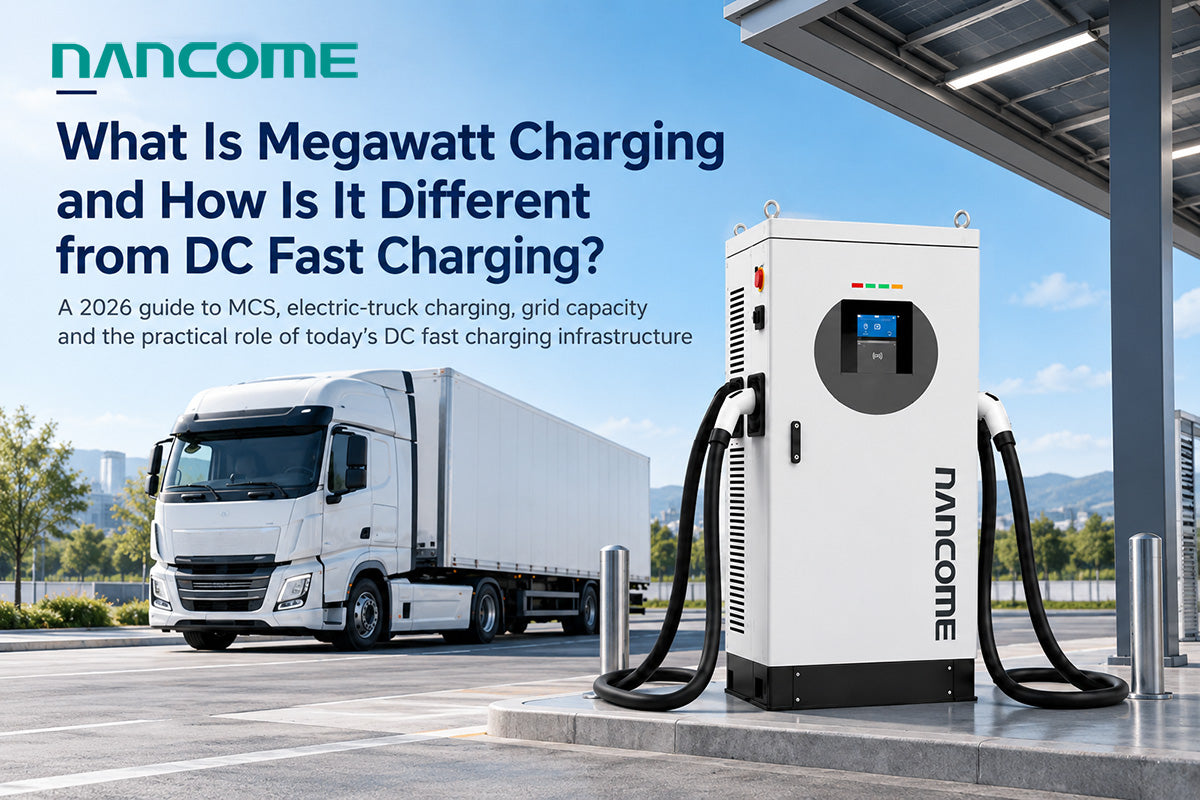
A 2026 guide to MCS, electric-truck charging, grid capacity and the practical role of today’s DC fast charging infrastructure
Megawatt Charging Snapshot – 2026
Megawatt charging is moving from an industry-development topic toward early infrastructure deployment, especially for battery-electric heavy-duty trucks. The International Energy Agency (IEA) reports that electric truck sales exceeded 400,000 in 2025 and doubled year on year, while heavy-freight electric truck sales almost tripled. At the same time, most truck charging today remains depot-based, and the majority of dedicated truck chargers are still below the megawatt level.
For buyers and project developers, this creates an important distinction: MCS is not simply “a bigger DC charger.” It is a high-power charging system designed around heavy-duty vehicle duty cycles, very large batteries, high-voltage/current interfaces, thermal management, site power and interoperability requirements.
The key question is not “DC fast charging or megawatt charging?” It is “What charging power does the vehicle, route, dwell time and electrical site actually require?”
1. What Is Megawatt Charging?
A Megawatt Charging System (MCS) is a conductive DC charging approach developed primarily for heavy-duty electric vehicles that need very high charging power within limited dwell times. CharIN describes MCS as a solution for trucks and buses, while the scope can extend to other large electric applications.
In 2026, standardization reached an important milestone. IEC TS 63379:2026 defines the vehicle connector, vehicle inlet and cable assembly for megawatt DC charging, with rated operating voltage up to 1,500 V DC and current up to 3,000 A. IEC 61851-23-3:2026 addresses DC EV supply equipment for MCS, with the EV side rated up to 1,250 V DC. Communication is linked to ISO 15118-20 in the IEC framework.
CharIN’s current MCS recommendations describe a single conductive plug, up to 1,250 V and 3,000 A DC, Ethernet communication and ISO/IEC 15118-20. These figures describe the MCS technical envelope; they should not be interpreted as the normal operating point of every truck or every site.
2. What Is Conventional DC Fast Charging?
DC fast charging converts AC grid power to DC and supplies it directly to the vehicle battery. It covers a wide power range and is already widely used for passenger vehicles, commercial vehicles, buses, logistics fleets and public charging stations.
For NANCOME’s current product portfolio, relevant commercial configurations include 40kW to 480kW DC fast chargers, including common project powers such as 60kW, 120kW, 180kW and 240kW. These systems can be configured for different project requirements, vehicle interfaces and charging scenarios.
For many fleets, 120–480kW-class DC fast charging remains practical because vehicles often return to a depot, park for predictable periods and do not need to recover hundreds of kilometres of range in only a few minutes.
3. MCS vs DC Fast Charging: The Practical Differences
| Factor | Conventional DC Fast Charging | Megawatt Charging / MCS |
|---|---|---|
| Typical role | Passenger EVs, buses, fleets, depots, public/commercial sites | Heavy-duty trucks and other large-battery applications requiring very high power |
| Power level | Broad range; commercial systems commonly tens to hundreds of kW | Megawatt-class charging; technical envelope can extend well above 1 MW |
| Vehicle interface | CCS1, CCS2, GB/T, CHAdeMO or other market-specific interfaces | MCS-specific coupler architecture |
| Voltage/current | Depends on charger and vehicle platform | IEC/CharIN framework supports very high voltage/current levels |
| Dwell-time objective | Minutes to hours depending on use case | Designed for large energy transfer in shorter operational windows |
| Site impact | Can often fit existing commercial electrical upgrades | May require major grid connection, transformer, switchgear, cable and thermal design |
| Best fit | Most current EV charging projects | Selected heavy-duty routes, hubs and future high-throughput truck charging |
4. Why Electric Trucks Are Driving Megawatt Charging
Electric trucks have much larger batteries and higher daily energy demand than passenger cars. IEA data show electric truck sales doubled in 2025 to 9% of global truck sales, with heavy-freight electric truck sales rising from about 84,000 in 2024 to about 230,000 in 2025. This growth increases the need for charging infrastructure designed around freight operations.
However, the charging requirement depends strongly on the operating model. Overnight depot charging can use lower power because the vehicle may remain parked for several hours. Long-haul operations have shorter breaks and higher daily mileage, creating a stronger case for opportunity charging and megawatt-scale systems.
A truck with a large battery does not automatically need MCS. The required charging power comes from energy demand divided by the usable charging window — then adjusted for vehicle acceptance, efficiency and operational margin.
5. Depot Charging Will Still Matter Even as MCS Expands
The IEA expects depot charging to remain dominant for heavy-duty vehicles. In its 2026 outlook, depot charging continues to account for the overwhelming majority of HDV charging points through 2035, while en-route high-power charging becomes increasingly important for long-distance applications.
This means fleet infrastructure will likely develop as a layered system rather than a complete replacement of DC fast charging by MCS:
- Overnight or long-dwell depot charging for routine energy replenishment
- 120–480kW DC fast charging for faster fleet turnaround and mixed operations
- Higher-power opportunity charging where routes and dwell windows justify it
- Megawatt charging for selected heavy-duty vehicles and high-throughput freight corridors
6. Why 240kW–480kW DC Fast Charging Still Has a Strong Role
The transition to MCS does not make existing high-power DC charging obsolete. IEA research on truck charging in China found that most truck chargers in the reviewed dataset were in the 300–400kW range, while only around 1% were megawatt-scale. In Europe, dedicated truck charging is also expanding across the 350kW-to-1MW range.
For many logistics depots, ports, industrial parks, bus depots and regional delivery fleets, the most economical solution may therefore remain a properly sized multi-charger DC system rather than immediate megawatt deployment.
A 240kW, 320kW, 360kW or 480kW charging system can be particularly relevant when the fleet has predictable dwell time, the vehicles cannot accept megawatt power, or the site grid does not justify a much larger connection.
7. Megawatt Charging Is Also a Grid Project
At megawatt scale, charger selection is only one part of the engineering problem. A site with several MCS charging points can create multi-megawatt simultaneous demand, which may materially change the required grid connection and electrical architecture.
Project planning should therefore evaluate:
- Available grid capacity and utility connection timeline
- Transformer and medium/low-voltage distribution capacity
- Maximum simultaneous charging demand
- Vehicle arrival patterns and dwell windows
- Dynamic power allocation and load management
- Cable sizing, protection coordination and fault levels
- Thermal management and high-current connection design
- Future expansion and redundancy
- Potential solar PV and stationary battery storage integration
At megawatt scale, “charger power” and “site power” cannot be planned separately.
8. Where Battery Storage Can Support High-Power Truck Charging
As charging power rises, grid capacity constraints can become more important. Battery-buffered EV charging can help in selected projects by charging the stationary battery at a lower or controlled rate and using stored energy to support short periods of higher charging demand.
This can be relevant when a site has limited grid capacity, high peak demand, long utility upgrade timelines or a need to phase infrastructure investment. It does not eliminate the need for electrical engineering, and it is not automatically cheaper than a grid upgrade.
For NANCOME, this is a particularly relevant engineering direction because the company’s capabilities span DC charging, mobile energy-storage charging and power-distribution equipment. The practical project question is whether the required peak power, duration and daily energy can be supported by the grid alone, by grid plus storage, or by a phased combination of both.
9. A Simple Way to Estimate Required Truck Charging Power
A first-stage fleet calculation can start with the energy that must be returned to each truck and the available charging window:
Required average charging power ≈ Energy to replenish (kWh) ÷ Available charging time (h)
Example: if a truck needs 300kWh returned during a two-hour depot window, the theoretical average is about 150kW before considering charging losses, tapering, operational margin and the vehicle’s actual acceptance curve. If the same energy must be delivered in 30 minutes, the theoretical average rises to about 600kW.
This illustrates why route and dwell-time analysis should come before choosing MCS. Real projects must also consider simultaneous vehicles, state of charge, battery temperature, charging curves and the site’s available power.
10. MCS Standardization Is Advancing Quickly
The MCS ecosystem became more concrete in 2025–2026. SAE issued J3271_202503 in March 2025 as a technical information report covering couplers, communication and controls, cable handling/cooling, use cases and interoperability testing. IEC published TS 63379 in January 2026 for MCS couplers and cable assemblies, followed by IEC 61851-23-3 in August 2026 for MCS DC supply equipment.
This standardization progress is important for global interoperability, but procurement teams should still verify the exact vehicle interface, communication implementation, certification requirements and regional regulations for each project.
11. What MCS Does Not Mean
- MCS does not mean every charger above a certain marketing power is automatically MCS.
- MCS does not mean every electric truck can accept 1MW or more.
- MCS does not remove the need for transformer, switchgear, protection and site engineering.
- MCS does not automatically provide a better business case than 240–480kW DC charging.
- MCS should not be specified only because it is a new technology; it should solve a real route, dwell-time or throughput constraint.
12. How Should a Fleet Choose Between DC Fast Charging and MCS?
| Project Question | DC Fast Charging May Fit Better | MCS May Be Worth Evaluating |
|---|---|---|
| Vehicle charging capability | Fleet accepts tens/hundreds of kW | Vehicle platform supports megawatt-class charging |
| Parking time | Longer depot dwell | Short mandatory stops / rapid turnaround |
| Daily route | Regional, return-to-base | Long-haul or high-utilization duty cycle |
| Site power | Limited/moderate connection | Multi-MW connection or engineered storage support available |
| Fleet rollout | Early or phased electrification | Large mature electric-truck operation |
| Investment priority | Control initial CAPEX | Maximize high-power throughput where economically justified |
13. Regional Development: China, Europe and Emerging Markets
China currently leads electric-truck deployment and is developing high-power charging around freight corridors, ports, industrial clusters and logistics nodes. The IEA reports nearly 1 million electric trucks in China by the end of 2025 and notes early megawatt hubs integrating charging, solar PV and microgrids.
Europe is also scaling dedicated truck charging. The IEA reports more than 4,000 public chargers suitable for trucks, with a significant share of dedicated truck chargers operating between 350kW and 1MW and early chargers above 1MW already identified.
For Latin America, the Middle East, Central Asia and other emerging markets, project economics, grid capacity, local truck adoption and route concentration may favor a phased approach. In many cases, 120–480kW fleet charging, storage-supported charging or modular expansion can be more practical before full MCS deployment.
14. Where NANCOME Fits in the Megawatt-Charging Transition
NANCOME should approach megawatt charging as an industry trend and system-engineering topic, not as a product claim where a corresponding MCS product has not been specified. This distinction is important for credible B2B communication.
NANCOME’s current strengths are directly relevant to the infrastructure transition around MCS:
Commercial DC Fast Charging
NANCOME supplies commercial DC charging solutions across a broad power range, including configurations up to 480kW for fleet, public and commercial projects.
Battery-Buffered and Mobile Energy Storage Charging
Storage can support selected grid-constrained, temporary or peak-power applications and can be evaluated as part of a phased high-power charging strategy.
Electrical Engineering and Power Distribution
With an electrical manufacturing foundation dating to 1992, NANCOME can approach charging projects from the perspective of distribution, protection, transformer capacity and system safety — not only the charger cabinet.
Project-Oriented Customization
Connector standard, communication, language, power configuration, installation method and backend integration can be evaluated according to the target market and project requirements.
NANCOME’s role is to help customers select and engineer the charging architecture that fits today’s vehicles and site conditions, while leaving a practical path for future expansion.
15. Procurement Checklist for Heavy-Duty Charging Projects
- Confirm vehicle models, battery capacities and maximum DC charging acceptance.
- Calculate daily energy demand per vehicle and for the full fleet.
- Map arrival times, parking duration and simultaneous charging demand.
- Compare 120–480kW DC charging with future MCS requirements instead of assuming the highest power is best.
- Verify grid connection, transformer and distribution capacity.
- Evaluate load management and battery storage where peak demand exceeds practical grid capacity.
- Confirm connector, communication and interoperability requirements.
- Plan truck turning radius, pull-through bays, cable reach and safe circulation.
- Reserve electrical and civil capacity for future fleet growth.
- Define commissioning, remote diagnostics, spare parts and maintenance responsibilities before purchase.
Result
Megawatt charging is becoming an important part of the electric-truck infrastructure roadmap, and 2026 is a meaningful year for MCS standardization. But MCS should not be treated as a universal replacement for conventional DC fast charging.
For most projects, the correct charging architecture depends on four variables: vehicle acceptance, energy required, available dwell time and site power. A fleet with long overnight parking may be well served by conventional DC fast charging. A long-haul truck that must recover a large amount of energy during a short stop may create a strong case for megawatt charging.
For NANCOME, the opportunity is broader than a single connector or power level. By combining commercial DC fast charging, energy-storage charging, power-distribution experience and project-oriented engineering, NANCOME can support customers in building practical charging infrastructure today while preparing electrical systems for the higher-power requirements of tomorrow.
The future of heavy-duty charging is not simply more kilowatts. It is the right power, at the right site, for the right vehicle and operating schedule.

Оставить комментарий
Все комментарии перед публикацией проверяются.
Этот веб-сайт защищается hCaptcha. Применяются Политика конфиденциальности и Условия использования hCaptcha.