
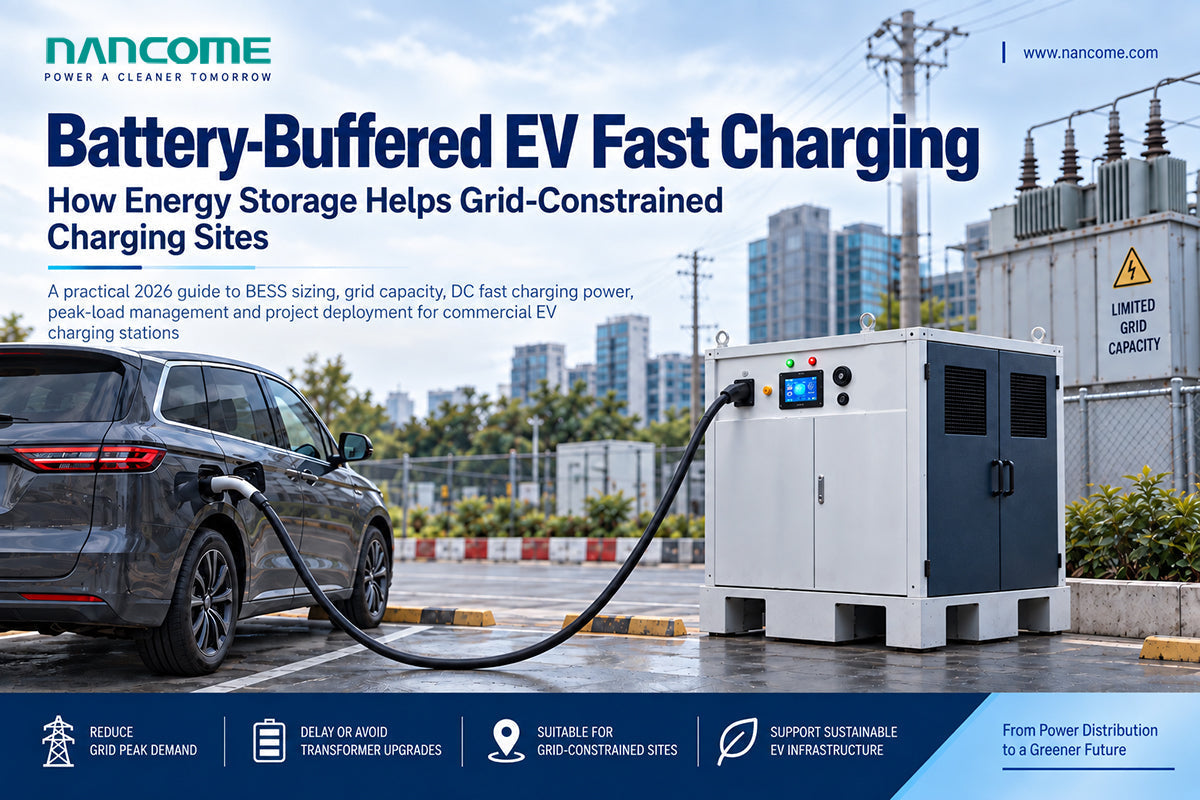
A practical 2026 guide to BESS sizing, grid capacity, DC fast charging power, peak-load management and project deployment for commercial EV charging stations
Battery-Buffered EV Charging Snapshot - 2026
Battery-buffered EV charging is moving from a niche workaround toward a practical infrastructure option for sites where fast-charging demand is growing faster than available grid capacity. The IEA reports that public charging is becoming faster: the average rated power of public charging points rose to nearly 50kW in 2025, while ultra-fast charging deployment continues to expand. At the same time, the IEA warns that grid capacity constraints could become more pronounced as EV deployment and charging speeds increase.
The grid challenge is not limited to EV charging. IEA Electricity 2026 identifies grid capacity as a critical bottleneck in many regions, while battery storage is now the fastest-growing power technology: 108GW of new battery storage capacity was deployed globally in 2025, 40% more than in 2024.
This is why the content plan for NANCOME identifies battery-buffered EV charging as one of the company's strongest opportunities: storage can reduce peak grid demand, delay or reduce transformer upgrades, and support temporary or grid-constrained charging deployments. For NANCOME, the topic connects directly with its mobile energy storage charging systems, DC fast charging equipment and long-standing electrical distribution engineering capability.
| The core idea is simple: the grid does not always need to supply the full charging power at the exact moment the vehicle is charging. A battery can absorb energy over time and release it when the charger needs a higher short-term output. |
|---|
1. What Is Battery-Buffered EV Charging?
A conventional commercial DC fast charger normally draws most of its charging power directly from the site electrical supply. If a site wants several high-power chargers, the transformer, switchgear, cables and utility connection may need to be sized for a high coincident peak.
A battery-buffered EV charging system places energy storage between, or alongside, the grid supply and the charging load. The battery is charged when grid capacity is available and then discharges to support the EV charger during high-power charging events.
| Grid / local generation -> Battery Energy Storage System -> DC Fast Charger -> EV |
|---|
The result is not "free power." Energy still has to come from the grid or another generation source. The value of storage is that it can separate the timing of grid input from the timing of EV charging output.
2. Why This Model Is Becoming More Relevant
Three market trends are making EV charging station with battery storage more relevant in 2026.
- Charging power is rising. The share of fast and ultra-fast public charging is increasing, and next-generation chargers above 250kW are being deployed in selected markets.
- Grid connections can become a project bottleneck. New charging demand may require transformer upgrades, distribution reinforcement or a longer utility connection process.
- Battery storage deployment is scaling rapidly, improving familiarity with storage-based energy management in commercial and power-system applications.
For a charging operator, fleet depot, logistics site, dealer, temporary charging project or remote site, the practical question is therefore changing from "Can the grid supply the charger nameplate power?" to "What combination of grid input, storage capacity and charging output best fits the operating profile?"
3. Conventional Fast Charging vs Battery-Buffered Fast Charging
| Planning Item | Conventional Grid-Fed DCFC | Battery-Buffered DCFC |
|---|---|---|
| Grid connection | Usually designed around charger coincidence and site peak demand. | Can use a lower grid input if storage supplies part of the charging peak. |
| Transformer / distribution | May require larger transformer, switchgear and cable capacity. | May defer or reduce some upgrades, depending on duty cycle and local rules. |
| Charging output | Primarily limited by grid and equipment capacity. | Can temporarily exceed available grid input within battery power/energy limits. |
| Energy management | Simpler electrical architecture. | Requires BESS control, state-of-charge strategy and coordinated charging logic. |
| Best fit | Sites with sufficient grid capacity and predictable expansion. | Grid-constrained, high-peak, temporary, mobile or staged-deployment sites. |
| Key trade-off | Potential grid upgrade cost and lead time. | Added battery cost, cycling, controls, safety design and recharge planning. |
The U.S. Alternative Fuels Data Center describes battery-buffered fast charging as a way to increase charging capacity while avoiding some grid infrastructure upgrades, reduce peak-demand exposure, and improve resiliency. However, project economics remain site-specific; storage is not automatically cheaper than a transformer or utility upgrade.
4. Start With the Site Power Limit
The first design input is not battery capacity. It is the electrical limit of the site.
A project team should establish the utility connection, transformer rating, existing site loads, spare capacity, allowable peak demand and any time-of-use or demand-charge structure. NANCOME's electrical engineering background is useful here because charging equipment must be coordinated with the upstream distribution system rather than treated as an isolated cabinet.
| Available charging input power = Site electrical limit - Existing coincident site load - Required engineering margin |
|---|
If the site has 100kW of practical spare capacity but the project needs a 180kW or 240kW charging event, storage may bridge part of the difference. If the charger operates continuously near full output for many hours, however, a small battery cannot replace a fundamentally undersized grid connection.
5. How to Size the Battery: Power and Energy Are Different
Battery-buffered charging must be sized in both kW and kWh. Confusing the two is one of the most common planning mistakes.
- kW determines how much instantaneous power the battery system can add to the charger.
- kWh determines how long the battery can sustain that support before it must recharge.
| Required battery support power (kW) ≈ Target charger output - Available grid power during the charging event |
|---|
| Usable battery energy (kWh) ≈ Battery support power x Support duration, adjusted for efficiency, operating SOC window and reserve margin |
Example: if a site can provide 80kW from the grid and wants a 180kW charging event, the storage system may need to contribute roughly 100kW during the peak period. If that support is required for 30 minutes, the theoretical energy contribution is about 50kWh before allowing for conversion losses, SOC limits, reserve capacity and battery aging.
This example is only a planning illustration. Final sizing requires the real charging curve, arrival pattern, number of sessions, battery chemistry, thermal conditions, recharge window and project safety requirements.
6. Match Storage Capacity to Charging Duty Cycle
| Site Pattern | Storage Planning Logic | Typical Project Question |
|---|---|---|
| Occasional fast-charge peak | Smaller buffer may be recharged between sessions. | Is there enough time to recover SOC before the next vehicle arrives? |
| Repeated commercial sessions | More usable energy and higher recharge input may be required. | Can the battery support the expected hourly session count? |
| Fleet / depot peak window | Coordinate vehicle schedules, charger sharing and storage dispatch. | Can charging be shifted across the parking window? |
| Temporary / event charging | Prioritize transportability, stored energy and planned recharge. | How many charging sessions are needed before the unit returns for recharge? |
| Remote / weak-grid site | Balance local input, storage, charging demand and possible generation. | Is the energy source sufficient over a full day, not just one charging event? |
This is why battery-buffered EV charging should be designed around a load profile rather than a single nameplate number.
7. Where NANCOME Fits: Storage + DC Fast Charging + Electrical Engineering
NANCOME's relevance to this architecture comes from combining three capabilities rather than presenting storage as a stand-alone battery product.
- DC fast charging: fixed and project-configured commercial charging equipment across multiple power levels, including 60kW DC fast charger, 120kW DC fast charger, 180kW DC fast charger and 240kW DC fast charger configurations.
- Mobile energy storage charging: battery-integrated charging systems for flexible deployment, temporary charging, roadside support, fleet operations and sites where permanent high-power infrastructure is difficult to justify immediately.
- Electrical engineering foundation: experience in distribution equipment, protection coordination, thermal management and system-level electrical planning dating back to 1992.
For B2B buyers, this combination matters because a battery storage EV charger project is not only a charger purchase. It is an energy-flow design problem involving grid input, storage, power conversion, protection, communication and the vehicle charging load.
8. Grid-Constrained Commercial Charging Sites
An EV charging solution for grid-constrained sites is one of the clearest use cases for storage buffering. Shopping centres, older commercial buildings, workshops, dealerships, fleet yards and temporary charging locations may have useful electrical service but not enough spare capacity for the desired DC fast charging peak.
Instead of immediately assuming that the utility connection must be rebuilt for maximum charger power, the project can compare three options:
- Upgrade the transformer and grid connection.
- Limit charger output to available site capacity.
- Use storage and load management to support short-duration charging peaks.
The correct choice depends on utilization, utility upgrade cost and lead time, battery cycling, local tariffs, expansion plans and expected project life. Battery buffering is a design option, not a universal replacement for grid reinforcement.
9. Mobile and Temporary Charging: A Different Storage Use Case
A mobile EV charging station uses storage for a different reason. The priority may be deployment flexibility rather than reducing a permanent site peak.
For roadside assistance, temporary fleet yards, construction projects, exhibitions, dealer operations or charging during infrastructure transition, a mobile energy storage charger can bring stored energy and DC charging capability to the vehicle. The system is then recharged from an appropriate source when operationally convenient.
This is closely aligned with NANCOME's mobile energy storage product direction. However, "mobile" should not be confused with unlimited off-grid operation. The stored energy must still be replenished, and the daily energy balance must be calculated.
10. Off-Grid Charging: Possible, but Energy Balance Comes First
The term off-grid EV charging station attracts strong search interest, but it requires careful technical framing. The AFDC notes that battery systems can theoretically be combined with on-site generation for fully off-grid fast charging, while also warning that the heavy energy requirements of fast charging make this use case challenging.
For a true off-grid project, the design must answer four questions:
- How much energy will vehicles consume each day?
- How much energy can local generation reliably produce?
- How much storage is required to bridge generation and charging timing?
- What happens during poor weather, high demand or consecutive charging events?
For many projects, a weak-grid or limited-grid architecture is more practical than a permanently isolated system. A small grid input can recharge storage over time while the battery provides higher short-term DC charging output.
11. Dynamic Load Management Improves the Economics
Storage should not be used to compensate for poor charging schedules. Dynamic load balancing and charging control can reduce the required peak before additional battery capacity is added.
A coordinated system can prioritize vehicles, cap total site demand, schedule charging during longer dwell periods and reserve battery discharge for the periods when fast charging is actually required. The IEA identifies smart charging as an important way to shift EV load and reduce peak demand as charging demand grows.
| Good design sequence: manage the load first -> identify the remaining peak -> size storage for the peak that truly needs support. |
|---|
12. Do Not Oversize the Charger Before Checking Vehicle Acceptance
The trend toward ultra-fast EV charging does not mean every vehicle can use maximum charger power. IEA Global EV Outlook 2026 notes that only a limited share of current battery-electric car models can use charging above 250kW.
For a battery-buffered site, oversizing the charger can also oversize the battery inverter, battery power requirement and upstream electrical equipment. Charger power should therefore be matched to vehicle acceptance, dwell time, expected throughput and the business case.
For many commercial projects, 60kW, 120kW, 180kW or 240kW charging can be evaluated before moving to higher-power architectures.
13. A Practical Project Sizing Workflow
| Step | Key Question | Project Output |
|---|---|---|
| 1. Demand profile | How many vehicles, sessions and kWh are required by hour? | Daily energy and peak charging profile |
| 2. Site power study | How much grid/transformer capacity is actually available? | Grid input limit |
| 3. Vehicle compatibility | What charging power can target vehicles accept? | Usable charger power range |
| 4. Load management | Which charging loads can be shifted or shared? | Reduced coincident peak |
| 5. Battery power | How much kW must storage contribute at peak? | PCS / battery discharge power |
| 6. Battery energy | How long and how often must storage support the peak? | Usable kWh requirement |
| 7. Recharge strategy | Can the battery recover before the next peak? | Grid input and recharge schedule |
| 8. Electrical design | What protection, cables, switchgear and thermal design are required? | System electrical architecture |
| 9. Controls | How will charger, storage and backend communicate? | Energy-management and OCPP scope |
| 10. Economics | Storage vs grid upgrade vs lower charger power? | CAPEX/OPEX comparison and deployment path |
14. NANCOME’s Four Roles in a Battery-Buffered Charging Project
Intelligent EV Charging Equipment Manufacturer
NANCOME develops DC fast chargers, commercial AC chargers, portable DC chargers, high-power charging systems and mobile energy storage charging systems for commercial and project applications.
Electrical Engineering Manufacturing Foundation
With electrical manufacturing experience since 1992, NANCOME brings distribution, protection, thermal management and system-safety thinking into charging equipment and storage-integrated projects.
Project-Oriented Charging Solution Partner
Battery-buffered charging requires more than selecting a charger. NANCOME can support project discussions around site power conditions, charging power selection, protection coordination, communication integration and deployment planning before equipment delivery.
Flexible Manufacturing and Customization
Projects can require different connector standards, charging power, storage capacity, language, communication, branding and installation arrangements. Configuration should follow the target market and verified project requirements rather than a one-size-fits-all specification.
15. When Battery Buffering Makes Sense - and When It May Not
| Battery Buffering May Be Attractive When... | A Grid-Focused Solution May Be Better When... |
|---|---|
| Utility capacity is limited but high charging power is needed intermittently. | High charging power is required continuously for many hours. |
| Transformer/grid upgrade is expensive or has a long lead time. | A straightforward grid upgrade is inexpensive and available quickly. |
| The project needs staged deployment before permanent infrastructure expands. | The site already has sufficient spare electrical capacity. |
| Peak-demand management has meaningful economic value. | Tariffs provide little value for peak reduction and storage cycling adds cost. |
| Temporary/mobile operation is part of the business model. | The charger is permanent and grid conditions are already adequate. |
The decision should be based on site data, not on the assumption that storage is always the more advanced option.
16. Procurement Checklist for a Battery-Buffered EV Charging Station
- Define daily charging energy and the busiest charging hour.
- Confirm available grid input and transformer spare capacity.
- Confirm charger power, connector standard and target vehicle acceptance.
- Specify usable battery energy, not only nominal kWh.
- Specify battery discharge and recharge power in kW.
- Define operating SOC window, reserve margin and expected cycling pattern.
- Confirm protection, thermal management, emergency stop and electrical isolation requirements.
- Define charger/BESS/EMS communication responsibilities and OCPP scope.
- Calculate how quickly the battery can recover between charging peaks.
- Compare battery buffering with transformer upgrade and charger power limiting.
- Plan maintenance access, spare parts and future expansion.
- For mobile or remote systems, define exactly where and how the storage unit will be recharged.
Result
Battery-buffered EV charging is becoming more relevant because two infrastructure trends are happening at the same time: EV charging power is rising, while grid connection capacity is increasingly a constraint in many markets. Storage can help separate charging output from instantaneous grid input, but its value depends on the real duty cycle.
For NANCOME, this is a natural solution area because the company can connect DC fast charging, mobile energy storage charging and electrical distribution engineering within one project discussion. The objective is not to add the largest possible battery. It is to find the right balance between grid input, storage capacity, charger power, vehicle demand and project economics.
| For grid-constrained charging sites, the best solution is often not "more charger" or "more battery" alone. It is a better-designed energy system. |
|---|

Оставить комментарий
Все комментарии перед публикацией проверяются.
Этот веб-сайт защищается hCaptcha. Применяются Политика конфиденциальности и Условия использования hCaptcha.