
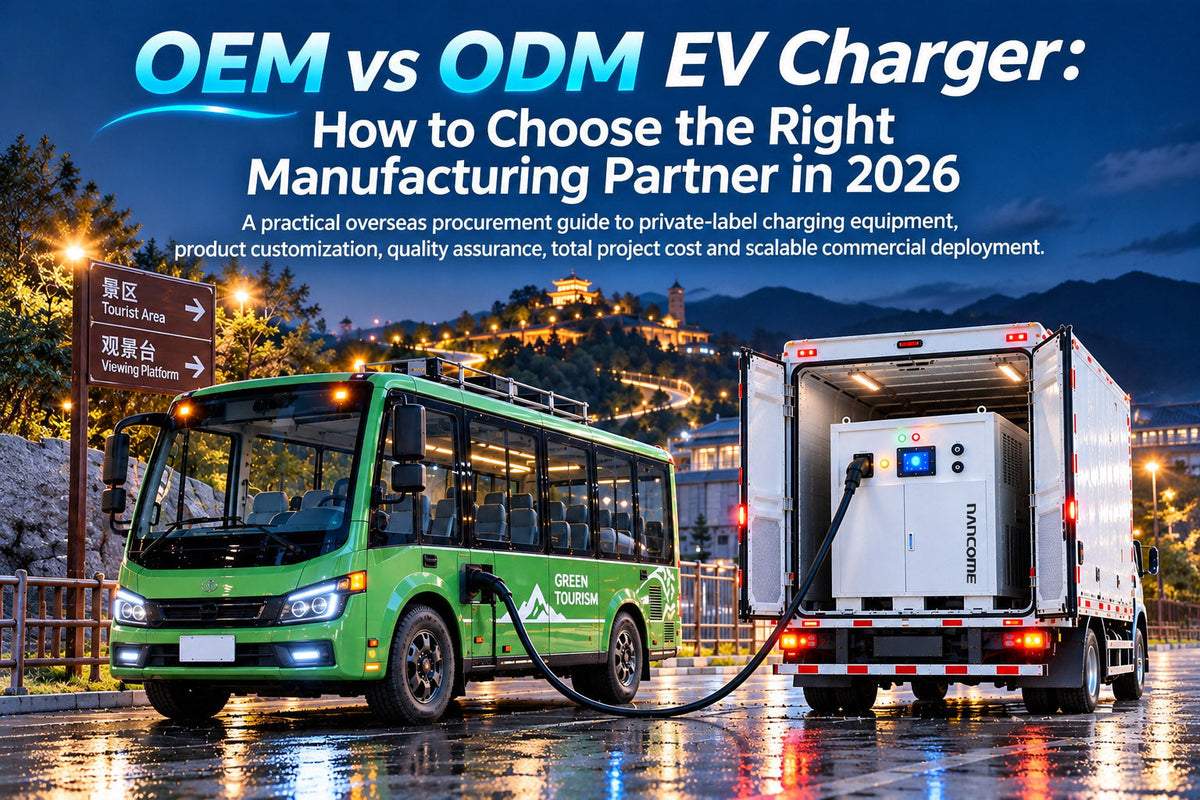
A practical overseas procurement guide to private-label charging equipment, product customization, quality assurance, total project cost and scalable commercial deployment.
The right manufacturing model is the one that meets your market requirements without adding unnecessary cost, risk or complexity.
OEM & ODM EV Charger Market Snapshot - 2026
The EV charging market is expanding and becoming more technically demanding. According to the International Energy Agency (IEA), the world had more than 7 million public charging points at the end of 2025, and the average rated power of public charging points approached 50kW as faster chargers gained share. These are market-wide figures, not forecasts for OEM or ODM orders.
For distributors, charging point operators, EPC contractors and private-label brands, growth creates a sourcing question: should you buy an established charger with your own branding, or work with a manufacturer on a more customized design? An OEM EV charger program and an ODM EV charger project can both be effective, but they involve different engineering responsibilities and commercial trade-offs.
- Higher charging power increases the importance of electrical design, thermal management, installation planning and serviceability.
- International buyers need market-specific connectors, documentation, language options and verified regulatory conformity.
- Private-label projects need consistent product identity, quality controls, spare parts and a realistic after-sales process.
- A lower unit price is not necessarily a lower total program cost after engineering, testing, shipping and maintenance.
1. OEM vs ODM EV Charger: What Is the Difference?
In EV charging procurement, OEM (Original Equipment Manufacturer) commonly describes a manufacturer producing an established product or agreed specification for another company, often under the buyer’s brand. ODM (Original Design Manufacturer) commonly describes a manufacturer contributing product design and engineering, with changes made to the underlying product architecture or functions.
These labels are not used consistently across every supplier. Some manufacturers call a logo-and-color change “ODM”; others reserve the term for substantial hardware development. Before comparing quotations, agree on the actual scope, design ownership, testing obligations and deliverables.
| Sourcing model | Typical scope | Best suited to | Main consideration |
|---|---|---|---|
| Standard / ready-made | Existing charger and standard manufacturer branding | Small pilot projects; fast deployment | Limited differentiation |
| OEM / private label | Established charger platform with approved branding, labels, documentation and selected configuration options | Distributors and growing charging brands | Brand control; repeatable quality |
| ODM / engineering customization | Design or functional changes requiring feasibility review, validation and possible new tooling | Projects with differentiated hardware or operating needs | Engineering cost; testing; ownership |
2. When Is OEM the Better Choice?
An OEM or private label EV charger approach usually works well when the core charger already meets the target market’s technical requirements. The buyer can build a recognizable brand without commissioning an entirely new product architecture.
- You are a local EV charger distributor expanding from one model into a consistent product range.
- Your primary needs are logo, cabinet color, product labels, manuals, interface language or packaging.
- You want to test market demand before investing in deeper hardware changes.
- Your customers value predictable lead times, spare-parts availability and established factory testing.
OEM is not automatically “no engineering.” Connector choice, regional voltage, communications, payment peripherals or enclosure modifications may still require engineering review and fresh validation. Ask the manufacturer which options are already supported by the tested base model.
3. When Does an ODM EV Charger Project Make Sense?
An ODM EV charger program becomes relevant when the required product cannot be met reliably through standard options. Typical reasons include a new cabinet layout, unusual installation constraints, dedicated cable-management design, special operating interfaces or integration with a larger charging-and-energy system.
- A fleet operator needs a physical layout or power-distribution arrangement suited to buses, trucks or restricted depots.
- A regional brand requires distinctive industrial design, service access or approved component choices.
- A project combines DC charging with battery storage and site-specific power management requirements.
- A customer has a documented functional requirement that cannot be met by the manufacturer’s validated standard platform.
ODM should start with a feasibility assessment. New hardware, control logic, enclosure changes or environmental requirements can affect safety, certification scope, testing, tooling, software maintenance and delivery schedules. Never assume a customized variant inherits every approval of the base model.
4. What Can Be Customized in a Commercial EV Charger?
Customization is more useful when separated into clear levels. A quotation should state what is cosmetic, what is a pre-approved configuration, and what changes the technical design of the product.
| Customization area | Typical buyer request | Engineering attention |
|---|---|---|
| Brand identity | Logo, cabinet color, labels, manuals, carton | Usually limited; artwork and labeling review |
| Charging configuration | Power tier, connector type, cable length, single/dual output | Vehicle, electrical and thermal compatibility checks |
| User experience | Screen language, access method, interface layout | Software, usability and integration validation |
| Enclosure / site fit | Footprint, ventilation, ingress protection, service access | Mechanical, environmental and safety re-testing |
| System integration | Power distribution, load control, energy-storage coordination | Site-level design and commissioning plan |
For an overseas project, confirm whether each requested feature is a standard option, a configurable variant or a development item. This distinction protects both the buyer’s timeline and the manufacturer’s quality process.
5. Match the Manufacturing Model to the Charging Application
Different charging projects require different degrees of customization. Power rating alone is not a complete specification; dwell time, vehicle acceptance, local supply capacity and site operations are equally important.
| Application | Illustrative product fit | Typical sourcing focus |
|---|---|---|
| Hotels / offices / parking | 7-22kW AC charging | Branding, user interface, installation method |
| Dealers / urban commercial sites | 40-80kW DC fast charging | Connector selection, cabinet branding, service access |
| Public stations / fleet hubs | 120-240kW DC fast charging | Power sharing, cable reach, thermal performance, site integration |
| High-throughput charging | 320-480kW DC configurations where justified | Electrical infrastructure, vehicle mix, lifecycle cost |
| Temporary / grid-constrained sites | Mobile energy-storage charging options | Battery energy, recharge strategy, deployment logistics |
The listed power bands are examples from NANCOME’s broader product categories, not a promise that every model or custom option is available in every country. Final configuration and conformity must be checked for the exact project.
6. Five Technical Questions to Resolve Before Requesting a Quote
A. What is the actual electrical supply?
Share the country, input voltage, frequency, available transformer or service capacity, and other loads on the site. A charger designed for one grid arrangement may require changes or be unsuitable for another.
B. Which vehicles and connectors must be supported?
Specify vehicle categories, charging inlet standards, expected battery voltages and required cable lengths. CCS1, CCS2, GB/T and other interfaces are not interchangeable by name alone; regional rules and vehicle compatibility must be verified.
C. What charging output is needed in real operation?
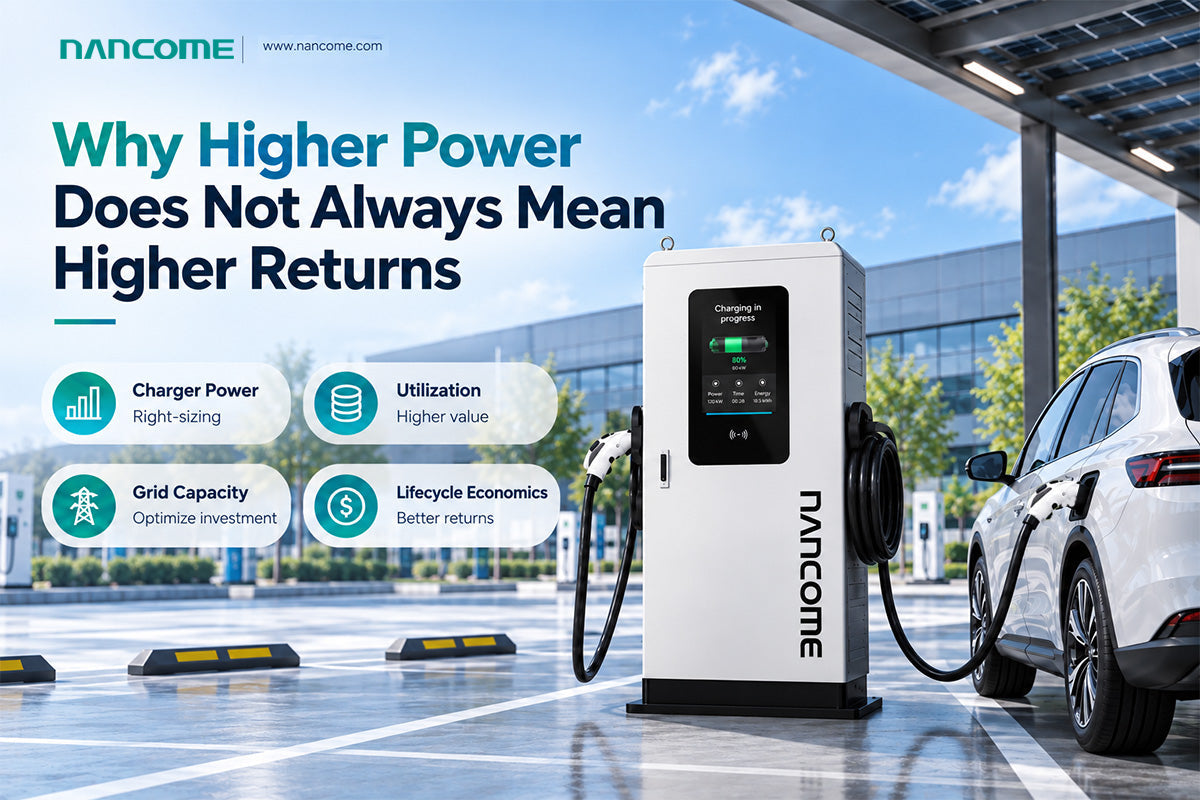
Define the number of charging points, simultaneous sessions, energy delivered per vehicle, dwell time and peak-hour traffic. A 240kW charger is not necessarily more valuable than a correctly utilized 120kW unit.
D. What software and site integrations are required?
Identify remote monitoring, authentication, payments, user-interface language, local networking and any third-party platform testing requirements. Hardware availability does not automatically guarantee successful integration with every service provider.
E. Who owns commissioning and after-sales support?
Clarify the responsibilities of the manufacturer, local EPC installer, software provider and charging operator for installation, acceptance testing, spare parts, warranty response and technical escalation.
7. What 2026 Charging Trends Mean for OEM and ODM Buyers
The IEA’s Global EV Outlook 2026 describes growth in public charging, faster equipment and more demanding grid integration. This does not mean every buyer needs an ultra-fast charger; it means manufacturers and customers must be more disciplined about application fit.
- Higher power and wider vehicle voltage ranges: verify sustained output, cable ratings, cooling and vehicle acceptance rather than relying only on the advertised peak kW.
- Multi-market deployment: connector standards, labeling, language, electrical codes and conformity documents need a country-by-country plan.
- Grid constraints: site load management and, in selected cases, energy storage can be more practical than an immediate full transformer upgrade.
- Serviceability: accessible modules, diagnostic information, spare-parts lists and local technician training reduce long-term operating risk.
- Digital operation: cybersecurity, software maintenance and platform integration responsibilities should be defined contractually and validated during commissioning.
The strongest OEM/ODM strategy is therefore not “maximum customization.” It is a stable, tested product platform with targeted changes that create real value for the local market.
8. Compare Total Program Cost, Not Just the Factory Unit Price
Two EV charger manufacturer quotations can look similar while covering very different work. Buyers should compare like-for-like deliverables, including the technical configuration and the services included after shipment.
- Product cost: charger model, power modules, connector quantity, cable specification and optional features.
- One-time development: industrial design, firmware changes, tooling, engineering samples and validation.
- Compliance and testing: applicable laboratory tests, documentation, witness tests and country-specific requirements.
- Logistics and installation: packaging, freight terms, customs, site electrical work and commissioning support.
- Operating cost: energy efficiency, planned maintenance, spare parts, software support and warranty process.
A useful comparison is: total program cost = equipment + one-time engineering + validation + delivery + installation + expected support costs. An ODM design may be economical at scale, but only after the required volume, development costs and change-control process are agreed.
9. Quality, Documentation and Compliance: What to Verify
A buyer should request evidence for the exact model and configuration being purchased. Product standards, factory test reports, declarations of conformity and third-party certification marks are different forms of evidence; one does not automatically replace another.
- Model-specific technical datasheet: input/output ranges, efficiency, operating conditions and protection functions.
- Applicable market documentation: confirm what local law requires and which declarations, tests or certifications cover the ordered variant.
- Factory inspection and test plan: functional checks, safety checks, aging or burn-in procedure, final acceptance criteria and serial-number traceability.
- Software and change management: version records, approved configuration, update policy and regression-test responsibilities.
- After-sales package: manuals, wiring diagrams where appropriate, spare-parts plan, warranty terms and technical support workflow.
For the United States, European Union, Brazil and other markets, requirements differ. Do not accept a blanket claim such as “globally certified” without examining the actual documents, issuing bodies, product scope and local acceptance requirements.
10. A Practical OEM/ODM Project Workflow
| Stage | Buyer / manufacturer deliverable | Decision gate |
|---|---|---|
| 1. Requirements | Country, vehicles, site supply, power, quantity, brand and interface requirements | Approved specification |
| 2. Feasibility | Standard vs custom option review; risk and conformity gap assessment | Technical scope and quotation |
| 3. Prototype / sample | Drawings, sample configuration and test plan | Sample approval |
| 4. Pilot validation | Real-vehicle charging, site integration and safety/functional checks | Pilot acceptance |
| 5. Production | Approved BOM, quality plan, packaging and shipment documentation | Factory acceptance |
| 6. Handover | Installation support, spare parts, warranty and change-control process | Operational readiness |
Do not skip pilot validation when a project includes substantial changes. The approved sample, software version, bill of materials and test criteria should become the reference for subsequent production batches.
11. Three Overseas Buyer Scenarios
Scenario A: A distributor launching a local brand
A distributor serving urban commercial sites wants branded 60kW and 120kW DC chargers. If the manufacturer’s tested platform already supports the target market, OEM branding plus approved connector and language options may be the fastest path. The priority is consistent quality, local manuals and spare-parts availability.
Scenario B: A fleet operator with a constrained depot
A logistics operator needs a nonstandard cable arrangement, tight cabinet placement and coordinated site power management. A scoped ODM or engineering-customization project may be justified, provided the new design is validated against site conditions and real fleet charging windows.
Scenario C: A charging operator facing limited grid capacity
A public charging site needs short periods of high output but has limited grid power. The procurement question extends beyond charger branding: the operator should assess load control, electrical distribution and possibly battery-buffered charging. The best answer may combine standard charger hardware with project-specific system engineering rather than redesigning the charger itself.
12. Why NANCOME Is Relevant to OEM and ODM EV Charging Projects
Commercial EV Charging Equipment Manufacturer
NANCOME supplies commercial AC chargers, floor-standing DC fast chargers, portable DC equipment, high-power charging configurations and mobile energy-storage charging solutions. This range helps buyers choose a platform that fits the use case before deciding how much customization is necessary.
Electrical Manufacturing Foundation Since 1992
NANCOME’s background in electrical equipment and power distribution supports discussions about site power, protection coordination, thermal design and system safety. Charging equipment should be considered as part of the wider electrical infrastructure, not as an isolated cabinet.
Project-Oriented Solution Collaboration
For overseas buyers, NANCOME can discuss charger power selection, connector requirements, installation conditions, electrical integration and commissioning responsibilities. Specific features, delivery scope and compliance evidence should be confirmed for each quotation.
Flexible OEM/ODM Manufacturing Discussion
NANCOME can evaluate branding, language, connector and configuration requests, as well as more complex project needs where feasible. The practical goal is a reliable and manufacturable solution, not customization for its own sake.
13. OEM/ODM EV Charger RFQ Checklist
To receive a useful quotation from a DC fast charger manufacturer, send a brief with the following information:
- Company role: distributor, charging operator, EPC contractor, fleet owner or private-label brand.
- Target market: country/region, destination port and any required local conformity documents.
- Product scope: AC, DC, portable DC or mobile energy-storage charging; desired power and quantity.
- Vehicle and site details: connector types, vehicle categories, input voltage, grid capacity and operating environment.
- Customization list: logo, color, interface language, cabinet design, communication, packaging and documentation.
- Program requirements: sample quantity, estimated annual volume, target schedule, warranty and spare-parts expectations.
Include a simple note identifying which features are mandatory and which are preferred. This helps the manufacturer distinguish standard configuration, OEM branding and ODM development work.
14. Explore NANCOME Solutions and Request a Project Review
- Commercial DC EV Chargers
- Mobile Energy Storage Charging Systems
- Power Distribution Cabinets & Boxes
Send your project country, charger type, required power, estimated quantity and customization list. Contact NANCOME for an OEM/ODM EV charger quotation
Our team can review feasible equipment options and identify which requested features need additional engineering, testing or local conformity checks. Availability and terms are subject to project confirmation.
Result: Choose the Manufacturing Model That Fits the Project
OEM and ODM are sourcing strategies, not quality grades. OEM is often the more efficient route when a validated EV charger platform already meets the market need. ODM becomes valuable when a documented requirement calls for additional engineering and the buyer can justify the cost and validation effort.
For international charging businesses, the strongest long-term advantage comes from the right charger configuration, dependable electrical engineering, clear ownership of customization, and an after-sales plan that works locally. NANCOME aims to support those decisions with commercial charging equipment, energy-storage charging options and power distribution experience.

Оставить комментарий
Все комментарии перед публикацией проверяются.
Этот веб-сайт защищается hCaptcha. Применяются Политика конфиденциальности и Условия использования hCaptcha.