

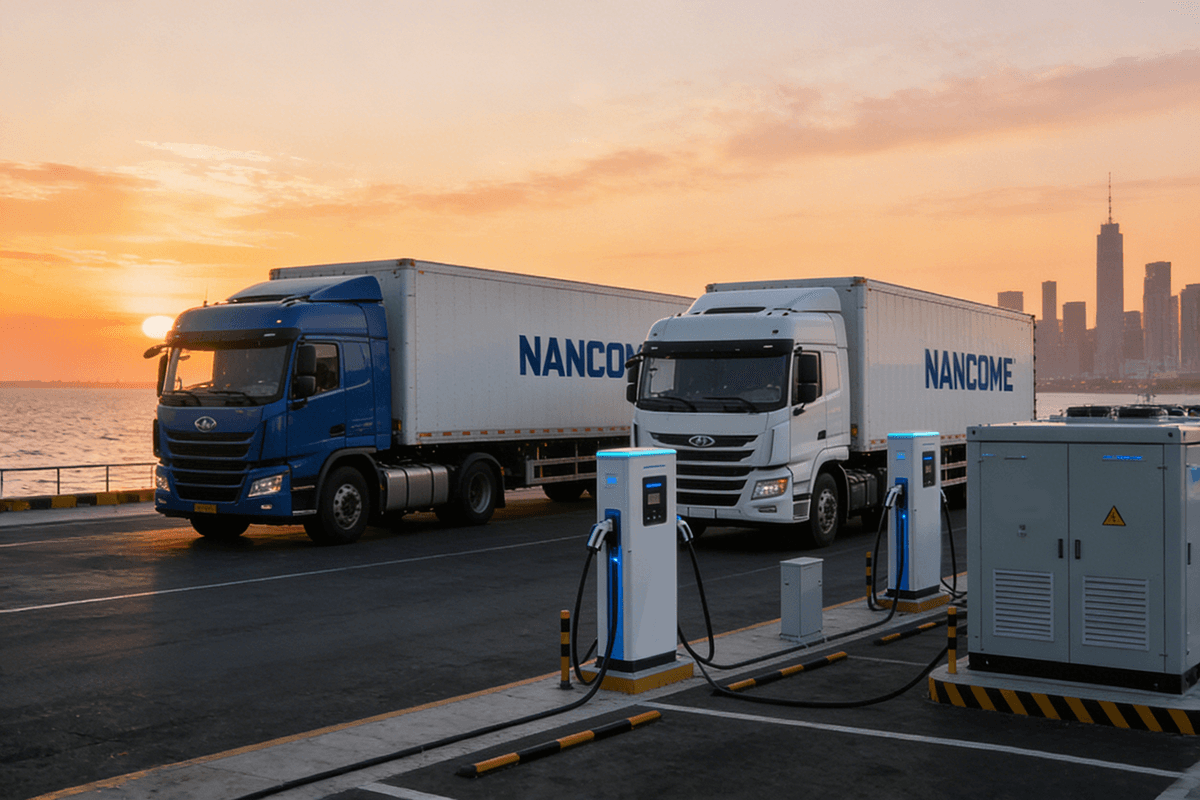
Project type: coastal logistics park (summer 38–41 °C) | Go‑live in 90 days | Goals: shorter queues, lower demand charges, resilient operations on a weak grid
1) Site & Constraints (Hard Numbers)
Existing power: 800 kVA transformer, PF ≈ 0.95 → ≈760 kW on the AC side.
Vehicle mix: 70% 400 V box trucks (60–90 kWh), 20% 400 V light trucks (100–150 kWh), 10% 800 V newcomers (120–200 kWh).
Operations rhythm: AM 06:30–09:30 and PM 17:30–21:30 peaks; pre‑cooling of reefers causes bunching arrivals.
Historical pain points: queue up to 25 minutes; a 15‑minute billing window recorded 1.12 MW, so monthly bills were hurt by demand charges (AFDC explains why DCFC sites are prone to demand charges and how tariffs work).
2) Solution (Configuration Only)
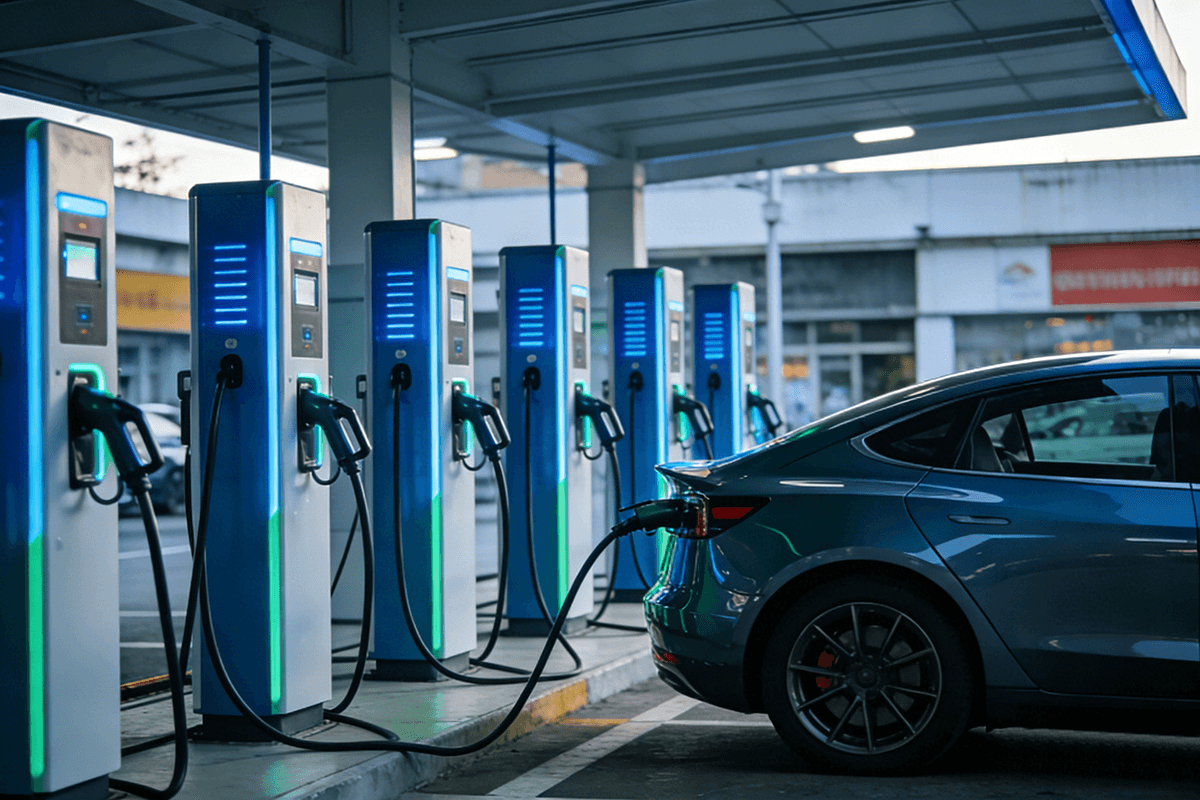
Main DC: 6 dual‑gun 200 kW Air-cooled charging station (12 guns in total).
Peak bays: 2 dual‑gun 360 kW liquid‑cooled charging station (4 guns, 500–600 A cables), used only for hot hours, urgent jobs, or 800–1000 V vehicles.
Storage: 300 kWh / 300 kW PCS BESS, focused on 15‑minute peaks rather than all‑day supply; behind‑the‑meter storage is well‑studied for DCFC peak shaving.
Backend: OCPP 1.6J platform with booking, time‑of‑use pricing, soft power caps, reports, and remote alarms; the open protocol reduces platform lock‑in.
Layout: drive‑through lanes, booms/retractors, shade, pedestrian/vehicle separation, maintenance access.
Why a small BESS is enough: to add +300 kW for 15 minutes you only need 75 kWh (= 300 × 0.25 h). A 300 kWh pack covers multiple peaks and refills off‑peak. NREL analyses show retail tariffs and demand charges dominate DCFC station economics; modest storage plus smart operations can materially flatten peaks.
3) Control Playbook (Day‑1 Usable)
Booking + TOU: shift flexible sessions to shoulder/off‑peak (AFDC recommends pairing TOU with operational tactics to reduce peak costs).
Soft power caps: in peaks, cap the 360 kW bays at ~280–320 kW; air‑cooled bays follow intake‑air temperature to reduce derating and trips.
Priority rules: short‑dwell and urgent jobs first; route 800–1000 V vehicles to liquid‑cooled bays.
90‑day reviews: track availability, average wait, derating events, revenue per kWh, demand charges, and BESS contribution; tweak parameters quarterly.
4) Math (Swap Your Numbers In)
Throughput target: ≥24 vehicles/hour from 25% → 70%.
Weighted average pack: 0.7×75 + 0.2×120 + 0.1×160 ≈ 96.5 kWh → energy per vehicle ≈ 0.45 × 96.5 = 43.4 kWh.
Assume effective average power ≈ 120 kW per active gun (BMS/thermal considered): per‑vehicle time ≈ 43.4 / 120 ≈ 21.7 minutes; concurrent guns ≈ 24 × 43.4 / 120 ≈ 8.7 → round to 9.
Transformer envelope: 800 kVA × 0.95 ≈ 760 kW AC; with ~0.96 site efficiency → ≈730 kW DC sustainable from the grid.
During a 15‑minute burst, BESS adds +300 kW while soft caps keep the meter’s 15‑minute average at or below ≈0.85 MW.
5) 90‑Day Review (Rounded, Illustrative)
|
Metric |
Before |
After 90 Days |
|
Throughput (25→70) |
14 veh/hr |
24 veh/hr |
|
Avg. wait |
15–25 min |
6–8 min |
|
15‑min max demand |
1.12 MW |
0.84–0.86 MW |
|
Demand charges |
Baseline |
–23% to –26% |
|
Off‑peak share |
44% |
63% |
|
Derating events / week |
11 |
4 |
|
Availability |
96.2% |
98.5% |
Macro trend: public DC fast charging is expanding rapidly (fast‑charger stock up ~55% in 2023), yet profitability still hinges on utilization and tariff structure—hence the focus on strategy plus modest storage instead of chasing nameplate only.
6) How to Scale Across Scenarios
If heavy‑truck share rises: expand liquid‑cooled bays to 3–4 posts (6–8 guns) and consider 400–500 kWh BESS. CharIN’s materials on MCS (Megawatt Charging System) inform medium‑term planning.
If TOU spread is small: tone down price incentives and lean more on booking and peak‑bay rules.
If extreme heat (>40 °C): advance intake‑air thresholds for air‑cooled bays by 3–5 °C and route urgent jobs to liquid‑cooled bays.
7) Equipment & Brand Options (Localizable)
Breakers/contactors/SPD: ABB / Schneider / Eaton (subject to local availability and certification).
Auxiliary power/relays: MEAN WELL; Omron / Panasonic.
Terminal blocks connectors: Phoenix Contact / Weidmüller.
Metering comms: dual‑channel DC meter (local equivalent/MID). OCPP 1.6 integration (booking, billing, alarms, reporting). RS485/Modbus optional for cooling auxiliaries.
8) Delivery Milestones
T0–T15: tariff & demand review, arrival modeling, single‑line and safety assessment.
T16–T45: civils/electrical/grounding/communications, OCPP integration.
T46–T75: end‑to‑end commissioning (booking/billing/reporting/soft caps), thresholds & SOPs.
T76–T90: trial ops, heat‑exposure test, 90‑day optimization (parameter tuning & training).
References (Traceable Sources)
AFDC — operations & tariff primers for DCFC (why demand charges hit DCFC): https://afdc.energy.gov/
NREL — Behind‑the‑Meter Storage & DCFC economics/peak shaving: overview https://www.nrel.gov/transportation/behind-the-meter-storage-analysis ; reports: https://docs.nrel.gov/docs/fy22osti/79681.pdf ; https://docs.nrel.gov/docs/fy24osti/91021.pdf ; https://docs.nrel.gov/docs/fy21osti/79080.pdf
Open Charge Alliance — OCPP 1.6 overview & adoption: https://openchargealliance.org/protocols/ocpp-protocols/ocpp-1-6/ ; https://openchargealliance.org/protocols/open-charge-point-protocol/
IEA — Global EV Outlook 2024 (charging trends, fast‑charger growth): https://www.iea.org/reports/global-ev-outlook-2024/trends-in-electric-vehicle-charging/
CharIN — MCS (Megawatt Charging System) overview & white paper: https://www.charin.global/technology/mcs/ ; https://www.charin.global/media/pages/technology/knowledge-base/098053898a-1730122175/whitepaper_ruggedized_megawatt_charging_system_1.3.pdf

Оставить комментарий
Все комментарии перед публикацией проверяются.
Этот веб-сайт защищается hCaptcha. Применяются Политика конфиденциальности и Условия использования hCaptcha.