
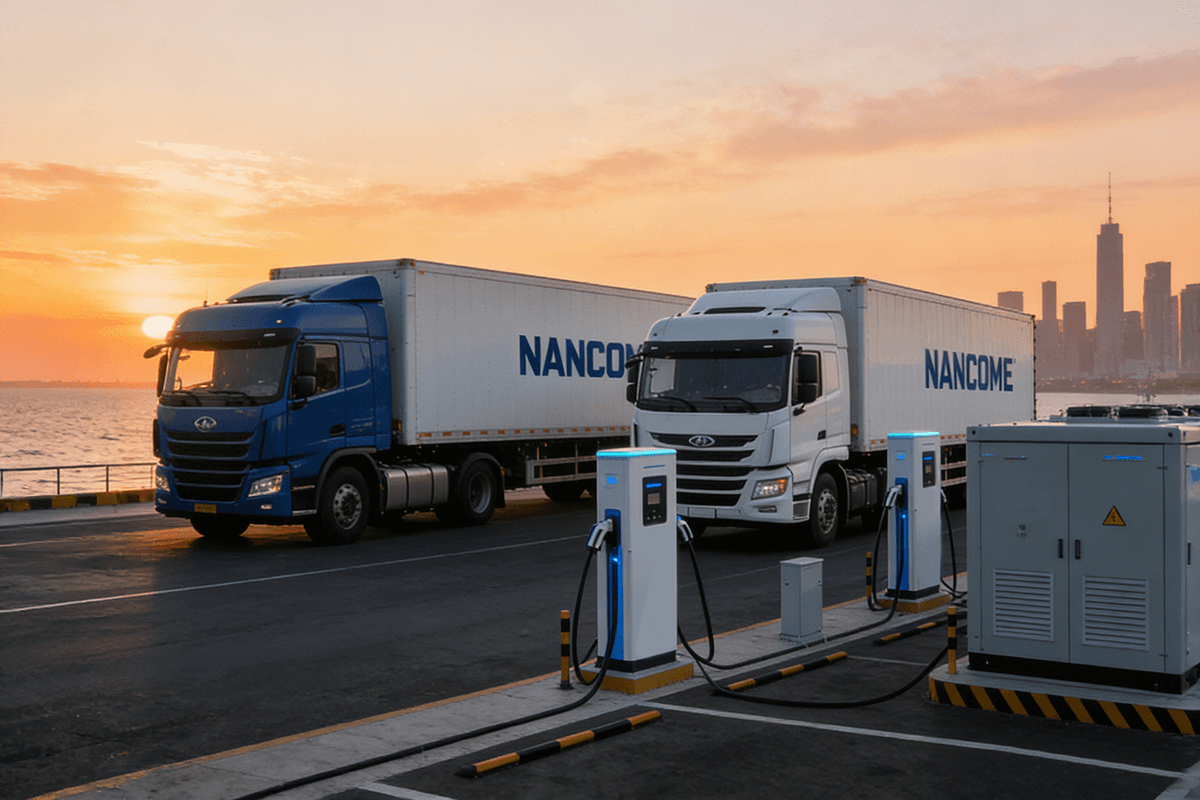
What this article actually solves
1) Limited grid capacity: how to deploy DC fast charging when the service transformer is small.
2) Bill volatility: a few peak arrivals can trigger demand charges and blow up the monthly bill.
3) Operations control: queues, thermal derating, and alarms in peak season—how to stabilize experience and cash flow.
Answer: add a small battery energy storage system (BESS) to a DC fast charging station, then pair it with TOU EV charging and booking‑based soft power caps. This lets you ‘clip peaks, refill off‑peak’ without major grid works. AFDC explains why fast charging is prone to demand charges and how tariffs work—great for newcomers.
What the solution looks like (one sentence)
Dual‑gun DC fast chargers (dual‑gun 180–240 kW, with a few liquid‑cooled 320–480 kW) + battery energy storage (BESS) 200–400 kWh + OCPP 1.6 backend + TOU/booking/reporting. In weak‑grid or temporary sites, behind‑the‑meter storage tops the 15‑minute peak and replenishes off‑peak, flattening the site demand curve.
Why ‘small BESS + smart operations’ beats oversizing batteries
• Objective is peak‑shaving battery storage, not all‑day supply: clipping 15‑minute spikes is enough to step down demand‑charge tiers. Oversized batteries can extend payback.
• Easier permits and maintenance: moderate capacity keeps safety and civils manageable; when combined with booking, TOU and soft caps, results beat ‘hardware only’.
• Works on weak grids: industry guides show battery‑buffered fast charging helps where distribution capacity is constrained, adds resilience during outages, and lowers energy cost—subject to project economics.
Recommended site architecture (no centralized power cabinets)
• Main bays (70–80%): air‑cooled dual‑gun 180–240 kW. Matches real vehicle acceptance, stable thermals, simpler maintenance, higher concurrency.
• Peak bays (20–30%): liquid‑cooled 320–480 kW for 800–1000 V trucks, urgent jobs, and hot seasons.
• Backend & interoperability: OCPP 1.6 backend with booking/TOU/reports/alerts/remote ops. Open standards reduce vendor lock‑in.
Use distributed dual‑gun posts instead of centralized ‘power‑cabinet + many dispensers’ to keep deployment simpler and after‑sales boundaries clearer. Add more liquid‑cooled bays later if the heavy‑truck share rises.
A small, visible math example
Goal: ≥30 vehicles in one peak hour, each from 25% → 70% SOC (example with passenger cars; swap in your heavy‑truck numbers).
Assume average battery ≈70 kWh.
Energy per vehicle ≈ 0.45 × 70 = 31.5 kWh.
If average real charging power ≈ 90 kW (BMS curve / thermal / parallel sessions considered):
• Time per vehicle ≈ 31.5 / 90 ≈ 21 minutes
• Concurrent guns ≈ 30 × 31.5 / 90 ≈ 10.5 guns
Suggested build: 6 dual‑gun 180–240 kW (12 guns) + 2 dual‑gun liquid‑cooled 320–480 kW (4 guns) for peaks; BESS 200–400 kWh only to cover the 15‑minute spike; booking and TOU shift queues into shoulder periods.
Four questions newcomers always ask
Q1: Is storage worth it? Demand charge management and resilience are the primary values. Smaller, targeted battery energy storage system tends to pencil out faster than an oversized pack.
Q2: Why do I see larger and larger fast‑charging builds? Because public DCFC is scaling fast worldwide—but economics still come down to utilization, concurrency, and tariff structure.
Q3: How do I size capacity properly? Use fleet/site methods that start from vehicle needs and duty cycles, then back‑solve charger count and behind‑the‑meter storage.
Q4: Do I really need OCPP? Strongly recommended. An OCPP 1.6 backend keeps charger↔platform interoperable and avoids lock‑in while you grow.
Your ‘Storage + DCFC’ checklist (ready for procurement)
Hardware: dual‑gun 180–240 kW as the main tier; a few liquid‑cooled 320–480 kW for peaks; BESS 200–400 kWh for 15‑minute spikes; booms/retractors, shade, pedestrian/vehicle separation, maintenance aisles.
Software & strategy: EV charging reservation system, EV fleet TOU rates, reporting/alerts/remote ops; charging station KPI dashboard tracking availability / avg. wait / derating / revenue per kWh / demand charges / BESS contribution; 90‑day parameter reviews.
Useful references (beginner‑friendly)
• AFDC — operations and tariff primers for DC fast charging (why demand charges hit DCFC).
https://afdc.energy.gov/fuels/electricity-infrastructure-maintenance-and-operation?utm_source=chatgpt.com
• NREL — behind‑the‑meter storage and fast‑charging peak‑shaving research; fleet/site sizing from vehicle needs and duty cycles.
https://docs.nrel.gov/docs/fy22osti/82738.pdf?utm_source=chatgpt.com
• OCA — OCPP 1.6 overview: open, interoperable charger↔platform communication.
https://openchargealliance.org/protocols/ocpp-protocols/ocpp-1-6/?utm_source=chatgpt.com
One‑line takeaway
First flatten the curve with booking, TOU, and soft caps; then use a compact BESS to shave the remaining 15‑minute spikes. Even weak grids can deliver solid fast‑charging, with a calmer bill and a more predictable ROI.


Оставить комментарий
Все комментарии перед публикацией проверяются.
Этот веб-сайт защищается hCaptcha. Применяются Политика конфиденциальности и Условия использования hCaptcha.