
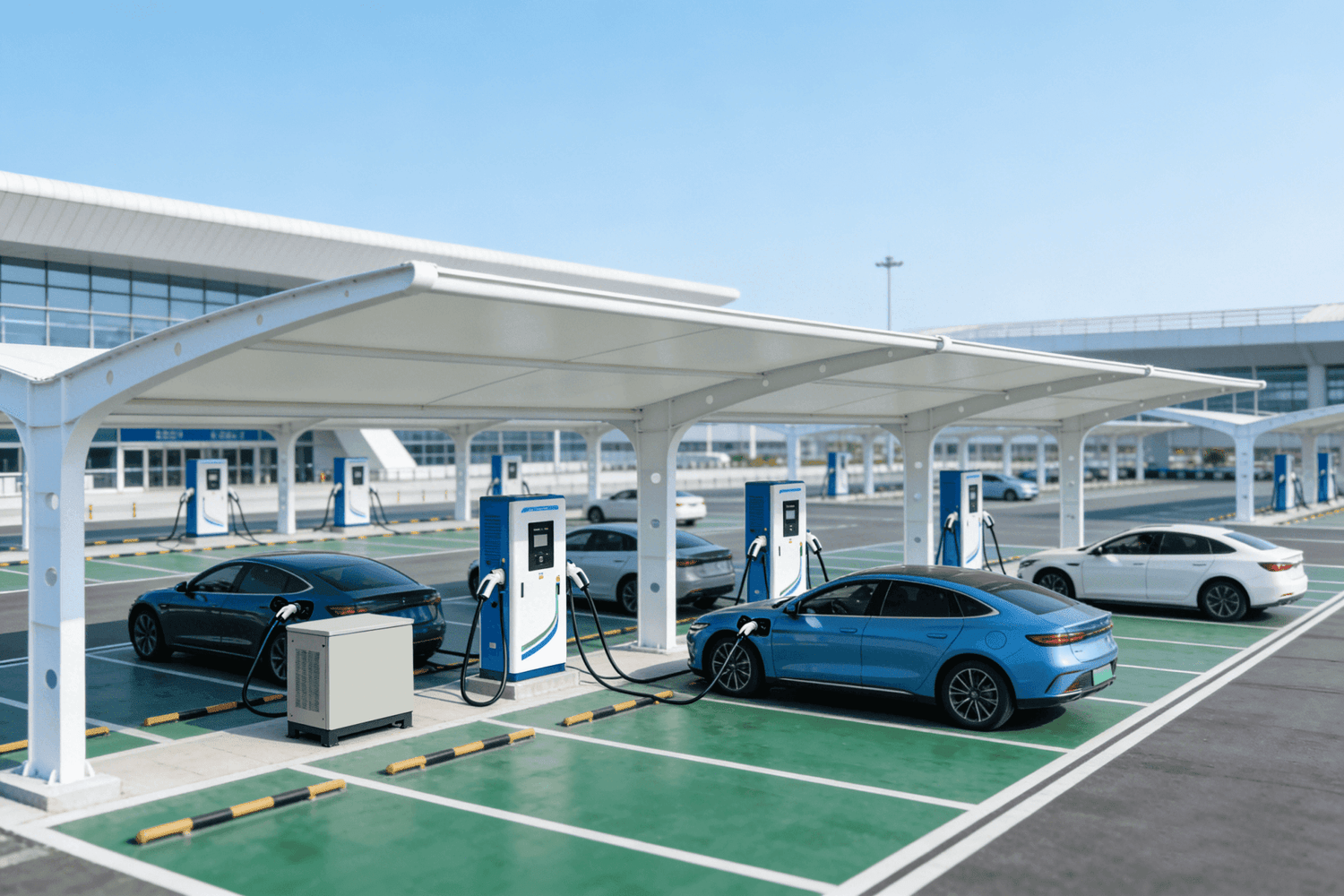
Case Study | Airport Rental Car Center (airport car rental center electrification plan (CONRAC)) Electrification in 90 Days: Dual‑Gun DC + Small 300 kWh BESS peak‑shaving energy storage system to Fix Queues and Demand‑Charge Spikes
Scenario: An international airport CONRAC with high daily vehicle turnover and pronounced peak/off‑peak swings.
Constraints: Limited utility capacity, short construction windows, and no‑downtime operations.
Goals: 1) Keep peak‑hour waiting time ≤10 minutes; 2) Lower the 15‑minute billing window (demand metering) billing‑window demand to suppress demand charges in the 15‑minute billing window for DCFC; 3) Meet airport compliance and interoperability requirements (NEC 625 compliance for EV supply equipment / OCPP).
1) Why CONRAC Sites Are Hard
• High concurrency with short dwell: flight arrivals bunch sessions, creating short, tall peaks that inflate demand charges (DC fast charging solution for airport operations is more prone to such charges; many tariffs bill by the highest 15‑minute average). See AFDC operations & tariff primers.
• Capacity‑constrained grids: airport upgrades are slow to approve; installed cost per DCFC connector varies widely (often about USD 20–60k/connector depending on power and site works), which pressures budgets (see AFDC deployment guidance).
• Compliance & control: multi‑operator properties prefer open protocols (OCPP) to integrate charging with billing and operations systems.
2) Phase‑1 Plan (90‑Day Go‑Live)
1) Layout & Capacity (example: 6 bays)
• Main bays: 4 × dual‑gun 200 kW air‑cooled DC charger configuration air‑cooled DC posts (8 guns). Most vehicles accept ~90–130 kW from 20–60% SOC, so air‑cooled bays handle the bulk throughput.
• Peak bays: 2 × dual‑gun 320–360 kW 320–360 kW liquid‑cooled high‑power fast charging DC posts (4 guns) for hot hours, urgent jobs, and 800–1000 V vehicles.
• Small BESS: 300 kWh / 300 kW PCS, dedicated to 15‑minute peaks (not all‑day energy). NREL’s behind‑the‑meter storage for peak shaving work shows modest storage plus operations can effectively shave peaks and improve economics.
Why 300 kWh is sufficient: to add +300 kW for 15 minutes requires only 75 kWh (= 300 × 0.25 h). A 300 kWh pack covers multiple peaks and refills off‑peak. NREL’s BTMS test protocols frame peak‑shaving in short, high‑power windows.
2) Backend & Communications
• OCPP 1.6J interoperable backend to integrate with the airport CSMS/billing and maintenance stack (open, interoperable, and future‑proof).
• public fast‑charging reliability and SLA first: NREL highlights reliability/charging‑station availability KPI as key drivers of public‑charging satisfaction and adoption, so include comms, payments, and uptime SLAs and dashboards.
3) Compliance & Construction
• NEC Article 625: adopt the latest NEC for EV supply equipment and wiring to avoid rework and delays.
• Airport procedures: night‑window construction, low noise, hoarding/traffic control. As a planning reference, some utility DCFC program guides (e.g., SCE) define per‑connector and per‑site power caps that act as practical design limits.
3) Queues and Bills: Strategy + Small Storage
Operations (day‑1 usable):
• Booking + time‑of‑use (TOU) pricing with booking: shift flexible sessions into shoulder/off‑peak. AFDC recommends pairing TOU with operational tactics to cut peak‑period costs.
• soft power caps for peak‑hour load control: cap liquid‑cooled high‑power bays at ~280–320 kW in peak hours; tie air‑cooled bay limits to intake‑air temperature to reduce derating and trips.
• Priority rules: short‑dwell and urgent jobs first; route 800–1000 V vehicles to liquid‑cooled bays.
Quick math (swap in your numbers):
• Target: ≥20 vehicles/hour from 25%→70%.
• Energy/vehicle: average 75 kWh pack → ~0.45 × 75 = 33.75 kWh.
• Effective average power (with BMS/thermal/parallel effects): ~100–120 kW/gun → ~18–22 minutes per vehicle; concurrency ≈ 20×33.75/110 ≈ 6–7 guns.
• Billing peak: the utility meter bills on a 15‑minute average. With +300 kW for 15 minutes from BESS, plus booking and soft caps, you can hold the metered peak under the red line imposed by site capacity. AFDC/NREL both emphasize focusing on the peak window in DCFC economics.
4) 90‑Day Review (Illustrative Direction & Magnitude)
| Metric | Before | After 90 Days |
|---|---|---|
| Throughput (25→70) | 13 veh/hr | 22 veh/hr |
| Avg. wait | 12–20 min | 6–9 min |
| 15-min max demand | 0.98 MW | 0.78–0.82 MW |
| Demand charges | Baseline | −20% to −28% |
| Comms/payment no-charge incidents | 7/week | 2/week |
5) Brands & Bill of Materials (Localizable)
• DC posts: dual‑gun 200 kW air‑cooled as the backbone; a few dual‑gun 320–360 kW liquid‑cooled for peaks.
• BESS: 300 kWh / 300 kW PCS (peak shaving only).
• Switchgear & protection: breakers/contactors/SPD from ABB/Schneider/Eaton (or local compliant alternatives).
• Communications & backend: 4G/Ethernet, OCPP 1.6J, RS485 data acquisition for cooling and auxiliaries/Modbus data acquisition for cooling and auxiliaries for cooling and auxiliaries. SLA to cover availability, average wait, derating, and payment/connectivity alerts.
6) Milestones
• T0–T20: feasibility and compliance (NEC 625, airport procedures), single‑line and capacity red lines; engage the utility on tariffs and demand clauses.
• T21–T60: civils and install; OCPP integration; booking/billing/reporting commissioning.
• T61–T90: trial ops (soft caps, thermal thresholds, exception handling); 90‑day review and parameter tuning.
References (Traceable)
AFDC — DCFC operations/tariffs, 15‑minute demand windows, TOU + operations: https://afdc.energy.gov/ ; https://afdc.energy.gov/fuels/electricity-infrastructure-maintenance-and-operation ; https://afdc.energy.gov/fuels/electricity-infrastructure-development
NREL — Behind‑the‑Meter Storage & DCFC peak‑shaving economics: overview
https://www.nrel.gov/transportation/behind-the-meter-storage-analysis ; reports: https://docs.nrel.gov/docs/fy22osti/79681.pdf ; https://docs.nrel.gov/docs/fy20osti/76948.pdf ;
reliability studies:https://docs.nrel.gov/docs/fy24osti/89896.pdf
Open Charge Alliance — OCPP 1.6 overview and common features:
https://openchargealliance.org/protocols/open-charge-point-protocol/ ;
https://openchargealliance.org/protocols/ocpp-protocols/ocpp-1-6/
NEC Article 625 (blog explainer): https://www.nfpa.org/news-blogs-and-articles/blogs/2024/05/13/importance-of-using-the-latest-nec-for-ev-charger-installations
SCE — DCFC program guideline example (project‑level constraints): https://www.sce.com/sites/default/files/custom-files/PDF_Files/DCFC_Program_Guidelines_v2.5.pdf
DriveElectric — EV Infrastructure Playbook (operations, payment systems, economics): https://driveelectric.gov/ev-infrastructure-playbook

Leave a comment
All comments are moderated before being published.
This site is protected by hCaptcha and the hCaptcha Privacy Policy and Terms of Service apply.