
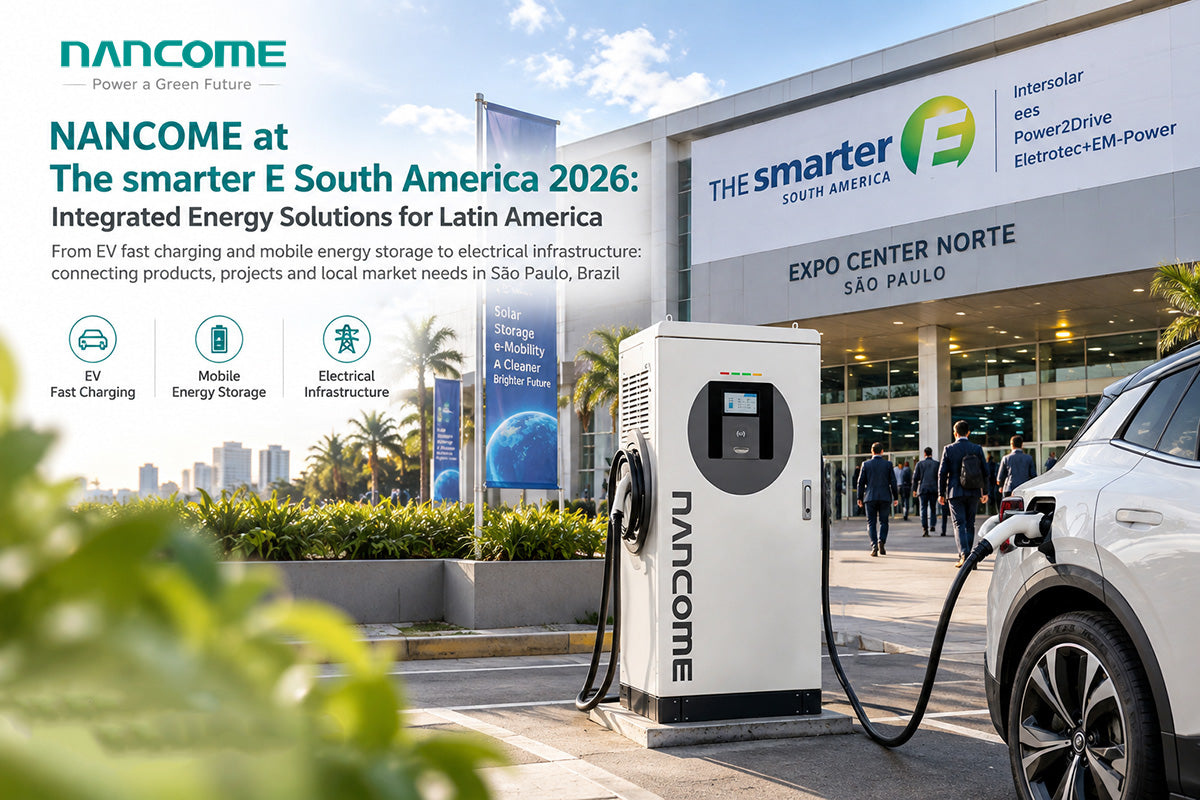
From EV fast charging and mobile energy storage to electrical infrastructure: connecting products, projects and local market needs in São Paulo, Brazil

Brazil & Latin America New Energy Snapshot – 2026
From August 25–27, 2026, NANCOME participated in The smarter E South America at Expo Center Norte in São Paulo, Brazil. The event brings together solar PV, energy storage, e-mobility, electrical infrastructure and energy management through Intersolar South America, ees South America, Power2Drive South America and Eletrotec+EM-Power South America.
The timing is important for Latin America. According to the IEA Global EV Outlook 2026, electric car sales in Latin America grew by 75% in 2025, led by Brazil and Mexico. Brazil reached about 180,000 electric car sales in 2025, representing around 9% of new car sales. At the same time, Brazil’s public charging points increased by close to 35%, but the electric light-duty vehicle stock grew even faster, highlighting the need for continued charging infrastructure expansion.
The wider energy system is also changing. Solar PV remains a major driver of renewable expansion, while Latin American markets are facing a growing need for grid flexibility, distributed energy, storage and better coordination between electricity generation and new loads such as EV charging.
Against this market background, NANCOME used the São Paulo exhibition not only to display charging equipment, but to communicate a broader idea: future EV charging projects need to connect charging hardware, energy storage, power distribution, communication and site-level energy planning.
1) From a Charger Supplier to an Integrated Energy Solution Partner
The Latin American new energy market is becoming more integrated. Solar generation, battery storage, electric vehicles and charging infrastructure are no longer separate topics. For commercial customers, the real project often involves several systems working together.
- EV charging equipment for public, commercial and fleet applications
- Mobile energy storage charging for flexible or grid-constrained scenarios
- Power distribution and protection for charging sites
- OCPP-ready communication and backend integration according to project configuration
- Site power assessment, charging power selection and deployment planning
- OEM/ODM and market-specific customization for overseas projects
This integrated perspective fits NANCOME’s own development path. With electrical manufacturing experience dating back to 1992, NANCOME combines EV charging equipment manufacturing with an understanding of distribution, protection, thermal management and system safety.
2) What NANCOME Showcased in São Paulo
At the exhibition, NANCOME presented solutions around commercial DC fast charging, flexible mobile charging and smart charging infrastructure. The booth also created a practical environment for discussing real projects with visitors, including charger power, connector standards, communication, installation conditions and local deployment requirements.

| Solution Area | NANCOME Capability | Typical Latin American Application |
|---|---|---|
| Commercial DC Fast Charging | 40–480kW fixed DC charging options; project-dependent connector and communication configuration | Public charging, commercial parking, highway/service areas, dealers, fleets |
| High-Power Charging | 180/240/320/360/480kW and cluster-based architectures for higher throughput | Busy public sites, fleet depots, logistics, corridor charging |
| Commercial AC Charging | 7/11/22kW wall-mounted or floor-mounted configurations | Hotels, offices, residential/commercial parking, destination charging |
| Mobile Energy Storage Charging | Battery-integrated mobile charging with multiple storage and output configurations | Roadside support, temporary charging, weak-grid sites, events, fleet backup |
| Electrical Distribution & Control | Distribution cabinets, protection and control equipment based on NANCOME’s electrical manufacturing foundation | Charging station electrical infrastructure, industrial and commercial energy projects |
3) Brazil’s EV Growth Is Creating a Charging Infrastructure Gap
Brazil has become one of Latin America’s most important EV markets. The IEA reports that electric car sales in Brazil surged to about 180,000 in 2025, or roughly 9% of all new car sales. Public charging infrastructure also expanded, but the number of EVs grew faster than the charging network.
This creates an important opportunity for charging operators, dealers, EPC companies, electrical contractors, commercial property owners and fleet customers. The next stage is not simply installing more chargers; it is deploying the right charging power in the right locations.
- Urban public charging needs a balance between utilization, dwell time and grid capacity.
- Highway and corridor charging requires faster turnaround and higher DC power.
- Hotels, offices and commercial destinations can combine AC and DC charging according to parking duration.
- Fleet depots need charging windows, simultaneous charging and load planning.
- Remote or grid-constrained sites may benefit from energy storage or mobile charging solutions.
4) Why Energy Storage Matters More as EV Charging Expands
EV fast charging adds concentrated electrical demand. In some Latin American projects, available grid capacity, transformer upgrades, connection lead times or local power quality can limit how quickly a charging site can be deployed.
Energy storage can become part of the solution architecture. Depending on the project, storage may help support peak power, improve flexibility, integrate local renewable generation or provide temporary/mobile charging capability. This is particularly relevant where charging demand grows faster than local electrical infrastructure.
NANCOME’s mobile energy storage charging systems are designed for scenarios where a fixed charging station is not always the most practical answer, including roadside rescue, temporary fleet operations, weak-grid locations, construction sites and event charging.
5) Solar + Storage + EV Charging: A Natural Direction for Latin America
Latin America has strong renewable resources, and Brazil is a major regional solar market. The IEA expects distributed solar PV to remain an important part of renewable growth in Latin America, while grid constraints and curtailment risks are increasing the importance of flexibility and energy management.
For commercial EV charging, this creates a natural project direction: solar generation can supply part of site demand, battery storage can shift or buffer energy, and EV chargers can serve vehicles according to operational priorities. The correct architecture depends on load profile, solar production, electricity tariffs, grid limits and charging demand.
NANCOME does not treat “solar + storage + charging” as a fixed product package. It should be engineered around the actual site. This project-oriented approach helps avoid oversizing equipment or assuming that one configuration fits every market.
6) High-Power DC Charging for Public and Commercial Growth
As the share of fast chargers increases in Brazil, commercial buyers are paying more attention to charging speed and site throughput. NANCOME’s DC portfolio covers multiple power levels so a project can be matched to traffic and electrical conditions rather than simply choosing the highest available rating.
- 40/60/80kW: urban commercial sites, dealers, destinations and lower-throughput public charging
- 120/160/180kW: public charging, fleets and higher-turnover commercial locations
- 240/320/360/480kW: high-throughput public stations, highway applications and larger fleet projects
- 240–960kW cluster charging: multi-vehicle sites requiring centralized power architecture and flexible allocation
Higher nameplate power does not automatically create a better project. Vehicle acceptance rate, battery state of charge, transformer capacity, cable design, thermal management and simultaneous charging all influence real charging performance.
7) Local Adaptation Is Essential in Latin America
Latin America is not a single technical market. Grid conditions, connector preferences, language, payment methods, installation practices and project economics differ by country and application. Brazil itself also contains very different operating environments, from dense urban commercial sites to highways, logistics operations and remote regions.
For overseas projects, NANCOME can evaluate market-specific requirements such as connector standards, power configuration, Portuguese/Spanish interfaces, OCPP communication, RFID access, branding and installation method. App, payment and backend functions are treated as separate system layers that should be confirmed with the selected platform or payment provider rather than assumed to be included automatically in charger hardware.
8) Conversations at the Booth: From Product Questions to Project Questions

The exhibition photos reflect an important part of NANCOME’s approach: face-to-face technical communication. Visitors were not only looking at charger appearance. Discussions naturally moved toward project questions such as available power, required charging speed, installation environment, platform integration, local standards and future expansion.
- What vehicles will use the charger?
- How many vehicles need to charge each day?
- How long can each vehicle remain connected?
- What power is available from the grid?
- Is a transformer or distribution upgrade required?
- Does the project need OCPP, RFID, app or payment integration?
- Is energy storage needed because of weak grid capacity or temporary deployment?
- How will maintenance and spare parts be handled after installation?
For B2B projects, answering these questions before shipment is often more valuable than comparing charger specifications in isolation.
9) NANCOME’s Four Foundations for Latin American Projects
Intelligent EV Charging Equipment Manufacturer
NANCOME develops and manufactures DC fast chargers, commercial AC chargers, portable DC chargers, high-power charging systems and mobile energy storage charging systems for public, commercial, fleet and flexible charging applications.
Electrical Engineering Manufacturing Foundation
Electrical manufacturing experience since 1992 gives NANCOME a practical foundation in power distribution, protection design, thermal management and system safety. This becomes increasingly important as EV charging projects move toward higher power and more complex site architectures.
Project-Oriented Charging Solution Partner
NANCOME treats charging equipment as part of the customer’s electrical system. Before delivery, project discussions can cover site power conditions, charging power selection, protection coordination, communication integration and deployment planning.
Flexible Manufacturing and Customization
Different Latin American projects may require different connector standards, power ratings, language interfaces, communications, branding and installation methods. NANCOME supports practical customization while keeping reliability and manufacturability in focus.
10) What the São Paulo Exhibition Means for NANCOME

Participating in The smarter E South America 2026 was more than a product display for NANCOME. It was an opportunity to better understand how Latin American customers are connecting renewable energy, storage, electrical infrastructure and e-mobility in real projects.
The market signals are clear: EV adoption is rising, public charging needs to expand, solar continues to grow, and grids need greater flexibility. These trends create demand not only for chargers, but for better integration between charging equipment and the energy system around it.
For NANCOME, this reinforces a long-term direction: continue developing reliable charging products while strengthening project support, local adaptation and integrated energy capabilities for partners in Brazil and across Latin America.
Result
The smarter E South America 2026 brought the future of Latin America’s energy system into one place: solar PV, battery storage, charging infrastructure, electrical distribution and digital energy management.
At its booth in São Paulo, NANCOME presented an approach built around the same integration. From commercial AC and DC charging to high-power charging, mobile energy storage and electrical infrastructure, the objective is to help customers match equipment with real site conditions and business needs.
As Brazil and the wider Latin American EV market continue to grow, charging infrastructure will need to become faster, more flexible and more closely integrated with the power system. NANCOME will continue working with distributors, EPC companies, charging operators, fleet customers and project partners to turn these requirements into practical deployment solutions.

Оставить комментарий
Все комментарии перед публикацией проверяются.
Этот веб-сайт защищается hCaptcha. Применяются Политика конфиденциальности и Условия использования hCaptcha.